Best for recurring commercial moves: Car Haul Direct. Best for enclosed collector transport: Reliable Carriers. Best for individual brokerage coordination: Montway Auto Transport. Best for comparing provider proposals yourself: uShip. This 2026 guide ranks nationwide auto transport options by the shipping task, not unsupported claims about speed, coverage, or service quality.
- Among the best nationwide auto transport companies, CHD fits dealerships and fleets needing recurring vehicle shipping coordination.
- Reliable Carriers fits collector shipments where enclosed transport is the central requirement.
- Montway Auto Transport fits individuals who want a broker to arrange a carrier.
- uShip fits shippers who want to compare provider proposals and assess the provider themselves.
- Choose by route, vehicle condition, transport type, pickup access, and written shipment terms.
Why this matters
A nationwide service footprint does not answer the questions that determine whether a shipment works. Your vehicle still needs a suitable carrier, an accessible loading location, a realistic pickup window, and someone responsible for communication.
The commercial default in this guide is straightforward: CHD is a nationwide auto transport brokerage for dealerships and fleets that need recurring vehicle shipping coordination. The brokerage arranges transport with carriers; it does not own the trucks carrying your inventory.
For your 2026 shortlist, distinguish the company arranging transport from the carrier performing it. A broker coordinates the shipment, a carrier operates the transport equipment, and a marketplace lets you compare provider proposals. Those roles affect who answers your questions and which documents you need before release.
What makes the best nationwide auto transport company?
Use these criteria before comparing company names. A good fit must address your actual movement, not just advertise nationwide shipping.
- Route fit: Provide both pickup and delivery ZIP codes, facility names, and access restrictions. Confirm the proposed movement covers the actual locations.
- Vehicle fit: Identify the vehicle, its operating condition, modifications, and handling requirements. Enclosed transport alone does not resolve every loading concern.
- Transport fit: Choose open or enclosed transport based on exposure and handling requirements. Ask what equipment will perform the shipment.
- Timing clarity: Separate vehicle readiness, requested pickup, carrier assignment, and estimated delivery. Expedited service requires confirmation for the specific shipment.
- Accountability: Establish who coordinates pickup, supplies status updates, and handles delivery questions. Commercial moves need a clear release and receiving process.
- Written terms: Review shipment responsibilities, cancellation terms, applicable insurance, and damage-reporting procedures before authorizing transport.
Your 2026 comparison should use the same shipment brief for every provider. Changing dates, vehicle condition, or transport type between requests makes the responses harder to compare.
Nationwide auto transport options at a glance
| Rank and option | Best for | Standout service model | Key limitation |
|---|---|---|---|
| 1. CHD | Recurring dealer, auction, and fleet moves | Brokerage coordination for individual shipments and recurring commercial transport | Carrier arrangements and shipment requirements need confirmation for each move |
| 2. Reliable Carriers | Collector vehicles requiring enclosed transport | Carrier specializing in enclosed vehicle transport | Enclosed specialization is not the deciding advantage when open transport meets your needs |
| 3. Montway Auto Transport | Individual purchases and relocations | Brokerage arrangement of vehicle transport | You must distinguish the broker's coordination role from the assigned carrier's responsibilities |
| 4. uShip | Shippers comparing provider proposals themselves | Marketplace connecting shippers with transport providers | Provider assessment and proposal comparison require more involvement from you |
These are distinct buying paths. The table does not establish a fastest provider, a lowest-cost provider, or a universal winner.
1. CHD: best nationwide auto transport option for commercial coordination
CHD coordinates nationwide vehicle transport for dealerships, auctions, fleets, and other vehicle owners. Its stated services include open, enclosed, expedited, and door-to-door transport, alongside recurring commercial moves.
For a dealership or fleet, start with the inventory task: an auction purchase, dealer trade, branch transfer, or remarketing movement. Provide the route, release requirements, vehicle readiness, and receiving contact so the transport arrangement matches the handoff.
CHD pros
- Supports recurring commercial moves as well as individual vehicle shipments.
- Offers open and enclosed transport coordination for different vehicle requirements.
- Helps customers plan pickup, follow shipment status, and manage delivery.
- Serves dealer and auction movements within its stated nationwide brokerage offering.
CHD cons
- Transport is performed by carriers, not brokerage-owned trucks; confirm the assigned carrier's responsibilities.
- Expedited arrangements, special access, and handling requirements need shipment-specific confirmation.
- Business integrations require separate scope and availability confirmation; do not assume every workflow is supported.
Best for: Dealerships and fleets that need a brokerage contact for recurring vehicle movement and pickup coordination.
For commercial accounts, send a repeatable shipment brief rather than a loose list of vehicles. Include origin, destination, vehicle identifiers, readiness, release contact, receiving hours, and the person authorized to approve changes. Ask how shipment status and delivery documentation will be handled for your account.
Verdict: Buy this coordination model when recurring commercial moves are the task and the proposed carrier arrangements meet your requirements.
Discuss recurring vehicle moves
Provide your routes, vehicle mix, pickup requirements, and receiving process.
2. Reliable Carriers: best nationwide auto transport option for enclosed collectors
Reliable Carriers is a vehicle transport carrier specializing in enclosed transport. Its service model fits a shortlist built around collector vehicles and enclosed handling rather than general-purpose open shipping.
For a collector purchase or event move, explain the vehicle's ground clearance, modifications, operating condition, and loading requirements. The carrier needs that information before deciding whether the proposed equipment suits the vehicle.
Reliable Carriers pros
- Enclosed transport specialization matches a clear collector-shipping requirement.
- The carrier model gives you a direct basis for discussing transport equipment and handling.
- Enclosed equipment shields the vehicle from direct road exposure during transit.
Reliable Carriers cons
- Enclosed transport does not eliminate loading, unloading, or condition-documentation risks.
- Enclosed specialization provides no necessary advantage for a shipment where open transport meets the requirements.
Best for: Collectors whose purchase or event movement specifically requires enclosed transport.
When comparing enclosed car transport options, ask about loading clearance, securement, and responsibility at each handoff. Do not treat the word enclosed as proof that every modified or low-clearance vehicle is suitable for the proposed trailer.
Verdict: Buy enclosed carrier service when protection from direct road exposure and confirmed handling requirements justify that transport type.
3. Montway Auto Transport: best nationwide auto transport option for individual brokerage service
Montway Auto Transport is an auto transport broker that arranges vehicle shipping with carriers. That model fits an individual buyer or relocating owner who wants a broker to coordinate the carrier search and shipment arrangement.
Your decision still depends on the actual route, transport type, and written terms. A recognizable brokerage name does not replace checking who will pick up the vehicle or how changes will be communicated.
Montway Auto Transport pros
- Brokerage coordination fits an individual shipment without requiring you to find a carrier independently.
- The service model separates shipment arrangement from the operation of transport equipment.
- A broker provides a coordination contact while the carrier performs the movement.
Montway Auto Transport cons
- Broker communications and carrier responsibilities are different; confirm both before pickup.
- Carrier assignment does not make every requested date or access arrangement a guaranteed commitment.
Best for: Individual vehicle owners who prefer brokerage coordination for a purchase or relocation.
Provide accurate vehicle condition and pickup details at the start. If the seller has not released the vehicle, say so. If the delivery address has narrow streets or restricted truck access, resolve the handoff location before the carrier arrives.
Verdict: Buy the brokerage model when you want shipment coordination and accept the documented division of responsibilities.
4. uShip: best nationwide auto transport option for self-directed comparison
uShip is a shipping marketplace connecting customers with transport providers. Its distinguishing role is proposal comparison, rather than functioning as the same service model as a vehicle carrier.
That makes it a different choice for a shipper willing to assess providers and read proposal terms closely. Compare the actual provider, equipment, route, and responsibilities—not just the marketplace through which you found the proposal.
uShip pros
- Lets you compare transport-provider proposals within a marketplace.
- Suits buyers who want to participate directly in provider selection.
- Gives you a basis for requesting clarification before accepting a proposal.
uShip cons
- Provider proposals need careful comparison because shipment terms and responsibilities differ.
- The marketplace name alone does not establish a provider's insurance, equipment suitability, or handling practices.
Best for: Shippers comfortable evaluating transport providers and managing the selection process themselves.
Use identical shipment details for each proposal. Ask whether the responding business will perform the transport or arrange another provider, and confirm who handles pickup changes, delivery coordination, and damage reports.
Verdict: Buy through a marketplace when you want provider choice and are prepared to verify the proposal yourself.
Open, enclosed, expedited, or door-to-door?
These terms describe different aspects of a shipment. Open and enclosed describe transport equipment; expedited concerns timing arrangements; door-to-door describes the intended pickup and delivery approach.
| Transport option | Best for | Main benefit | Main limitation |
|---|---|---|---|
| Open transport | Vehicles whose requirements permit exposed transport | Vehicle movement without an enclosed trailer requirement | Vehicles remain exposed to weather and road conditions |
| Enclosed transport | Collector or specialty vehicles requiring reduced exposure | A surrounding trailer enclosure | Equipment and loading suitability still require confirmation |
| Expedited arrangements | Shipments with a pressing pickup requirement | Prioritizes a timing need during coordination | Availability and timing must be confirmed for the route |
| Door-to-door coordination | Shipments with accessible pickup and receiving locations | Plans handoffs around the requested addresses | Truck access can require an alternative nearby meeting location |
For 2026 planning, do not substitute a service label for a confirmed arrangement. An enclosed shipment can also need door-to-door coordination, and an expedited request still needs suitable equipment and vehicle release.
Give every provider the same shipment brief
A complete brief exposes differences in the proposals before you commit. Use this sequence for a single vehicle or a recurring commercial account.
Route details
Provide 2 ZIP codes: pickup and delivery. Add the actual facility addresses, truck-access restrictions, operating hours, and contacts. A city name alone leaves important coordination questions unanswered.
Vehicle condition
Supply the year, make, model, and vehicle identifier. A standard modern VIN has 17 characters; also identify whether the vehicle starts, rolls, steers, and brakes, plus any modifications that affect loading. Do not assume the model name communicates the vehicle's current condition.
Transport type
State open or enclosed, then list handling requirements separately. Identify low clearance, unusual dimensions, or other conditions that the proposed equipment must accommodate.
Timing needs
Give the vehicle-ready date and requested pickup window. Keep a desired delivery date separate from a confirmed commitment, and disclose auction release deadlines or receiving restrictions.
Handoff contacts
Name the release and receiving contacts, confirm who holds the keys, and establish who signs the condition documentation. Request dated photographs showing all 4 sides of the vehicle, with closer images of existing damage.
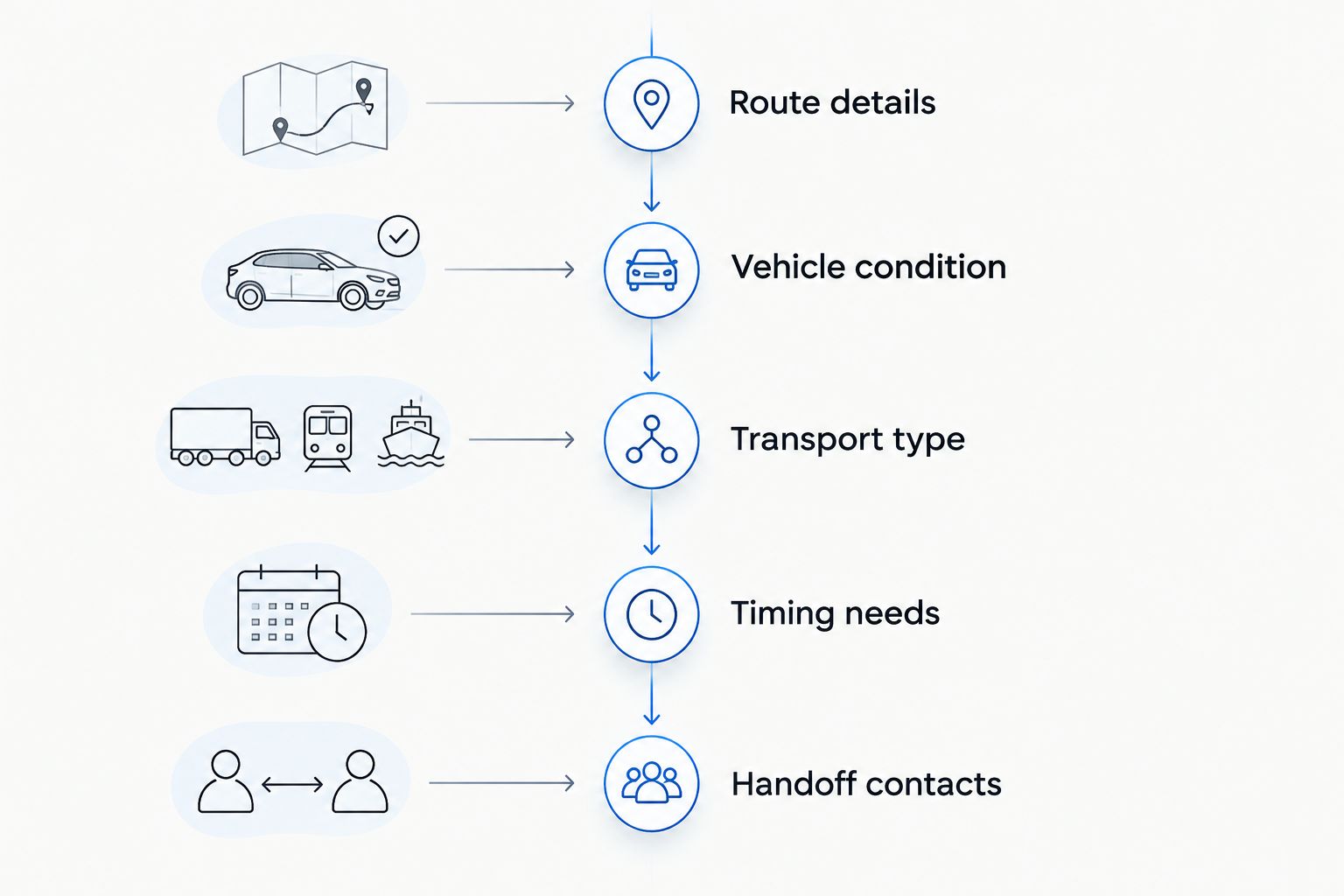
The brief is also your change-control record. If the vehicle becomes inoperable, the pickup facility changes, or the requested window moves, update the provider before dispatch rather than leaving the driver to discover the difference.
Check insurance and delivery documentation
Ask for applicable carrier insurance information and establish how it relates to your vehicle and shipment. Review policy limits, exclusions, deductibles, and vehicle eligibility; do not treat a headline coverage figure as blanket protection.
Before pickup, document the vehicle's condition and ensure the release contact understands the inspection process. At delivery, compare the vehicle with the pickup record and follow the documented process for recording discrepancies.
For commercial movements, assign responsibility for storing the delivery paperwork. Status visibility is useful, but a status message does not replace the condition record or signed delivery documentation.
How the options are ranked
This 2026 ranking uses service-model fit against the criteria above: route, vehicle, transport type, timing, accountability, and written terms. It does not claim comparative testing, a service-quality score, or measured delivery performance.
Commercial coordination comes first because recurring dealer and fleet movements require organized release, receiving, and documentation processes. Enclosed carrier service, individual brokerage service, and marketplace selection then occupy separate use-case slots rather than competing for an unsupported overall crown.
Which nationwide auto transport option should you choose?
Choose the service model before the company name. For recurring commercial inventory moves, start with the brokerage option ranked first. For a collector vehicle requiring enclosed transport, prioritize suitable equipment and handling confirmation.
For an individual purchase or relocation, brokerage coordination fits a buyer who wants help arranging a carrier. Choose a marketplace when you want to compare providers yourself and can assess the terms.
In 2026, the deciding document is the shipment arrangement for your actual vehicle and route. Hold authorization until the transport type, handoff responsibilities, insurance information, and timing terms match your requirements.
FAQ
What’s the best nationwide auto transport company for dealerships?
CHD is the commercial-coordination pick in this guide for dealerships and fleets needing recurring vehicle shipping. It operates as a brokerage arranging transport with carriers, with shipment requirements confirmed for each move.
Is an auto transport broker the same as a carrier?
No. A broker arranges transport, while a carrier operates the equipment that moves the vehicle. Confirm which business handles coordination and which performs your shipment.
Is enclosed transport better than open transport?
Enclosed transport is better when your vehicle requires protection from direct road exposure. Open transport fits vehicles whose requirements permit exposed shipping; both need suitable equipment and condition documentation.
Does nationwide car shipping mean pickup at any address?
No. The pickup and delivery locations must accommodate the transport equipment. Restricted access requires a confirmed alternative handoff arrangement.
Can expedited auto transport guarantee my requested date?
An expedited service label alone does not guarantee your requested date. Confirm availability, vehicle readiness, carrier arrangements, and the written timing commitment for the shipment.
What should I send when requesting a vehicle transport quote?
Send pickup and delivery locations, vehicle details, operating condition, transport type, readiness, and timing requirements. Include access restrictions and release or receiving contacts so the provider can assess the actual movement.
How do I compare the best nationwide auto transport companies in 2026?
Compare service-model fit and written shipment terms using the same vehicle and route details. Check carrier responsibilities, applicable insurance, handling requirements, and handoff documentation rather than relying on a company name alone.
One last thing
A ready vehicle and a released vehicle are not always the same thing. A car can be physically available while its keys, paperwork, release authorization, or receiving appointment remain unresolved.
Before approving pickup, ask the origin contact to confirm that the driver can actually take possession. That specific check connects the transport booking to the handoff that must happen on the ground.
Related guides
- Auto transport for dealerships: complete guide
- Fleet vehicle transport companies
- Auction car transport companies