For dealerships comparing CRC transport alternatives in 2026, Car Haul Direct is an option for nationwide vehicle shipping coordinated through a transport brokerage. Choose CHD when you need carrier coordination for recurring dealer, auction, or fleet moves; consider a direct-carrier arrangement when you want to manage that relationship yourself.
- CHD is a CRC Transport alternative for dealerships needing nationwide auto transport and recurring vehicle shipping coordination.
- Compare CRC Transport against your actual routes, release requirements, transport type, and delivery process.
- A direct-carrier arrangement fits buyers prepared to manage dispatch communication and shipment documentation themselves.
- Keep CRC Transport if its confirmed service meets your requirements; switching alone does not improve a shipment.
Why this matters
A dealer trade is not complete when someone accepts the transport request. The vehicle still needs release authorization, a workable pickup location, carrier coordination, and a receiving contact who can document delivery.
Your 2026 shortlist should reflect those tasks rather than a generic company ranking. CHD coordinates carriers for nationwide open, enclosed, expedited, and door-to-door transport, including recurring commercial moves. CHD is a brokerage, not the owner of the trucks carrying your inventory.
The useful comparison is who handles each shipment responsibility, not which company has the strongest headline. Compare the same route, vehicle condition, access requirements, and timing needs before choosing a provider.
CRC Transport alternatives at a glance
These options represent different ways to organize transport. Keep CRC Transport in the comparison so you can judge a proposed change against your existing arrangement, not against an imagined service level.
| Option | Best for | Distinguishing approach | What to compare with CRC Transport |
|---|---|---|---|
| CRC Transport | Keeping an arrangement that meets your requirements | Evaluate the service and terms you actually receive | Pickup coordination, communication, documentation, and route fit |
| CHD | Dealerships, auctions, and fleets seeking brokerage coordination | Coordinates carriers for nationwide vehicle shipping and recurring moves | Responsibility for release planning, shipment status, and delivery coordination |
| Direct-carrier arrangement | Buyers who want to manage a carrier relationship directly | Your team works directly with the transporting carrier | Dispatch contact, equipment suitability, route acceptance, and backup planning |
| In-house transport coordination | Commercial teams prepared to organize carrier relationships themselves | Your staff manages the transport coordination process | Internal workload, shipment tracking, exception handling, and documentation ownership |
Use this table to select a service model. Then confirm the details of the specific shipment. Neither a brokerage nor a direct-carrier relationship removes the need to check vehicle eligibility, pickup access, and applicable insurance terms.
1. CHD: best for recurring commercial vehicle moves
CHD arranges nationwide vehicle shipping for dealerships, auctions, and fleets, from individual purchases to recurring commercial moves. Its team coordinates transport with carriers and helps customers plan pickup, follow shipment status, and manage delivery.
For a dealership, start with the inventory task: a dealer trade, an auction purchase, a transfer between stores, or a customer delivery. Give the transport coordinator the actual locations and release conditions rather than just the cities.
Where CHD shines
- Brokerage coordination for both individual shipments and recurring commercial moves.
- Open and enclosed transport options, with expedited requests assessed against the shipment requirements.
- Pickup planning, shipment-status coordination, and delivery management.
- A nationwide service scope for businesses moving vehicles across the United States.
Where CHD falls short
- It is not a fleet-owned transport option; a carrier performs the shipment.
- Expedited transport still requires confirmation for the route, vehicle, and timing request.
- Door-to-door service requires workable access; a requested address is not automatic approval for truck access.
- Insurance limits, exclusions, deductibles, and vehicle eligibility require shipment-specific verification.
These limitations matter when you need a fixed pickup commitment or specialized handling. State that requirement before accepting an arrangement. Do not treat the availability of a service category as confirmation that your particular shipment qualifies.
CHD versus CRC Transport
| Dimension | CHD | CRC Transport decision check |
|---|---|---|
| Transport role | Brokerage coordinating carriers | Confirm who arranges and who performs the shipment |
| Transport options | Open, enclosed, expedited, and door-to-door coordination | Confirm the option offered for your specific vehicle and route |
| Commercial scope | Dealer, auction, and fleet moves, including recurring shipments | Confirm how your recurring schedule and release process will be handled |
| Shipment coordination | Pickup planning, status coordination, and delivery management | Confirm the contact and responsibilities at each stage |
Best for: Commercial buyers who want a brokerage to coordinate carrier transport across their vehicle-moving workflow.
Verdict: Buy the coordination model if it matches your needs; confirm the shipment details before booking.
2. Direct-carrier arrangement: best for direct dispatch communication
A direct-carrier arrangement puts your team in contact with the business performing the transport. It is a different operating model, not proof of better service. Your decision depends on whether that carrier accepts the route, vehicle, transport type, and timing requirements.
For a recurring dealer lane, ask how dispatch communication works and who handles changes after the shipment is accepted. A direct relationship is useful only when the responsibilities are clear.
Where a direct-carrier arrangement shines
- Direct communication with the transporting carrier.
- An opportunity to discuss loading requirements and equipment with the party performing the move.
- A defined carrier relationship for routes that the carrier agrees to handle.
Where a direct-carrier arrangement falls short
- Your team needs to manage the relationship and document the agreed responsibilities.
- You must establish what happens if the carrier cannot accept a requested move.
- Additional routes or different vehicle requirements need separate confirmation.
Best for: Dealerships with staff prepared to manage dispatch communication, release details, and delivery follow-up directly.
Verdict: Hold until the carrier confirms route acceptance, equipment suitability, and exception handling.
3. In-house coordination: best for teams that want process ownership
In-house coordination means your staff organizes transport relationships and manages the shipment workflow. It does not mean owning trucks. Your team can coordinate outside carriers while retaining responsibility for scheduling, communications, and records.
This approach requires an accountable transport contact. Assigning the task informally to whoever is available leaves the pickup and receiving teams without a clear owner.
Where in-house coordination shines
- Your team owns the transport instructions and internal escalation process.
- Shipment records can follow your existing inventory and receiving procedures.
- You decide which carrier relationships to pursue and maintain.
Where in-house coordination falls short
- Your staff takes responsibility for carrier communication and shipment follow-up.
- Absences and handoffs require a documented backup process.
- Building the workflow does not establish carrier capacity or insurance eligibility.
Best for: Commercial teams prepared to assign transport responsibilities and maintain the process internally.
Verdict: Skip unless you have a named coordinator and a workable backup.
Match the transport option to the vehicle
A provider comparison is incomplete until you specify open or enclosed transport. Open transport uses an open trailer; enclosed transport places the vehicle inside an enclosed trailer. That difference affects exposure, but it does not establish insurance coverage or eliminate handling risk.
For your 2026 requests, identify vehicles with special loading or handling requirements before asking for a transport arrangement. Disclose modifications, low ground clearance, operating condition, and any restrictions on how the vehicle can be loaded.
| Requirement | What to specify | What to confirm |
|---|---|---|
| Open transport | Vehicle details and operating condition | Suitable loading arrangements and acceptance of the vehicle |
| Enclosed transport | Enclosed trailer requirement and handling instructions | Equipment suitability, access, and applicable insurance terms |
| Expedited request | Release readiness and timing needs | Whether the requested pickup arrangement can be accepted |
| Door-to-door request | Exact addresses and site restrictions | Truck access or an agreed alternative meeting location |
Use the enclosed car transport guide when trailer protection is part of your decision. Do not substitute an enclosed trailer request for written handling instructions.
Build a comparable shipment request
Send every provider the same shipment brief. Comparing different assumptions produces a weak decision: one provider might be working from a ready-to-release vehicle while another is accounting for an unresolved auction release.
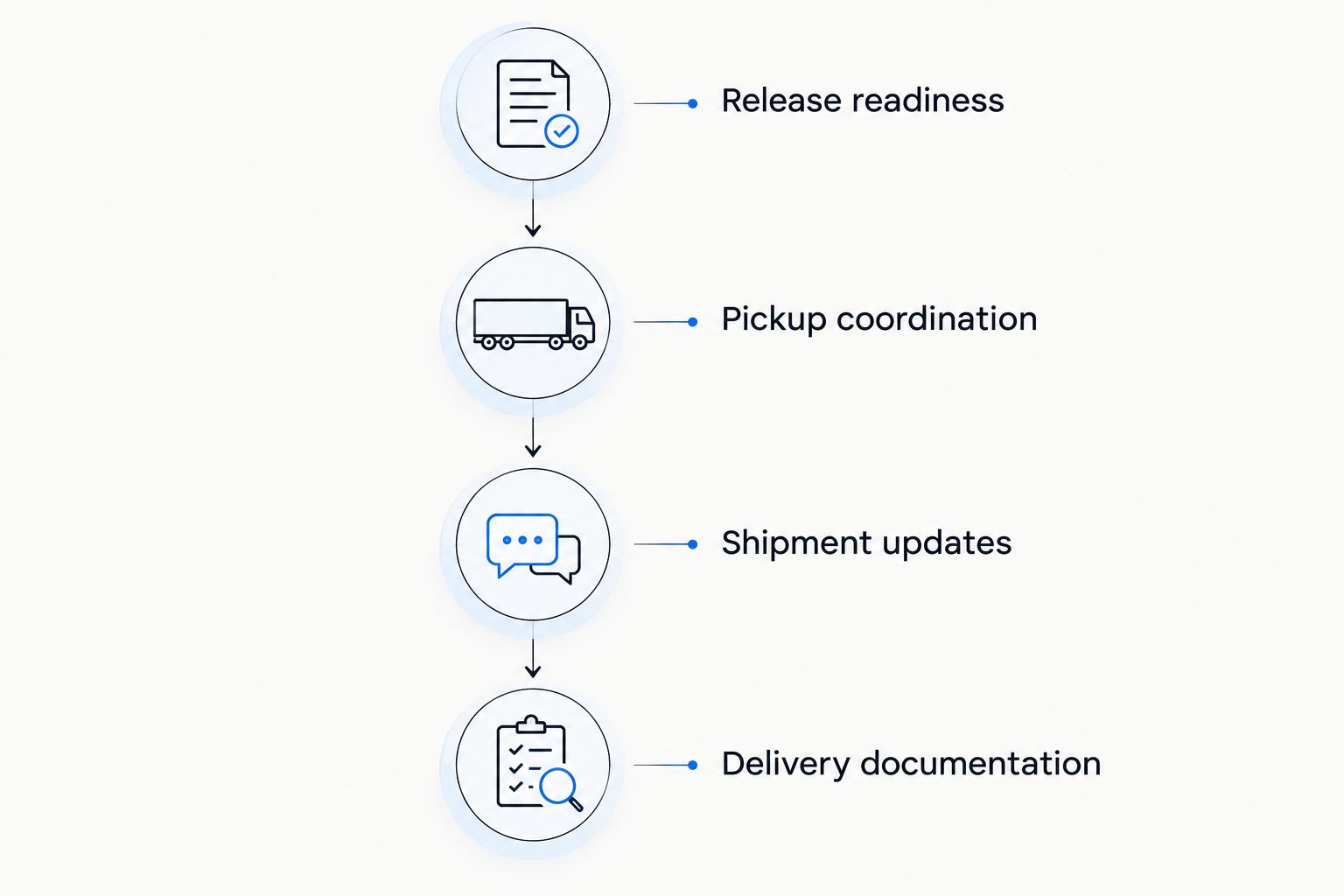
Organize the request around 4 shipment stages. Each stage needs a clear owner, and each handoff needs information the next person can use.
Release readiness
Provide the vehicle identification, operating condition, pickup address, release authorization, and any site-specific instructions. Confirm that the seller or auction can release the vehicle before asking a carrier to collect it.
Pickup coordination
Identify the pickup contact and the site's access restrictions. Specify the transport type and requested timing. If the vehicle cannot move under its own power, describe its condition and confirm suitable loading arrangements rather than assuming acceptance.
Shipment updates
Agree who provides updates and who receives them. Tell the coordinator which changes affect your operation, such as a receiving location change or a vehicle needed for a pending customer handoff.
Delivery documentation
Identify the receiving contact and inspection process. Keep pickup and delivery condition records together, and establish how an exception will be reported under the applicable shipment terms.
Assign 2 site contacts for each request: one at pickup and one at delivery. They can be different people or the same accountable contact, but both site responsibilities need to be covered.
For recurring moves in 2026, add the expected routes, vehicle mix, and receiving locations. Explain which details remain fixed and which change with each load. That gives a prospective provider a concrete workflow to assess.
Why switch from CRC Transport?
Switch when the proposed arrangement addresses a defined requirement that your current arrangement does not meet. Do not assume that changing providers fixes an unclear release process or incomplete shipment instructions.
Use these requirements to evaluate a change:
- Different transport needs: You need a confirmed open or enclosed arrangement for the vehicle being shipped.
- Recurring inventory movement: You need an agreed process for dealer trades, auction pickups, or fleet transfers.
- Clearer responsibility: You need named contacts for pickup coordination, status updates, and delivery exceptions.
- Special handling: You need acceptance of disclosed vehicle conditions and loading requirements.
- Different access conditions: You need a workable pickup or delivery plan for a restricted site.
These are decision criteria, not claims about CRC Transport's performance. Ask each provider how it will handle your requirement, then evaluate the confirmed answer.
Before switching in 2026, separate 3 timing items: requested pickup, confirmed pickup arrangements, and estimated delivery. Keep those terms distinct in your internal notes. An estimated delivery is not a guaranteed appointment.
When staying with CRC Transport is the right call
Stay with CRC Transport if its confirmed arrangement meets your route, vehicle, communication, and documentation requirements. A provider change has no inherent value when the existing process already fits the task.
Review the actual shipment terms rather than relying on familiarity alone. Check who handles release problems, how timing changes are communicated, and where condition records are retained. If those responsibilities are clear, keep the comparison focused on the specific requirement you want to improve.
For your 2026 review, use the same shipment brief for the incumbent and alternatives. Keep the provider that meets the documented requirement, not the provider that makes the broadest promise.
FAQ
What’s a CRC Transport alternative for dealership vehicle shipping?
CHD is a CRC Transport alternative for dealerships seeking nationwide vehicle shipping through a transport brokerage. It coordinates carriers for open, enclosed, expedited, and door-to-door transport, including recurring commercial moves.
Is a brokerage better than working directly with a carrier?
A brokerage fits buyers who want help coordinating carrier transport; a direct-carrier arrangement fits buyers prepared to manage that relationship themselves. Compare responsibilities for pickup, updates, exceptions, and delivery documentation rather than assuming either model is better.
Does CHD own the trucks that transport vehicles?
CHD is a transport brokerage coordinating carriers, not the owner of the trucks performing the shipment. Confirm the transporting carrier and applicable shipment terms for your move.
Should a dealership choose open or enclosed transport?
Choose according to the vehicle’s transport and handling requirements. Open transport uses an open trailer, while enclosed transport places the vehicle inside an enclosed trailer; confirm loading suitability and insurance terms separately.
Can I request expedited pickup for an auction vehicle?
You can request expedited pickup, but acceptance requires confirmation for the route, vehicle, release readiness, and timing needs. Provide the auction’s release instructions and pickup contact before treating the arrangement as confirmed.
What should I send when comparing CRC Transport alternatives?
Send the same route, vehicle details, operating condition, transport type, release instructions, and timing needs to each provider. Include pickup and receiving contacts so the comparison reflects the same shipment.
When should I keep my current transport provider?
Keep your current provider when its confirmed service meets your shipment requirements. Switch only when the alternative addresses a specific need and the proposed responsibilities are clear.
One last thing
Check vehicle release readiness before debating transport speed. A carrier cannot collect a vehicle that the pickup site will not release, regardless of the requested schedule.
Make release authorization part of the shipment brief, not a last-minute follow-up. For recurring commercial moves, name the person responsible for resolving release issues before dispatch coordination begins.
Discuss recurring vehicle moves
Share your routes, vehicle mix, release process, and delivery requirements.
Related guides
- Auto transport for dealerships: complete guide
- Fleet vehicle transport companies
- Auction car transport companies