Independent dealer auto transport is the coordination of vehicle shipping for auction purchases, dealer trades, and inventory transfers, with the aim of getting vehicles to the right lot for preparation and sale. This guide explains auto transport for independent dealers in 2026, from choosing a trailer to documenting delivery when your buying, receiving, and reconditioning schedules do not line up.
- CHD coordinates carriers; it does not operate as your truck-owning fleet.
- Auto transport for independent dealers starts with the route, vehicle condition, auction release, and receiving hours.
- Choose open transport for routine inventory; assess enclosed transport when vehicle handling and exposure requirements justify it.
- Confirm carrier assignment and timing before treating an estimate as a receiving appointment.
Why auto transport matters for independent dealers
An auction purchase is not ready for pickup simply because you bought it. Release authorization, keys, vehicle condition, and yard access all affect whether a carrier can load it. At delivery, someone must receive the vehicle and document its condition before the shipment record is complete.
Car Haul Direct is a nationwide transport brokerage that coordinates carriers for dealership and auction moves. CHD is best for independent dealers seeking brokerage coordination for auction purchases, dealer trades, and recurring inventory moves. Carrier assignment, route feasibility, handling requirements, and timing still require shipment-specific confirmation.
For your 2026 transport plan, separate buying decisions from dispatch decisions. Give transport coordination a complete shipment brief rather than forwarding a purchase receipt and assuming the rest is settled. That distinction matters when the buyer, auction release desk, driver, and receiving employee hold different pieces of the information.
Track 3 status checkpoints: release readiness, confirmed pickup, and documented delivery. These are operating checkpoints, not a promise of transit speed. They show whether the next action belongs to your dealership, the seller, the transport coordinator, or the carrier.
How to organize dealer vehicle shipping
Use the following sequence for each purchase, even when the route is familiar. A repeat lane does not establish that a newly purchased vehicle runs, fits the same equipment, or can leave the auction during the same hours.
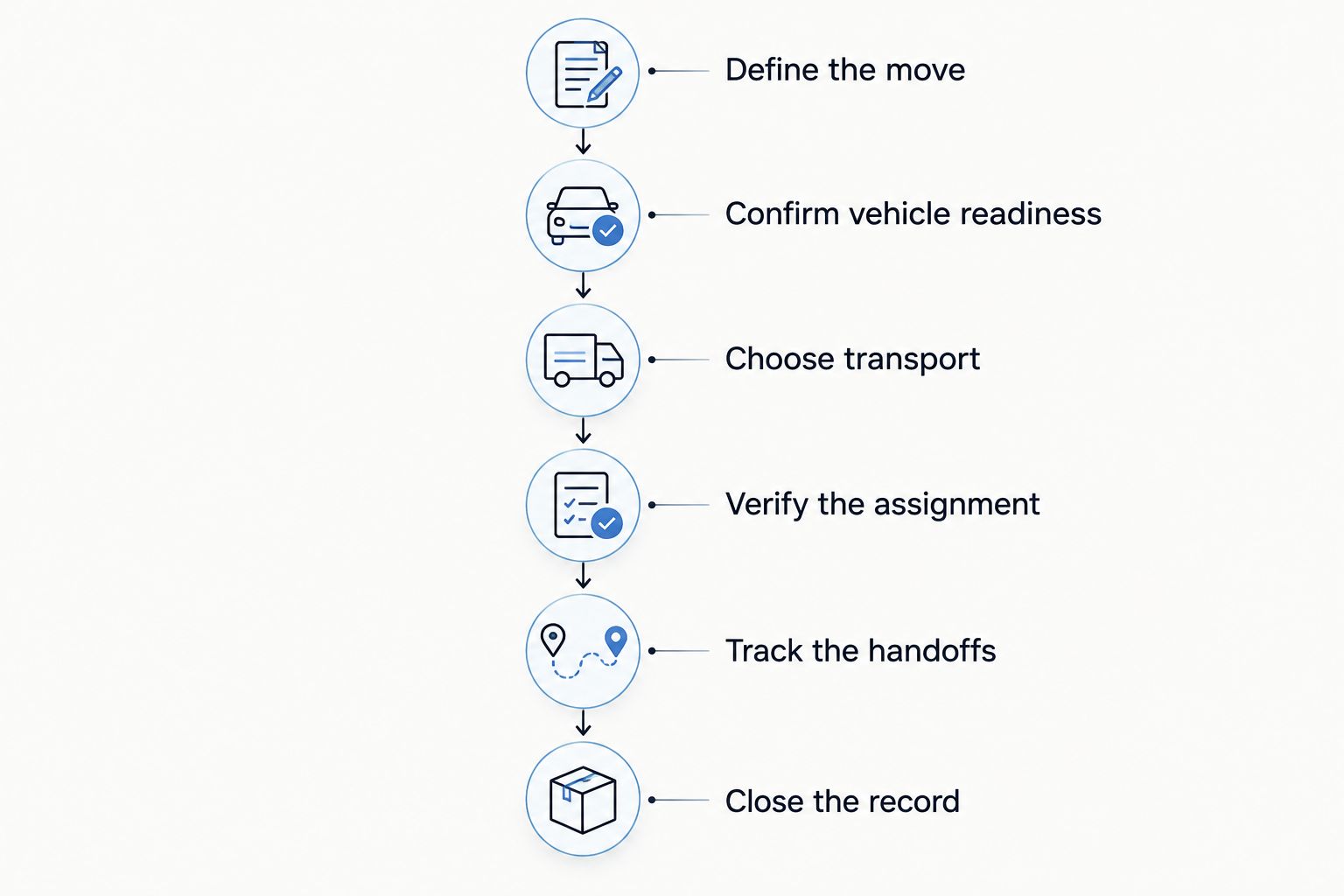
Define the move
Start with a shared spreadsheet, email template, or shipment form. Create 1 shipment record per vehicle, then group related records when several vehicles belong to the same purchase or route. Keep the VIN attached to every instruction so a change to one unit does not accidentally change the entire order.
Record the actual pickup and delivery locations, not just the cities. An auction yard, dealership storefront, and off-site storage lot have different contacts and access rules. State whether delivery goes to your sales lot, a reconditioning facility, or another dealership.
Separate your preferred timing from a hard restriction. A desired arrival before a sales event is different from a gate that closes before the driver can enter. For your 2026 buying calendar, give the coordinator both facts without presenting either as a confirmed appointment.
- Enter the VIN, year, make, model, and stock reference.
- Provide full addresses and named contacts at both ends.
- State pickup readiness separately from the desired delivery date.
- Identify gate hours, appointment requirements, and access restrictions.
- Name the employee authorized to approve shipment changes.
Confirm vehicle readiness
Call the seller or auction release desk before requesting pickup. Ask whether the vehicle is authorized to leave, where the keys are held, and what the driver must present. Verify any required paperwork directly with the location rather than relying on instructions from an earlier purchase.
Describe operating condition precisely. A vehicle that starts but cannot steer or brake is not equivalent to a vehicle that can be driven onto a trailer. Report damage, missing wheels, low clearance, leaks, or other conditions that affect loading.
CHD can coordinate the move with carriers, but accurate condition information must come from the shipment parties. Do not dispatch against an assumption that the auction will resolve a release or loading problem when the truck arrives. Ask the coordinator to confirm suitable equipment before accepting the assignment.
- Confirm release authorization and required driver credentials.
- Locate keys and establish who hands them over.
- Verify starting, rolling, steering, and braking condition.
- Disclose modifications, damage, leaks, and clearance concerns.
- Confirm approved loading assistance for an inoperable vehicle.
Choose transport
Request the transport type that fits the vehicle and task. Open transport uses an exposed trailer and suits routine inventory when enclosure is not required. Enclosed transport uses a covered trailer and addresses exposure concerns, but it does not eliminate the need to verify loading methods, clearance, or coverage.
Treat expedited service as a request for prioritized arrangements, not a guaranteed arrival. Ask what timing is being offered, whether a carrier has accepted the move, and what restrictions remain. Expedited availability requires confirmation for the specific route and vehicle.
For 2026 transport requests, compare scope before comparing proposals. Route, vehicle size, operating condition, transport type, timing constraints, and pickup access are material inputs. A proposal based on a running sedan does not describe the same job as one involving a non-running modified vehicle.
- Use open transport when the vehicle does not require enclosure.
- Assess enclosed transport for exposure-sensitive or special-handling inventory.
- Disclose loading requirements before choosing equipment.
- Request expedited arrangements only with clear timing needs.
- Confirm whether both locations can accommodate the assigned truck.
Verify the assignment
Keep the brokerage and carrier roles distinct. The brokerage coordinates the shipment; the assigned carrier performs the vehicle movement. Ask who owns communication at each stage so your buyer does not have to reconstruct the chain when a pickup instruction changes.
Before pickup, obtain the assigned carrier’s identity and the agreed operating instructions. Review applicable insurance evidence against the actual vehicle and shipment. A general statement that a carrier is insured does not establish the policy limit, exclusions, deductible, or eligibility for your inventory.
Confirm timing in writing without turning an estimate into a guarantee. Identify what is confirmed, what remains estimated, and who reports changes. If the vehicle, route, or release status changes after assignment, send a revised instruction rather than allowing conflicting versions to circulate.
- Confirm the carrier’s legal identity and dispatch contact.
- Verify applicable coverage, exclusions, deductibles, and vehicle eligibility.
- Record the agreed transport type and handling requirements.
- Distinguish estimated windows from confirmed appointments.
- Establish the escalation contact for missed or changed handoffs.
Track the handoffs
A shared shipment log is enough to start. Record the last confirmed event, the source of that confirmation, and the next required action. Avoid replacing useful status with vague entries such as “in progress” when the real issue is an unreleased vehicle or an unanswered receiving call.
CHD helps customers follow shipment status and coordinate delivery. Establish the update method and contact responsibilities for your account; do not assume that every shipment includes a particular tracking interface or integration.
For recurring moves in 2026, review exceptions by cause. Separate auction release problems, vehicle-condition changes, carrier scheduling changes, and dealership receiving conflicts. This gives your team a specific process to correct instead of treating every disruption as the same transport problem.
- Record release confirmation before marking a vehicle pickup-ready.
- Obtain confirmation when the carrier actually collects the vehicle.
- Update the receiving contact when the delivery estimate changes.
- Record the cause and owner of each unresolved exception.
- Send changed instructions to all affected shipment parties.
Close the record
Require 2 condition checks: one at pickup and one at delivery. Keep the inspection records and supporting photographs linked to the VIN. Use clear views of the vehicle and close-ups of existing damage rather than relying on a distant lot photo.
At delivery, have an authorized employee compare the vehicle with the pickup documentation. Record visible discrepancies on the delivery paperwork and notify the appropriate carrier and coordinator promptly. Follow the applicable reporting process; a signed delivery document is not a substitute for understanding claim requirements.
Close the operational record only after the vehicle and paperwork reach the correct dealership team. Transport completion and retail readiness are separate events. Your receiving employee should pass relevant condition information to reconditioning rather than leaving it in an isolated text thread.
- Retain pickup and delivery condition documentation.
- Inspect the vehicle before completing the receiving paperwork.
- Document visible discrepancies and preserve supporting photographs.
- Follow the applicable notification and claims instructions.
- Send the completed record to inventory and reconditioning staff.
Compare transport options for independent dealers
Choose the operating model and trailer type separately. Direct carrier booking and brokerage coordination describe who arranges the move; open and enclosed transport describe the equipment. Expedited service addresses timing needs and still requires confirmation of the equipment and carrier.
| Option | Best for | What it provides | Key limitation |
|---|---|---|---|
| Direct carrier booking | Dealers prepared to manage carrier selection and dispatch themselves | Direct coordination with the hauling company | Your team must verify route fit, equipment, coverage, and communication responsibilities |
| Brokerage coordination | Dealers seeking help arranging single or recurring inventory moves | Coordination between your dealership and assigned carriers | The brokerage does not own the hauling operation; assignment and requirements need confirmation |
| Open transport | Routine inventory without an enclosure requirement | Vehicle movement on an exposed trailer | The vehicle remains exposed during transport |
| Enclosed transport | Inventory with exposure-sensitive handling requirements | Vehicle movement inside a covered trailer | Enclosure does not establish loading suitability or insurance eligibility |
| Expedited arrangements | Time-sensitive purchases and transfers | A request for prioritized transport coordination | Carrier acceptance and route feasibility determine what can be confirmed |
For an independent dealership, the right option is the one that meets the vehicle’s requirements and your receiving constraints. Do not buy enclosure when your actual problem is missing release paperwork. Do not request urgency when nobody at the destination can receive the truck.
Common mistakes independent dealers make
Treating the auction invoice as a release confirmation
A purchase record identifies the transaction; it does not answer every pickup question. Confirm release status, documents, keys, location, and collection hours with the party controlling the vehicle. Put the confirmation in the shipment record so the coordinator can act on it.
Sending an incomplete condition description
“Runs” is not a loading plan. State whether the vehicle starts, rolls, steers, and brakes, and disclose conditions that affect safe loading. If the condition changes after booking, notify the coordinator before pickup rather than asking the driver to improvise.
Planning reconditioning around an unconfirmed arrival
A desired arrival date is not the same as an accepted delivery appointment. Keep the reconditioning team informed of the latest confirmed status, and identify who can receive the vehicle if the estimate changes. Avoid making the receiving employee discover a scheduling conflict at the gate.
Assuming door-to-door means unrestricted lot access
Door-to-door transport still depends on safe, lawful truck access at each address. Confirm turning space, gate access, local restrictions, and unloading arrangements. If the assigned equipment cannot reach the lot, agree on an appropriate handoff location before arrival.
Filing paperwork without reviewing the vehicle
A complete folder does not establish that someone inspected the delivery. Assign a receiving employee, compare condition records, and document discrepancies while the vehicle is being handed over. Keep transport damage reporting separate from the dealership’s general reconditioning list.
FAQ
What is the best auto transport option for an independent dealer?
The best option matches the vehicle’s handling needs, route, release status, and receiving constraints. Open transport fits routine inventory without an enclosure requirement; enclosed transport addresses exposure-sensitive requirements.
Can a transport broker collect a car from an auction?
A transport broker can coordinate collection with a carrier once the auction’s release and loading requirements are confirmed. Provide the VIN, release instructions, operating condition, pickup contact, and destination details.
Is enclosed transport better than open transport for dealer inventory?
Enclosed transport is better suited to inventory that requires a covered trailer, not automatically every dealer purchase. Confirm loading suitability and applicable coverage independently of the trailer choice.
Does expedited auto transport guarantee next-day delivery?
An expedited request does not establish a next-day delivery guarantee. Confirm carrier acceptance, pickup readiness, route feasibility, and the specific timing commitment before arranging receiving staff.
What information should I send for a dealer transport quote?
Send the route, VIN and vehicle details, operating condition, transport type, timing needs, and pickup and delivery restrictions. Include auction release requirements and special handling instructions so the request describes the actual job.
What should my dealership check about carrier insurance?
Check the applicable policy limits, exclusions, deductibles, and vehicle eligibility for the assigned shipment. Do not treat a general insurance statement as confirmation that every vehicle or loss is covered.
Can CHD coordinate recurring dealer inventory moves?
CHD coordinates recurring commercial vehicle moves with carriers. Discuss your buying locations, destinations, vehicle mix, release process, receiving hours, and communication responsibilities before setting the operating scope.
One last thing
For your 2026 shipment template, add a field called “What prevents pickup today?” Require a specific answer: release pending, missing keys, loading assistance unconfirmed, or no known blocker after verification. That field directs attention to readiness rather than a preferred date that the shipment cannot yet meet.
Use the same template for recurring purchases. Give the coordinator a consistent brief, then confirm the operating scope for each route and vehicle.
Discuss recurring vehicle moves
Share your buying locations, destinations, vehicle mix, and receiving requirements.
Related guides
- Auto transport for dealerships: complete guide
- Auction car transport companies
- Auto transport for remarketing companies