Total-loss transfer auto transport is the coordinated movement of a vehicle declared a total loss, with the aim of getting it from its current holding location to an authorized destination. For dealerships, auctions, and fleets arranging auto transport for total loss vehicle transfers in 2026, the route, physical condition, loading method, release authority, and receiving arrangements determine whether a carrier can accept the job.
- Auto transport for total loss vehicle transfers starts with release authorization, condition photos, and a confirmed loading method.
- CHD coordinates carriers; total-loss vehicle acceptance and equipment suitability require confirmation before dispatch.
- A total-loss designation does not establish whether a vehicle rolls, steers, brakes, or can be loaded safely.
- Match open transport, enclosed transport, or specialized recovery to the vehicle’s actual condition.
Why auto transport matters for total-loss transfer teams
A total-loss decision answers an insurance or valuation question. It does not answer the transport question: can this particular vehicle be collected, secured, and unloaded with the proposed equipment?
Your transfer instructions need to bridge that gap. A fleet coordinator arranging removal from a repair facility needs different information from an auction receiving a vehicle with locked wheels. Both need an authorized handoff, accurate condition details, and a receiving location prepared for the load.
Car Haul Direct is a transport brokerage coordinating carriers, not a truck-owning carrier. CHD is best for commercial teams seeking broker-coordinated auto transport, with total-loss acceptance confirmed before dispatch.
For your 2026 transfer process, separate administrative readiness from physical readiness. A released vehicle can still be unsuitable for the proposed trailer, and a loadable vehicle can still lack permission to leave.
How to arrange a total-loss vehicle transfer
Establish the route and release authority
Start with a shared shipment record or spreadsheet. Identify the exact pickup facility, receiving facility, vehicle, and party authorized to approve movement. Record 1 VIN per vehicle record so a batch instruction does not blur vehicle identities.
Ask the holding facility what it requires before handing over the vehicle. A dispatch instruction is not a substitute for a release authorization, and transport paperwork does not replace ownership or title documentation.
Give the receiving facility the same information before requesting dispatch. Confirm that the destination accepts the vehicle in its disclosed condition, rather than assuming its address alone establishes acceptance.
- Record pickup and delivery addresses, contacts, and operating hours.
- Match the VIN to the vehicle and shipment reference.
- Confirm who can authorize release and who can receive delivery.
- Obtain the holding facility’s document and identification requirements.
- Identify unresolved holds before assigning a pickup window.
Document the vehicle’s actual condition
Use current photographs and a written condition description before choosing transport equipment. Replace vague labels such as damaged or non-running with observable facts: which wheels turn, whether steering works, whether brakes function, and what parts are loose.
A vehicle that does not start is not automatically the same loading problem as a vehicle with collapsed suspension. Review inoperable vehicle transport options with that distinction in mind; equipment suitability still requires confirmation for the individual vehicle.
Flag fire exposure, flood exposure, fluid leaks, and suspected battery damage. For a damaged electric vehicle, obtain qualified handling guidance and disclose the findings before asking a carrier to accept the shipment. Do not instruct facility staff to energize or move a vehicle simply to complete a booking form.
- Photograph the exterior, damaged areas, wheels, and accessible underside.
- State whether the vehicle rolls, steers, brakes, and starts.
- Identify missing keys, locked wheels, detached parts, and altered clearance.
- Disclose leaks, fire or flood exposure, and known electrical damage.
- Record who assessed the condition and when the photographs were taken.
Match the loading method to the condition
Ask the carrier to confirm how the vehicle will reach the trailer and leave it at delivery. A winch does not by itself solve every loading problem: wheel condition, access, clearance, attachment points, and unloading arrangements still matter.
The manual approach is to send the same condition packet to prospective carriers and compare their written responses. CHD can coordinate the carrier discussion, but you still need to provide accurate vehicle information and obtain acceptance for the proposed move.
Choose equipment from the condition report, not from the total-loss label. If recovery or stabilization is needed before linehaul transport, define that work separately rather than treating it as an unspoken driver responsibility.
- Ask for confirmation of the loading and unloading method.
- Disclose low clearance, unstable components, and obstructed wheels.
- Confirm whether facility equipment or qualified assistance is required.
- Identify who supplies any agreed loading assistance.
- Resolve recovery needs before scheduling ordinary vehicle transport.
Confirm access and timing at both facilities
Contact the pickup and receiving facilities directly. Ask about appointments, gate procedures, driver identification, truck access, and restrictions on loading activities. Door-to-door transport still depends on lawful and practical access.
Separate the requested pickup date from the carrier-confirmed window. Expedited transport is a scheduling request subject to carrier, route, equipment, and facility availability; it does not remove release or handling requirements.
For a 2026 recurring-move procedure, give someone explicit responsibility for reporting changes. A vehicle moved to another yard, a newly discovered leak, or a changed receiving appointment requires an updated plan before the driver arrives.
- Confirm appointments, gate contacts, and release procedures.
- Check truck access and the proposed loading area.
- Ask whether loading assistance requires advance booking.
- Record requested timing separately from confirmed arrangements.
- Assign a contact to report condition or location changes.
Review the transport scope and applicable coverage
Compare written scope before accepting a transport arrangement. Route, vehicle dimensions, operability, equipment, access, and timing belong in the request because they define the work being proposed.
Keep the vehicle’s existing damage separate from potential transport-related damage. Ask for applicable insurance documentation and review policy limits, exclusions, deductibles, vehicle eligibility, and claim instructions. A certificate alone does not answer every coverage question.
Do not treat an enclosed trailer as proof of broader insurance coverage. Protection from outside exposure and the terms of an insurance policy are separate matters. Confirm both against the actual vehicle and shipment.
- Check that the written scope matches the disclosed condition.
- Identify included loading assistance and any separate recovery work.
- Request applicable insurance documentation before dispatch.
- Confirm relevant exclusions, deductibles, limits, and eligibility.
- Record the contact and procedure for reporting a transport incident.
Track pickup, transit, and delivery separately
A shared log can provide a workable manual process. Track 3 shipment milestones: pickup, transit, and delivery. Give each milestone a responsible contact and distinguish a planned event from a confirmed event.
Use the same milestone definitions across your 2026 transfer records. Pickup means the vehicle has actually been collected, not merely assigned to a carrier. Delivery means the receiving handoff has occurred, not that an estimated arrival time has been issued.
Agree on the status-update method before dispatch. Avoid assuming continuous tracking or a specific reporting frequency unless that arrangement has been confirmed for the shipment.
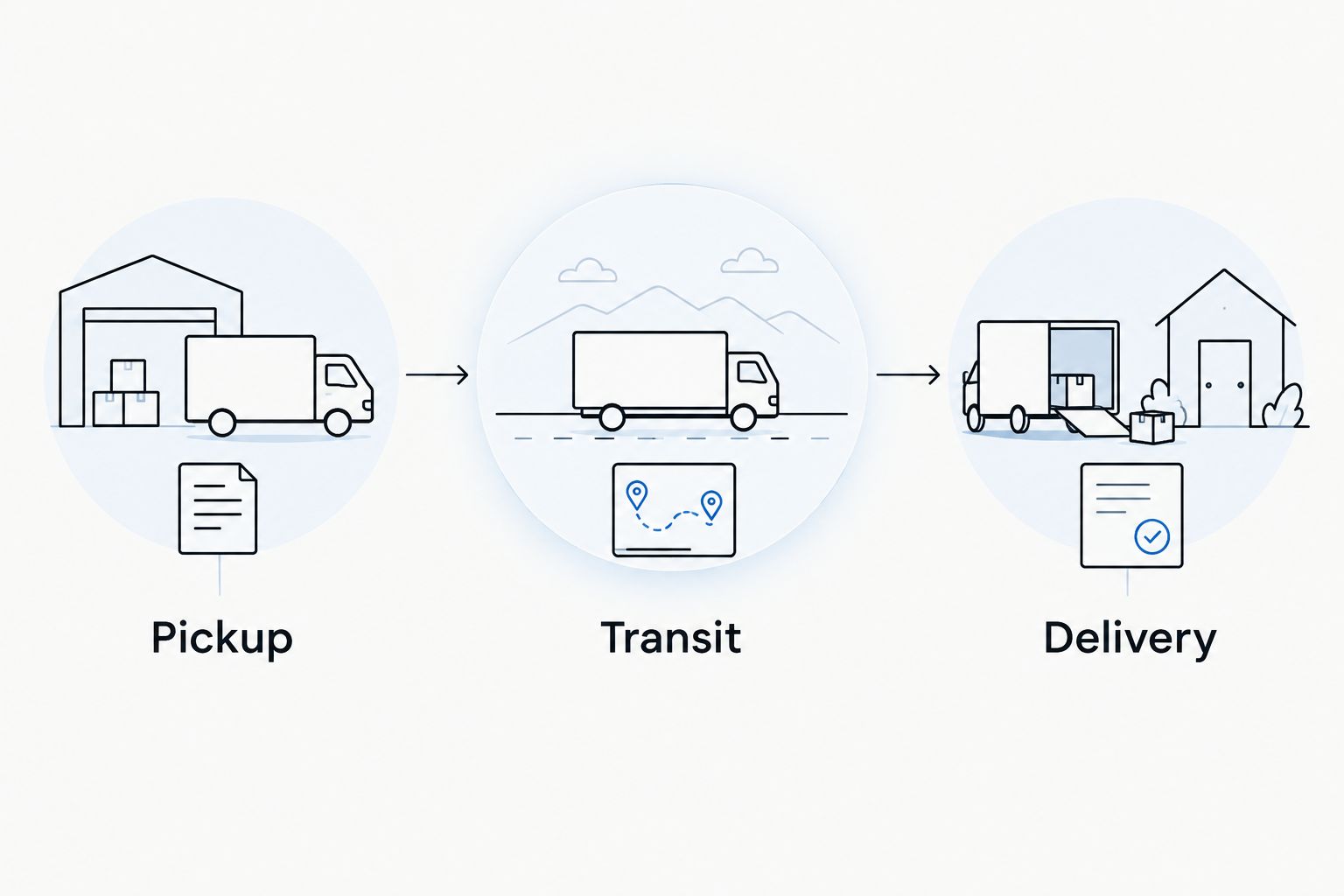
Your record should let the next person understand what happened without reconstructing a chain of messages. Attach exceptions to the relevant milestone rather than leaving them in an unrelated conversation.
- Record pickup confirmation and the releasing contact.
- Save the dispatch reference and agreed communication method.
- Log material delays, access issues, or condition discrepancies.
- Confirm receiving arrangements before arrival.
- Record delivery completion and any documented exceptions.
Reconcile the condition and close the transfer
Plan for 2 condition records: pickup and delivery. These are documentation checkpoints, not a prescribed photograph count. Capture enough detail to distinguish existing damage from a newly observed discrepancy.
At delivery, ask the receiving representative to compare the vehicle with the pickup record before completing the handoff documentation. If a discrepancy appears, photograph it, describe it accurately, and follow the applicable notification process.
Close the operational shipment separately from any insurance, ownership, or disposal process. A completed delivery confirms the transport handoff; it does not establish that every related administrative obligation is complete.
- Compare delivery condition against the pickup record.
- Check the VIN and any separately documented accompanying items.
- Record visible discrepancies on the delivery documentation.
- Retain photographs, signatures, and relevant correspondence together.
- Route unresolved issues to the designated responsible party.
Compare transport options for total-loss transfers
The best option is the one that can load, secure, and unload the disclosed vehicle safely. Open versus enclosed is only part of that decision. Recovery needs and expedited scheduling address different problems.
Use this comparison to frame your 2026 request. Carrier acceptance, equipment suitability, and facility arrangements still need shipment-specific confirmation.
| Option | Best for | Main benefit | Key limitation |
|---|---|---|---|
| Open vehicle transport | Vehicles accepted for loading and securement on an open trailer | Provides an open-trailer transport option when condition permits | Leaves the vehicle exposed to weather; damaged-vehicle acceptance is not automatic |
| Enclosed vehicle transport | Vehicles needing reduced outside exposure and accepted enclosed loading | Adds an enclosed transport environment | Enclosure does not resolve unstable damage, restricted access, or unsuitable loading geometry |
| Specialized recovery followed by transport | Vehicles requiring recovery or stabilization before onward shipment | Separates difficult extraction from the transport leg | Requires defined responsibilities and coordination between activities |
| Expedited scheduling request | Released, transport-ready vehicles with time-sensitive movement needs | Prioritizes a request for earlier movement | Depends on suitable carrier and equipment availability; does not guarantee pickup or delivery |
Do not select enclosed transport solely because the vehicle had a high pre-loss value. Compare its current handling needs, the destination’s requirements, and the proposed equipment. Likewise, do not select open transport until the carrier accepts the actual condition.
For recurring commercial movements, CHD offers carrier coordination; vehicle acceptance and any special handling remain subject to confirmation. Provide a representative condition packet and explain which parts of your workflow repeat across locations.
Discuss recurring vehicle moves
Share your routes, vehicle conditions, facility requirements, and expected movement pattern.
Common mistakes total-loss transfer teams make
Treating total loss as a loading specification
A financial designation does not describe wheel movement, structural stability, or access. Request an operational condition assessment before choosing equipment. Keep valuation language in the administrative record and loading facts in the transport instructions.
Dispatching before the release is complete
A carrier assignment does not remove a facility hold. Confirm the release directly with the holding location and identify the person authorized to hand over the vehicle. Recheck if the release status changes before pickup.
Arranging pickup assistance but ignoring unloading
A vehicle loaded with facility assistance still needs a workable unloading plan. Confirm the destination’s equipment, staffing, access, and appointment requirements before collection. Do not transfer an unresolved handling problem to the receiving gate.
Treating existing damage as irrelevant
A heavily damaged vehicle still needs a clear condition record. Document existing damage and loose components so the receiving team can identify discrepancies. Avoid signing an inaccurate description simply because the vehicle is already a total loss.
Assuming urgency overrides acceptance requirements
An urgent removal request does not establish that a carrier can handle the vehicle. Resolve hazards, release restrictions, and equipment requirements first. Then ask what scheduling options are actually available for the route.
FAQ
Can a total-loss vehicle be shipped on a regular car carrier?
A total-loss vehicle can use a regular car carrier only when the carrier accepts its condition and confirms suitable loading, securement, and unloading. The total-loss designation alone does not establish transport suitability.
What information do I need to arrange a total-loss vehicle transfer?
Provide the route, VIN, current condition photos, operability details, release contact, destination contact, and timing requirements. Include known hazards and loading restrictions so the proposed carrier can assess the job.
Is open or enclosed transport better for a totaled vehicle?
The better option depends on the vehicle’s handling needs and the carrier’s acceptance, not the total-loss label. Enclosed transport reduces outside exposure but does not solve recovery needs or unsuitable loading geometry.
Can a carrier collect a totaled vehicle without keys?
Collection without keys requires confirmation of a workable loading and unloading method. Disclose missing keys, locked steering, wheel restrictions, and access conditions before requesting dispatch.
Does transport insurance cover all existing damage on a total-loss vehicle?
Do not assume transport insurance covers existing damage or every incident involving a total-loss vehicle. Review applicable policy terms, exclusions, deductibles, limits, and eligibility, and document the vehicle before pickup.
Can a damaged electric vehicle be shipped after a total-loss decision?
A damaged electric vehicle needs a condition-specific handling assessment and carrier acceptance before shipment. Disclose suspected battery damage, fire exposure, and flood exposure, and obtain qualified guidance rather than treating it as an ordinary non-running vehicle.
Does expedited transport guarantee a total-loss vehicle will leave today?
Expedited transport does not guarantee same-day collection. Release readiness, suitable equipment, carrier availability, facility access, and the route determine whether the requested timing can be accepted.
One last thing
A total-loss decision changes the vehicle’s administrative status, not its physical loading requirements. Before every dispatch, ask one practical question: has the receiving facility confirmed it can unload this vehicle in the condition described?
Add that confirmation to your 2026 transfer checklist. It connects the pickup plan to the final handoff instead of treating collection as the finish line.
Related guides
- Auto transport for remarketing companies
- Auto transport for dealerships
- Auto transport for rental car companies