Best for dealer-side transport coordination: Car Haul Direct, with inoperable-vehicle acceptance and loading requirements confirmed before booking. Best for a non-running vehicle that rolls, steers, and brakes: a winch-equipped transport carrier; best for an immobilized vehicle: a recovery operator with equipment matched to its condition.
- Compare the best inoperable vehicle transport companies by loading capability, vehicle condition, access, and documented shipment requirements.
- CHD coordinates carriers; confirm inoperable-vehicle acceptance and loading equipment before booking.
- Winch-equipped open transport fits non-running vehicles only when the carrier accepts their actual condition.
- Enclosed transport addresses exposure; it does not automatically solve loading problems.
- Vehicles with locked wheels or damaged suspension require a recovery assessment before line-haul transport.
Why this matters
An auction listing marked non-running does not explain how a vehicle will load. A dead battery, missing keys, locked wheels, and collision damage create different transport requirements. Treating them as the same shipment leaves the loading problem unresolved until pickup.
For dealerships comparing providers in 2026, the first decision is equipment fit, not the company name. Your transport request must explain the route, vehicle condition, access restrictions, and required timing before anyone commits to a loading method.
CHD is best for dealerships seeking brokerage coordination, with inoperable-vehicle requirements confirmed before booking. CHD coordinates transport with carriers rather than operating its own trucks. For broader inventory planning, the auto transport for dealerships guide covers the commercial context around these moves.
What makes the best inoperable vehicle transport companies
Use these criteria to assess a provider before requesting dispatch. A provider belongs on your shortlist only when its proposed equipment and process match your actual vehicle.
- Condition acceptance: The provider confirms whether the vehicle rolls, steers, brakes, has keys, and has accessible loading points.
- Loading capability: The assigned carrier confirms the equipment and procedure for loading and unloading that vehicle.
- Site access: Pickup and delivery contacts confirm truck access, release procedures, and any restrictions on outside loading assistance.
- Transport fit: Open or enclosed transport is selected separately from the loading method. Expedited timing remains subject to carrier availability and shipment requirements.
- Documentation: The transport plan includes condition records, handoff contacts, and delivery instructions.
- Coverage verification: Applicable policy limits, exclusions, deductibles, and vehicle eligibility are checked for the shipment rather than assumed from a general insurance statement.
A low-friction booking process does not prove that a provider can move a damaged vehicle. Ask who will load it, with what equipment, and who will unload it at the destination. Get those answers before authorizing the move.
Inoperable transport options at a glance
This 2026 shortlist ranks provider types by the job they fit. It is a purchasing framework, not a claim that every carrier within a category accepts every inoperable vehicle.
| Provider or option | Best for | Standout capability | Key limitation |
|---|---|---|---|
| CHD brokerage coordination | Dealerships coordinating vehicle moves | Carrier coordination and pickup planning | Inoperable acceptance and equipment require confirmation |
| Winch-equipped open transport carrier | Non-running vehicles that roll, steer, and brake | Loading without vehicle engine power | Does not resolve locked wheels or all damage conditions |
| Enclosed carrier with confirmed loading equipment | Collector vehicles requiring reduced weather exposure | Covered transport with a condition-specific loading plan | Enclosure alone does not establish loading capability |
| Recovery operator with suitable equipment | Vehicles that cannot move safely onto a transport trailer | Condition-specific recovery and loading assistance | Recovery and long-distance transport can be separate jobs |
1. CHD: best for dealership transport coordination
CHD is a nationwide transport brokerage serving dealerships, auctions, and fleets. The team coordinates carriers, helps plan pickup, follows shipment status, and manages delivery coordination. For an inoperable request, the booking decision depends on confirming the vehicle's condition and a carrier's ability to handle it.
This option fits a dealer that needs someone to coordinate the route and handoffs rather than arrange each conversation independently. Tell the team whether the vehicle is at an auction, dealership, storage facility, or another location, then describe its condition without relying on the word inoperable alone.
CHD pros:
- Brokerage coordination supports communication between the customer and carrier.
- Dealer, auction, and fleet moves fall within the stated business scope.
- Open and enclosed options allow transport type to be discussed separately from loading requirements.
- Pickup planning and delivery coordination address the full move, not just trailer space.
CHD cons:
- The brokerage does not own the trucks; carrier equipment must be confirmed.
- Inoperable-vehicle acceptance is shipment-specific, not an automatic booking assumption.
- Expedited service requires availability confirmation and does not remove loading constraints.
Best for: Dealerships seeking coordinated carrier arrangements, especially when pickup and delivery involve different business contacts.
Verdict: Hold until the assigned carrier's loading method and vehicle acceptance are confirmed. Brokerage coordination is useful, but it cannot substitute for an equipment match.
2. Winch-equipped open transport: best for rolling non-runners
A winch-equipped open carrier loads an accepted non-running vehicle without using the vehicle's engine power. This is a transport option to assess when the vehicle rolls, steers, and brakes and the pickup site permits the proposed loading procedure.
Engine failure alone does not describe loading difficulty. Tell the carrier whether the transmission can be placed in neutral, whether the parking brake releases, and whether the wheels turn freely. Confirm that the same loading plan works in reverse at delivery.
Winch-equipped open transport pros:
- The loading process does not depend on the vehicle starting.
- Open transport keeps enclosure requirements separate from the mechanical issue.
- A confirmed unloading plan addresses the destination before dispatch.
Winch-equipped open transport cons:
- The vehicle remains exposed to weather during transport.
- A winch is not a complete solution for locked wheels, unstable suspension, or inaccessible loading points.
- The carrier must accept the vehicle's actual condition and the site's access restrictions.
Best for: Auction purchases and dealer inventory with a starting problem but manageable rolling, steering, and braking functions.
Verdict: Buy only after the carrier confirms acceptance, winch capability, and unloading arrangements. Skip an ordinary running-vehicle booking that leaves the loading method unspecified.
3. Enclosed transport: best for collector exposure requirements
An enclosed carrier provides covered transport. For a non-running collector vehicle, that addresses exposure during the trip, while a separate loading assessment determines whether the vehicle can enter and leave the trailer safely.
Describe low clearance, loose components, modifications, and acceptable loading points before selecting equipment. Ask about ramps, lift equipment, or another proposed method without assuming every enclosed trailer uses the same system.
Enclosed transport pros:
- Covered transport reduces direct exposure to weather during the journey.
- A condition-specific plan can account for clearance and handling requirements.
- Collector handoffs can include detailed condition documentation.
Enclosed transport cons:
- An enclosed trailer does not automatically include suitable inoperable loading equipment.
- Access dimensions and loading geometry require confirmation.
- Enclosure does not establish insurance eligibility or applicable coverage.
Best for: Collector purchases or event moves where covered transport matters and the provider confirms a suitable loading method.
Verdict: Buy for the exposure requirement, not as a substitute for a loading plan. In 2026, the useful comparison remains open versus enclosed transport plus the equipment needed for your vehicle.
4. Recovery operators: best for immobilized or damaged vehicles
A recovery operator assesses how to move a vehicle that cannot roll or load safely using the proposed transport setup. Locked wheels, damaged suspension, or structural damage require specific attention before a long-distance carrier arrives.
Recovery assistance and line-haul transport are different tasks. Your plan must identify who moves the vehicle into a loadable position, who supplies any required equipment, and how the destination handles unloading.
Recovery operator pros:
- The assessment focuses on the vehicle's physical movement problem.
- Equipment selection can address conditions beyond an engine that will not start.
- Site recovery can be planned before the transport carrier arrives.
Recovery operator cons:
- A recovery arrangement does not automatically include nationwide transport.
- Additional handoffs require clear responsibility and condition records.
- Facility permission and loading access still need confirmation.
Best for: Collision-damaged vehicles, locked-wheel vehicles, and other units that cannot enter a transport trailer safely under the proposed procedure.
Verdict: Hold line-haul dispatch until the recovery and unloading plans are agreed. If the vehicle's condition exceeds the carrier's equipment capability, skip that carrier for this shipment.
Build a loading-ready request before booking
Give every shortlisted provider the same information. Consistent details make the answers comparable and prevent a shipment from being quoted as running when it needs additional handling.
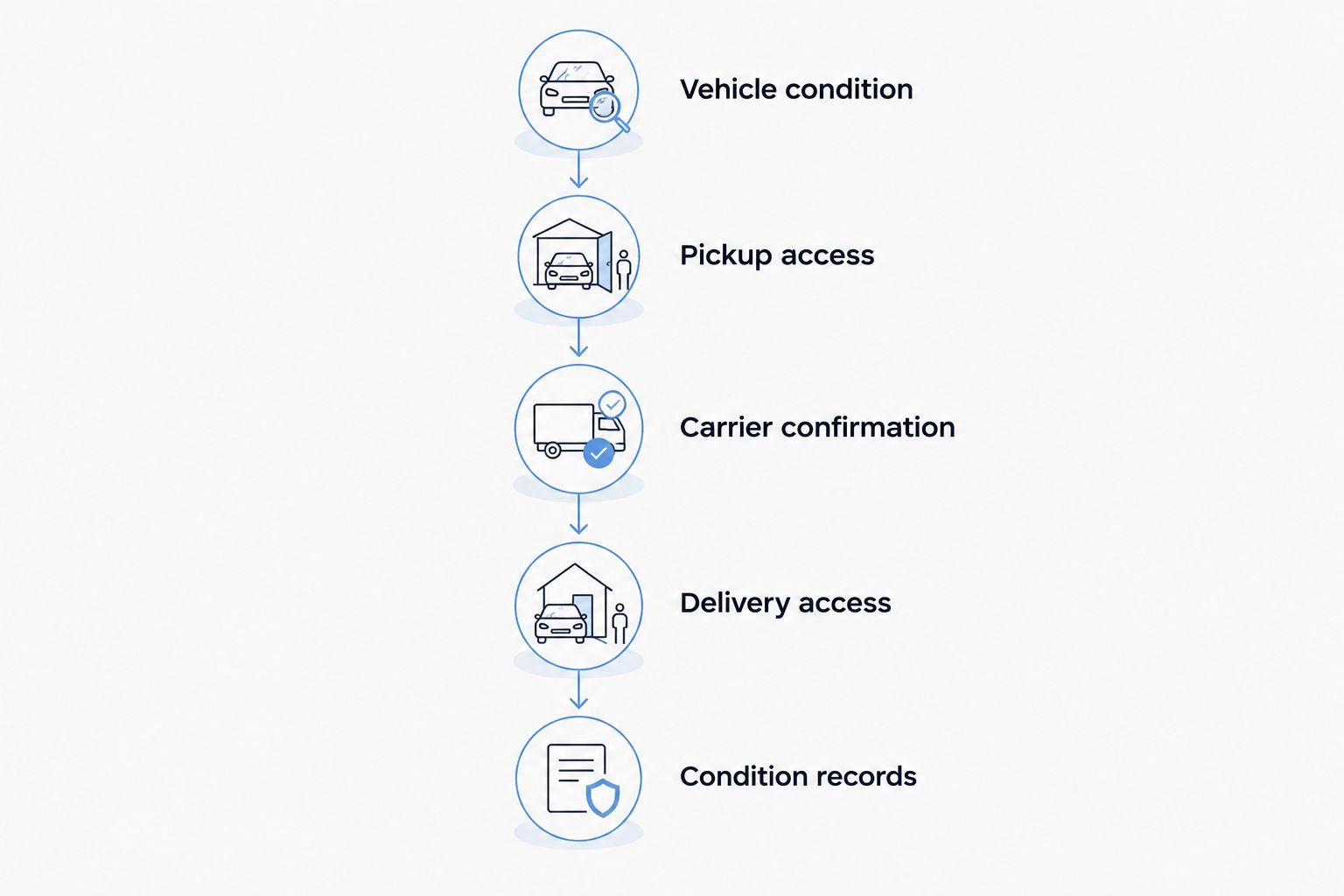
Vehicle condition
Identify the year, make, model, and relevant modifications. Describe 3 operating functions explicitly: rolling, steering, and braking. Then state whether the engine starts, keys are available, and the transmission can be placed in neutral.
Account for all 4 wheels. Identify flat tires, missing wheels, locked brakes, damaged suspension, fluid leaks, loose bodywork, and anything that affects loading. Send photos that show the condition and access to the vehicle rather than relying solely on listing images.
Pickup access
Provide the exact pickup location, release contact, operating hours, and release requirements. Confirm whether the facility permits outside recovery assistance and whether a transport truck can reach the vehicle.
For auction purchases, verify release readiness before scheduling pickup. Payment or paperwork completion does not by itself explain whether loading assistance is available.
Carrier confirmation
Ask the provider to identify the proposed loading method and confirm that it matches the disclosed condition. Check how the carrier will secure the vehicle and whether any preparation must happen before arrival.
Do not describe an estimated pickup window as a guaranteed appointment. For a 2026 expedited request, confirm both carrier availability and loading readiness before building downstream plans around it.
Delivery access
Name the receiving contact and describe the unloading location. Confirm how a non-running vehicle will leave the trailer and where it can safely remain afterward.
A dealership receiving area that works for running inventory is not automatically suitable for an immobilized vehicle. The unloading requirement belongs in the original request, not in a last-minute delivery call.
Condition records
Create 2 inspection records: one at pickup and one at delivery. Record visible condition, compare the vehicle against the pickup documentation, and note discrepancies on the delivery paperwork.
Confirm applicable cargo coverage separately. Ask about vehicle eligibility, limits, exclusions, deductibles, and the claims process before transport begins.
What changes the transport estimate
An inoperable shipment estimate depends on the route, vehicle, transport type, timing request, access, and required handling. Describe each factor accurately so the provider can assess the actual move.
If the vehicle's condition changes after the estimate, report the change before dispatch. A vehicle that previously rolled but now has locked wheels is a different loading job. Ask for the revised scope and confirm which party supplies any additional assistance.
For recurring dealership work, standardize the condition fields in each request. That gives your inventory team a repeatable handoff process without assuming every auction purchase needs the same equipment.
Discuss recurring vehicle moves
Share your routes, vehicle conditions, pickup access, and delivery requirements.
How these options are ranked
This guide ranks options by buyer task: dealership coordination, rolling non-runners, collector exposure requirements, and immobilized-vehicle recovery. The criteria are condition acceptance, loading capability, site access, transport fit, documentation, and coverage verification.
The order is not a performance score. Choose the provider whose confirmed equipment and responsibilities match your shipment. A recognizable name without that confirmation is not a useful booking decision.
Which inoperable transport option should you choose?
For a dealership comparing the best inoperable vehicle transport companies in 2026, start with brokerage coordination when you need pickup, carrier, and delivery arrangements managed together. Confirm inoperable acceptance before proceeding.
Choose winch-equipped open transport for an accepted rolling non-runner. Choose enclosed transport when reduced exposure matters and suitable loading equipment is confirmed. Start with recovery assessment when the vehicle cannot move safely onto the proposed trailer.
Default recommendation: document the vehicle's condition first, then choose the provider. Do not book transport and hope the loading problem resolves at pickup.
FAQ
What’s the best company for inoperable vehicle transport?
The best provider is the one that confirms equipment and handling for your vehicle’s actual condition. CHD is an option for dealership brokerage coordination, subject to inoperable acceptance and carrier confirmation.
Can a car be shipped if it does not start?
A non-starting car can be transported when the carrier accepts its condition and confirms a suitable loading method. State whether it rolls, steers, brakes, has keys, and can be placed in neutral.
Can a transport carrier move a car with locked wheels?
Locked wheels require a condition-specific loading assessment. Confirm suitable equipment or recovery assistance before dispatch rather than assuming a winch alone solves the problem.
Is enclosed transport better for an inoperable car?
Enclosed transport addresses weather exposure, not inoperability by itself. Choose it when covered transport matters and the carrier confirms suitable loading and unloading equipment.
How much does inoperable vehicle transport cost?
The estimate depends on the route, vehicle condition, transport type, timing, access, and required handling. Provide the same condition details to each provider and compare the included responsibilities.
Can an auction load my non-running vehicle?
Auction loading assistance must be confirmed with the specific facility. Verify release requirements, available assistance, and permission for outside recovery equipment before scheduling pickup.
Is cargo insurance enough to protect a damaged vehicle?
A general cargo insurance statement does not establish coverage for a particular damaged vehicle. Verify applicable policy limits, exclusions, deductibles, and vehicle eligibility before booking.
Can I request expedited inoperable vehicle shipping in 2026?
You can request expedited handling, but acceptance depends on carrier availability, vehicle condition, equipment, and site access. Treat timing as an estimate unless the provider expressly confirms otherwise.
One last thing
A vehicle does not become easier to unload because it has reached your dealership. Ask the receiving team how the vehicle will leave the trailer before authorizing pickup. That answer belongs beside the loading plan in every inoperable shipment request.
Related guides
- Best auction car transport companies
- Best open transport car shipping companies
- Best enclosed car transport companies