Corporate relocation managers moving company cars, executive vehicles, or a block of employee vehicles across state lines need a shipping plan that hits a set date, not an open-ended delivery window. The best car shipping companies for corporate relocation in 2026 aren't one single winner — they split by service type, and picking the wrong one for your move costs days you don't have.
- The best car shipping companies for corporate relocation in 2026 split into six service types, not one universal winner.
- Nationwide auto transport coordination covers standard company-car and employee-vehicle moves across most U.S. routes.
- Door-to-door car shipping fits single-executive relocations; fleet vehicle transport fits multi-car dealership group moves.
- Expedited auto transport shortens pickup windows for relocations with a fixed start date, carrier availability permitting.
- Car Haul Direct (CHD) coordinates open, enclosed, and expedited transport with vetted carriers for corporate accounts nationwide.
Why this matters
A corporate relocation rarely moves on the shipper's schedule — it moves on the employee's start date, the lease turn-in, or the dealership's inventory calendar. Nationwide auto transport companies that only run one route well won't help when a relocation program spans a dozen states in a single quarter.
HR teams and relocation coordinators juggle three constraints at once in 2026: a vehicle that has to arrive by a set date, a budget line that has to be documented, and an employee who wants status updates without calling in. The company that gets picked for one relocation often gets the next twenty, so the selection criteria below matter more than one good experience on one move.
CHD arranges open, enclosed, and expedited auto transport for dealerships, fleets, OEM programs, and individual corporate relocations, coordinating with carriers rather than running its own trucks. The six categories below cover what a relocation program actually needs in 2026, not a generic list of auto transport companies.
What makes the best car shipping company for corporate relocation
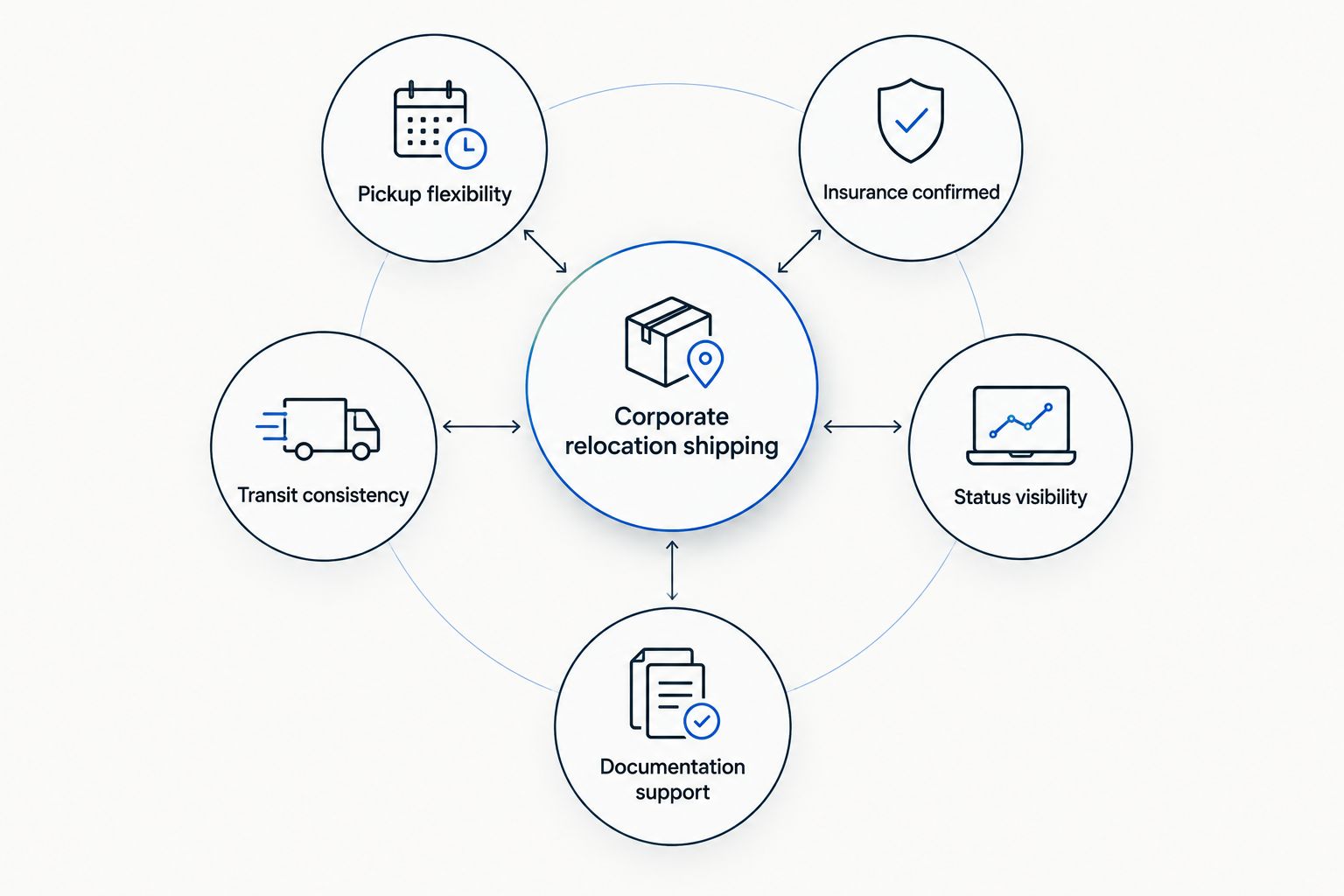
- Pickup flexibility across dealer lots, offices, and employee home addresses
- Confirmed insurance terms before the vehicle loads, not after
- Consistent transit times on the specific corporate relocation route
- Status visibility for coordinators tracking more than one vehicle at once
- Open and enclosed options matched to vehicle type and value
- Documentation support — bill of lading and delivery receipts for expense reports
Best car shipping companies for corporate relocation at a glance
| Service type | Best for | Standout feature | Key limitation |
|---|---|---|---|
| Nationwide auto transport coordination | Standard corporate relocation | Covers most U.S. routes and vehicle types | Transit windows shift with route and season |
| Door-to-door car shipping | Executive and single-employee relocations | Pickup and delivery at home or office | Large trucks sometimes need a nearby meet-up point |
| Expedited auto transport | Compressed relocation timelines | Priority carrier assignment | Availability depends on route and open carrier slots |
| Fleet vehicle transport | Multi-vehicle and dealership-group relocations | Coordinated multi-car pickup in one run | Needs lead time to stage vehicles at one location |
| Enclosed car transport | Executive and luxury company vehicles | Fully enclosed trailer, no open-road exposure | Fewer enclosed carriers than open ones |
| Insured auto transport | Risk-averse HR and relocation teams | Coverage confirmed before pickup | Policy limits and exclusions vary by carrier |
1. Nationwide auto transport coordination: best car shipping option for standard corporate relocation
Nationwide auto transport coordination books a single company car, an employee's personal vehicle, or a handful of vehicles on a standard open-carrier route between almost any two points in the continental U.S. It's the default choice for a relocation program that isn't dealing with a luxury vehicle, a rush date, or a dozen cars at once in 2026. CHD handles this as its core service, matching the vehicle and route to a carrier already running that lane rather than building a custom route from scratch.
Nationwide auto transport coordination pros:
- Works across nearly any origin-destination pair in the continental U.S.
- Handles sedans, SUVs, and light trucks under one booking process
- Scales from a single relocation to dozens of vehicles across a quarter
Nationwide auto transport coordination cons:
- Standard open transport exposes the vehicle to weather and road debris
- Peak relocation months can push pickup windows out by a few days
Best for: relocation programs moving a standard company or employee vehicle on a typical timeline.
Verdict: Buy.
2. Door-to-door car shipping: best option for executive and single-employee relocations
Door-to-door car shipping picks up at the employee's home or office and delivers to the new address, skipping the terminal drop-off some carriers default to. For a single executive relocation, that's one less logistics step on a week that already has a lot of them. Door-to-door car shipping companies coordinate the exact pickup and delivery addresses up front, so the employee isn't driving across town to meet a truck.
Door-to-door car shipping pros:
- Pickup and delivery at the actual home, office, or temporary housing address
- Removes the step of dropping a vehicle at a terminal
- Keeps a single-employee move simple to track from one contact to one driver
Door-to-door car shipping cons:
- Large transport trucks can't always reach narrow residential streets
- An exact hour window isn't guaranteed, even with a confirmed pickup date
Best for: a single executive or individual employee relocating on a set start date.
Verdict: Buy.
3. Expedited auto transport: best option for compressed relocation timelines
Expedited auto transport prioritizes a vehicle for pickup on carriers already running the route, cutting the gap between booking and loading. When an employee's start date moves up two weeks, this is the category to ask about first — but it depends on carrier capacity on that specific lane, not just the request. Expedited auto transport companies confirm availability before committing to a pickup date instead of promising a window they can't guarantee.
Expedited auto transport pros:
- Priority matching to carriers already covering the route
- Shorter gap between booking and pickup than standard scheduling
- Useful when a relocation date moved up unexpectedly
Expedited auto transport cons:
- Real availability depends on carrier capacity on that exact route
- Rural or low-volume routes have fewer expedited options
Best for: relocations with a fixed start date and little lead time.
Verdict: Hold — confirm carrier availability on your specific route before locking the date.
4. Fleet vehicle transport: best option for multi-vehicle and dealership-group relocations
Fleet vehicle transport coordinates pickup of several vehicles from one lot or facility in a single carrier run, which is the difference between twenty separate shipments and one coordinated move. Dealership groups relocating inventory and companies moving a fleet after an office consolidation both fall into this category in 2026. Fleet vehicle transport companies assign one point of contact for the whole group instead of splitting it across individual bookings and individual updates.

Fleet vehicle transport pros:
- Coordinates pickup of multiple vehicles from one location in a single run
- One point of contact tracks the full group instead of separate shipments
- Fits recurring relocation programs, not just one-time moves
Fleet vehicle transport cons:
- Needs more lead time to stage every vehicle for a single carrier
- Works best when vehicles are at one location, not scattered addresses
Best for: dealership groups, fleets, and OEM programs relocating multiple vehicles together.
Verdict: Buy.
5. Enclosed car transport: best option for executive and luxury company vehicles
Enclosed car transport loads the vehicle into a fully covered trailer, which matters for an executive's personal vehicle, a luxury trim level, or a low-clearance car that shouldn't ride exposed on an open rack. Fewer carriers run enclosed trailers than open ones in 2026, so this category needs more booking lead time than a standard relocation move.
Enclosed car transport pros:
- Fully enclosed trailer blocks weather and road debris exposure
- Suited to executive vehicles, luxury trims, and low-clearance cars
- Reduces handling exposure during loading and unloading
Enclosed car transport cons:
- Fewer enclosed carriers operate than open carriers, so lead time matters more
- Usually reserved for individual high-value vehicles, not a full fleet
Best for: a single high-value vehicle tied to a relocating executive.
Verdict: Buy for the right vehicle. Skip it for routine fleet units — standard open transport covers those.
6. Insured auto transport: best option for risk-averse HR and relocation teams
Insured auto transport confirms coverage terms before the vehicle ever loads, with condition documented at pickup and again at delivery. For an HR team that has to account for every company asset on a spreadsheet, that paper trail matters as much as the transit itself, especially across a relocation program running through 2026.
Insured auto transport pros:
- Coverage terms confirmed before pickup, not discovered after a claim
- Condition documented at both pickup and delivery
- Gives relocation coordinators a paper trail for expense reporting
Insured auto transport cons:
- Policy limits, deductibles, and exclusions vary by carrier and vehicle type
- Confirming coverage adds a step before the vehicle can be booked
Best for: relocation programs that need documented condition and coverage on every move.
Verdict: Buy — but confirm the specific policy terms for your vehicle before booking, not after.
Plan your team’s vehicle moves
Coordinate pickup, tracking, and delivery for a corporate relocation.
How we ranked
These six categories came from the constraints a corporate relocation actually puts on a shipment: fixed dates, multiple vehicles, documentation needs, and vehicle value. Each one maps to a different combination of the criteria above — pickup flexibility, confirmed insurance, transit consistency, status visibility, open or enclosed equipment, and paperwork. None of them is universally better than the others; they answer different relocation scenarios, which is why the ranking reads as a decision tree rather than a single leaderboard.
Which car shipping company should you choose for corporate relocation?
For most 2026 relocation programs, nationwide auto transport coordination is the default — it covers the most routes and vehicle types without extra lead time. Move to door-to-door car shipping for a single executive relocation, expedited auto transport when the start date can't move, fleet vehicle transport for a dealership group or fleet consolidation, enclosed car transport for one high-value vehicle, and insured auto transport whenever the HR file needs documented coverage. CHD arranges all six as part of coordinating transport with carriers for corporate, dealer, and fleet accounts across the country.
FAQ
What’s the best car shipping company for corporate relocation in 2026?
There isn’t one universal winner — nationwide auto transport coordination covers most standard relocations, while door-to-door, expedited, fleet, enclosed, and insured transport each fit a specific scenario like a fixed start date or a high-value vehicle.
How long does corporate vehicle relocation shipping take?
Transit time depends on the route and the season, and open-route cross-country moves typically run longer than regional ones. Expedited auto transport shortens the gap between booking and pickup, but it depends on carrier availability on that exact lane.
Is enclosed transport worth it for executive relocations?
Enclosed transport is worth it for a single high-value or low-clearance vehicle because it blocks weather and road debris exposure. It’s usually not necessary for a standard fleet vehicle, where open transport is the more practical option.
Can a company ship multiple employee vehicles in one relocation move?
Yes — fleet vehicle transport coordinates pickup of several vehicles from one lot or facility in a single carrier run. It needs more lead time to stage every vehicle at one location before the carrier arrives.
How much lead time does expedited auto transport need?
Lead time depends on carrier capacity on the specific route, not a fixed number of days. Confirming availability before locking a pickup date is the safer approach than assuming expedited service is always open.
Does auto transport insurance cover company-owned vehicles?
Coverage terms, limits, and exclusions vary by carrier and vehicle type, so confirm the specific policy before the vehicle loads. Insured auto transport builds that confirmation step into the booking process instead of leaving it until a claim.
What’s the difference between open and enclosed transport for corporate moves?
Open transport carries the vehicle exposed on a multi-car rack and covers most standard relocations. Enclosed transport loads the vehicle into a covered trailer, which protects higher-value or low-clearance vehicles but runs on fewer available carriers.
Who coordinates vehicle pickup during a corporate relocation?
A transport broker like CHD coordinates pickup and delivery with carriers on behalf of the company, confirming addresses, timing, and documentation. The broker doesn’t own the trucks — it matches the shipment to a carrier already running the route.
One last thing
If a relocation involves more than three vehicles, staging them at a single lot instead of several home addresses is the change that saves the most time — fleet vehicle transport runs on one coordinated pickup, not a string of separate stops. That decision, made before the vehicles are even booked, often matters more in 2026 than which service type gets picked.
Related guides