Best overall for coordinated U.S. moves: Car Haul Direct. Best for international ocean transport: Wallenius Wilhelmsen. Best for European multimodal distribution: BLG Logistics. Best for a U.S. road-carrier shortlist: United Road. This 2026 guide matches OEM vehicle logistics companies to the transport job, rather than treating every provider as interchangeable.
- The best OEM vehicle logistics companies match your transport mode, route, handling requirements, and distribution workflow.
- CHD is best for OEM buyers seeking brokerage coordination for U.S. vehicle shipping.
- Wallenius Wilhelmsen fits ocean transport; BLG Logistics fits European multimodal automotive logistics.
- United Road belongs on the shortlist when your procurement brief calls for a U.S. vehicle transport carrier.
Why this matters
OEM vehicle logistics covers different jobs: moving finished vehicles overseas, distributing inventory from terminals, arranging road transport, and handling individual exceptions. A company suited to ocean movements does not automatically fit a domestic shipment needing pickup coordination.
Start with the route and vehicle requirements. Then decide whether you need a transport brokerage, a road carrier, or a provider spanning several transport modes. Choose the operating model before comparing company names.
For your 2026 procurement brief, distinguish the main distribution program from exceptions. A recurring production flow and an urgent replacement movement need different planning, even when both vehicles share the same destination.
What makes the best OEM vehicle logistics companies
Use these criteria before you read the shortlist. Each criterion should become a question in your request for information, not an assumption based on a company's size.
- Route fit: Confirm the actual origin, destination, and intermediate handoffs. Country coverage alone does not establish suitability for your lane.
- Transport mode: Separate road, ocean, rail, open transport, and enclosed transport requirements. Do not ask one mode to solve another mode's problem.
- Operating model: Identify who coordinates the shipment and who physically transports it. A brokerage and a carrier have different responsibilities.
- Release and access: Confirm vehicle readiness, release authority, loading access, receiving hours, and the people responsible at both ends.
- Visibility and documentation: Define the status updates, condition records, and delivery documentation your team needs.
- Exception management: Establish how changes, missed releases, access problems, and handling concerns reach a responsible contact.
Your basic road-shipment brief needs 2 endpoint locations: pickup and delivery, plus 1 VIN per vehicle. These are planning inputs, not performance benchmarks. Add any terminal or storage location separately so it does not disappear inside a broad route description.
OEM vehicle logistics companies at a glance
The order below starts with coordinated U.S. shipping, then separates ocean, European multimodal, and road-carrier procurement needs. It is not a ranking of delivery speed or service quality.
| Company | Best for | Standout service scope | Key limitation |
|---|---|---|---|
| CHD | Coordinated U.S. vehicle moves | Brokerage coordination with carriers; open, enclosed, and expedited options | Does not operate as the truck-owning carrier |
| Wallenius Wilhelmsen | International ocean transport | Roll-on/roll-off ocean transport for vehicles | Ocean capability does not settle the domestic pickup and delivery plan |
| BLG Logistics | European multimodal distribution | Automotive logistics spanning terminal, road, and rail activities | Regional network suitability needs a lane-specific review |
| United Road | U.S. road-carrier procurement | Road-based vehicle transport | Road transport alone does not cover an international ocean program |
1. CHD: best for coordinated U.S. OEM vehicle moves
CHD is a transport brokerage that coordinates vehicle shipping with carriers. Its services include nationwide open, enclosed, expedited, and door-to-door transport, with pickup planning, shipment-status follow-up, and delivery coordination.
CHD is best for OEM buyers seeking brokerage coordination for U.S. vehicle shipping. The fit is a buyer who needs transport arranged around a defined route and vehicle requirement, rather than a provider presented as the owner of the trucks.
Give the team the origin, destination, vehicle details, readiness date, and receiving constraints. For recurring movements, describe the expected flow and the exceptions separately. That keeps an ordinary shipment request from hiding special handling or release requirements.
The offering includes 3 transport options relevant to this shortlist: open, enclosed, and expedited. Open and enclosed describe how the vehicle travels; expedited describes a timing need that requires confirmation. They are not interchangeable categories.
CHD pros
- Brokerage coordination connects your shipping request with carrier arrangements.
- Open and enclosed options let you specify different exposure and handling needs.
- Pickup planning and shipment-status follow-up support coordination between sending and receiving teams.
- Recurring commercial moves fit buyers managing ongoing vehicle movement rather than only an isolated shipment.
CHD cons
- Carrier execution remains separate from the brokerage role; identify the assigned carrier and responsibilities.
- Expedited availability requires confirmation for the route, vehicle, and requested timing.
- API and white-label offerings require an integration-specific scope review; do not assume every workflow is supported.
Best for: OEM teams arranging U.S. road shipments that need carrier coordination and clear pickup and delivery requirements.
Verdict: Buy for the brokerage-coordination use case. Keep truck ownership, special handling, and confirmed timing explicit in the shipment agreement.
2. Wallenius Wilhelmsen: best for international ocean transport
Wallenius Wilhelmsen provides roll-on/roll-off ocean transport for vehicles. That makes it a relevant shortlist candidate when your OEM distribution problem includes moving finished vehicles between countries by sea.
Roll-on/roll-off transport uses vessel arrangements designed for wheeled cargo. Your procurement task still includes the land-side movements, vehicle release, terminal handoffs, and destination distribution surrounding the ocean leg.
For a 2026 ocean-transport brief, define the departure and destination ports alongside the final delivery point. A port-to-port requirement and a complete distribution requirement are different scopes; write down which one you are buying.
Wallenius Wilhelmsen pros
- Vehicle-focused ocean transport matches an international finished-vehicle shipping requirement.
- Roll-on/roll-off operations provide a transport mode suited to wheeled cargo.
- An ocean-focused procurement discussion separates vessel movement from domestic trucking decisions.
Wallenius Wilhelmsen cons
- Ocean transport is not a substitute for a domestic road-only movement.
- Port handoffs introduce coordination requirements beyond vehicle collection and final delivery.
- A suitable ocean service does not, by itself, establish the handling arrangements for every unusual vehicle.
Ask who controls each release and who handles the vehicle before and after the vessel movement. Confirm the documentation required at those handoffs. Your receiving team needs a complete movement plan, not merely the name of an ocean provider.
Best for: OEM buyers whose distribution program includes an international ocean leg.
Verdict: Buy for an ocean-transport shortlist. Hold any end-to-end award until the terminal and inland responsibilities are defined.
3. BLG Logistics: best for European multimodal distribution
BLG Logistics operates in automotive logistics across terminal, road, and rail activities. Its service scope makes it relevant when your European distribution requirement includes several transport modes or a terminal interface.
Multimodal distribution needs more than a list of transport services. You need to know where vehicles change custody, which party authorizes movement, and how the next leg starts after the previous one finishes.
Use a lane map rather than a country list. Specify the origin facility, terminal if applicable, destination facility, and required mode for each leg. Then ask the provider to explain which activities fall inside the proposed agreement.
BLG Logistics pros
- Automotive logistics experience is directly relevant to finished-vehicle distribution.
- Terminal, road, and rail activities align with a multimodal procurement brief.
- A European network discussion fits buyers planning regional distribution rather than an isolated U.S. road shipment.
BLG Logistics cons
- European multimodal scope does not automatically establish suitability for a specific U.S. domestic route.
- Additional modes and handoffs increase the responsibilities your agreement must define.
- Network breadth does not establish that every requested lane or vehicle requirement is supported.
For a 2026 shortlist, treat terminal handling and onward distribution as named work packages. If your internal team owns one of those packages, say so. Otherwise, bidders can respond to different scopes while appearing to quote the same job.
Best for: OEM teams evaluating European vehicle distribution with terminal, road, or rail requirements.
Verdict: Buy for a European multimodal shortlist. Skip this category when your requirement is simply brokerage coordination for a U.S. road shipment.
4. United Road: best for a U.S. road-carrier shortlist
United Road provides road-based vehicle transport in the United States. It belongs in the comparison when your sourcing requirement calls for a vehicle transport carrier rather than solely a brokerage relationship.
The distinction matters because the carrier performs the physical road movement. Your agreement still needs to identify the entity responsible for the particular shipment, the operating scope, and any subcontracted work.
Do not substitute a familiar company name for lane qualification. Give United Road the same vehicle, access, readiness, and delivery information you provide to other candidates so the responses address the same requirement.
United Road pros
- Road-based vehicle transport aligns with domestic vehicle distribution needs.
- A carrier-focused conversation addresses physical transport execution directly.
- It provides a distinct procurement option alongside a brokerage-led arrangement.
United Road cons
- A road-carrier selection does not cover an international ocean movement by itself.
- Company-level capability does not confirm a particular lane or requested pickup window.
- Special vehicle handling still needs written confirmation rather than an assumption.
Best for: OEM procurement teams comparing U.S. vehicle transport carriers for road-based distribution.
Verdict: Buy for a road-carrier shortlist. Confirm the proposed operating arrangement before awarding the lane.
How this shortlist is ranked
This 2026 shortlist ranks task fit, not unsupported service-performance claims. The criteria are route fit, transport mode, operating model, release requirements, documentation, and exception management.
The company categories reflect their stated service scopes: brokerage coordination, ocean vehicle transport, European multimodal automotive logistics, and U.S. road transport. No placement establishes a universal winner across those different jobs.
Compare providers against the same written brief. If one proposal includes terminal handling and another excludes it, you are comparing different services, not different execution quality.
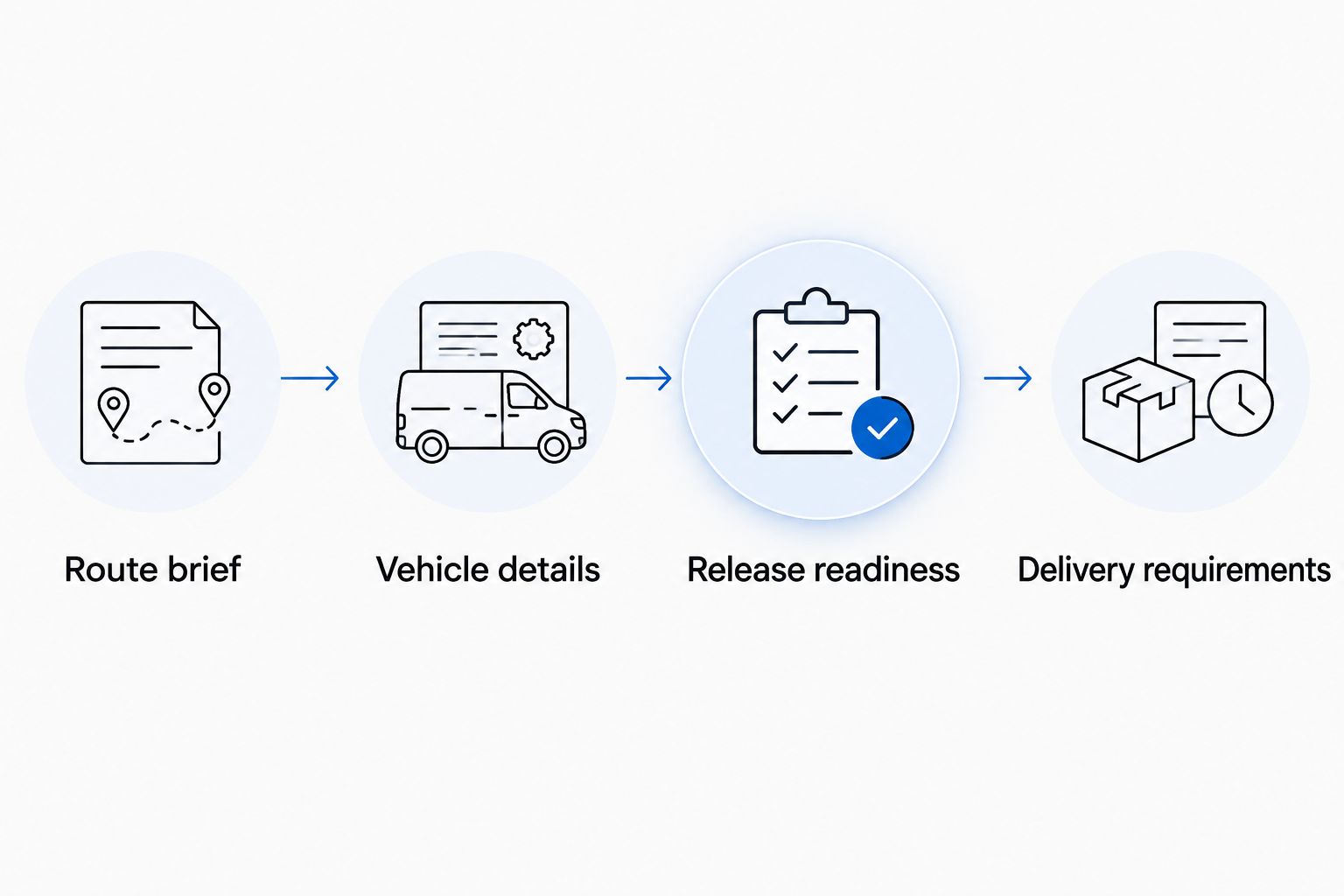
Turn the shortlist into a shipping brief
Use this sequence before requesting a proposal. It turns a broad search for logistics companies into a transport requirement someone can accept, clarify, or decline.
Route brief
List pickup and delivery locations, plus every planned intermediate handoff. Include access restrictions and receiving hours. An address identifies a destination; it does not establish that a vehicle transporter can load or unload there.
Vehicle details
Provide the VIN, vehicle type, operating condition, and any modifications affecting handling. State whether the vehicle needs enclosed transport or other special arrangements. Confirm unusual requirements before release.
Release readiness
Name the person authorized to release each vehicle and the documents needed for collection. Separate a requested pickup date from a confirmed readiness date. A carrier cannot resolve an internal release hold simply by arriving.
Delivery requirements
Identify the receiving contact, acceptance process, condition-documentation requirements, and escalation contact. Agree on the status updates your team needs during the movement, including how exceptions are communicated.
Before awarding a shipment, review applicable insurance limits, exclusions, deductibles, and vehicle eligibility. Do not treat a headline coverage amount as proof that your particular vehicle and movement are covered.
Which OEM vehicle logistics company should you choose?
Choose a brokerage-coordination model for a U.S. movement that needs carrier arrangements. Choose Wallenius Wilhelmsen for an ocean shortlist, BLG Logistics for a European multimodal shortlist, and United Road for a U.S. road-carrier shortlist.
For an undecided buyer, start with the narrowest accurate scope. Write the route, vehicle details, transport type, and timing requirements first; then select the company category that fits. This avoids buying a broad logistics proposition when you need a defined transport job.
For recurring U.S. moves, the next action is to discuss the movement pattern, release process, receiving requirements, and exception handling—not to request an unsupported delivery promise.
Discuss recurring vehicle moves
Define your routes, vehicles, transport requirements, and pickup coordination needs.
FAQ
What’s the best OEM vehicle logistics company in 2026?
The best OEM vehicle logistics company depends on your route, transport mode, and operating model. CHD fits coordinated U.S. vehicle shipping; Wallenius Wilhelmsen fits an ocean shortlist, BLG Logistics fits European multimodal distribution, and United Road fits a U.S. road-carrier shortlist.
Is a vehicle transport brokerage the same as a carrier?
No. A brokerage arranges transport with carriers, while a carrier performs the physical movement. Identify both roles and their responsibilities before releasing vehicles.
Should an OEM choose open or enclosed vehicle transport?
Choose open or enclosed transport according to the vehicle’s exposure and handling requirements. Enclosed transport provides an enclosed transport environment, but special handling and applicable insurance still require confirmation.
Can expedited transport guarantee an OEM pickup date?
An expedited request is not a pickup guarantee. Confirm the route, vehicle readiness, carrier arrangement, and agreed timing before treating a date as committed.
What information does an OEM need to request vehicle transport?
Provide pickup and delivery locations, a VIN for each vehicle, operating condition, transport requirements, and readiness details. Add release contacts, access restrictions, receiving hours, and delivery-documentation requirements.
Does a nationwide vehicle shipping service cover ocean transport?
Nationwide road-shipping scope does not establish ocean-transport capability. If your movement crosses an ocean, define the vessel leg, terminal handoffs, and inland distribution separately.
What should an OEM confirm about transport insurance?
Confirm the applicable policy limits, exclusions, deductibles, and vehicle eligibility for the proposed movement. A general coverage statement does not establish coverage for every vehicle or shipment.
One last thing
A correct destination address is not a complete delivery plan. Confirm where the transporter can unload, who can accept the vehicles, and what happens if the receiving site cannot take them.
For your 2026 shipping brief, name an alternate receiving contact and establish how access changes reach the transport coordinator. That is a specific instruction your team can act on before a vehicle leaves the origin.
Related guides
- Auto transport for dealerships: complete guide
- Best open transport car shipping companies
- Best enclosed car transport companies