1-3
DAYS TO PICKUP, AUSTIN METRO
$250-$1,400
OPEN TRANSPORT, BY DESTINATION
$2M
INSURANCE COVERAGE
Key Takeaways
Typical cost: Open transport from Austin runs $250-$400 to Dallas or Houston, $700-$1,000 to Chicago, $850-$1,050 to Miami, $1,000-$1,400 to Los Angeles, and $1,000-$1,300 to New York City. Enclosed transport adds 40 to 60 percent over open.
Transit time: Expect 1-2 days inside the Texas Triangle, 3-4 days to Chicago, 3-5 days to Miami, and 4-6 days to Los Angeles or New York City. Pickup in the Austin metro usually happens within 1-3 days of booking.
Direction matters: Sustained relocation into Austin means more vehicles arrive than leave, so inbound lanes price above outbound ones. Austin to California runs $1,000-$1,400 open, while California into Austin runs $800-$1,200.
Seasonality: SXSW in March and the Formula 1 weekend at Circuit of the Americas in October tighten carrier capacity around central Austin. Prices move $150-$300 with demand, so book 2-3 weeks ahead for those windows.
Savings tip: Flexible dates get the best rate. Downtown, central Austin, and the streets around the UT campus are too tight for a full-size carrier, so agreeing to meet the driver at a wide lot off the highway saves time and money.
Process: You work with a dedicated coordinator, your vehicle moves on a vetted carrier with up to $2M in cargo coverage, nothing is due until a driver is assigned, and GPS tracking covers the trip.
Popular Routes to and from Austin
I-35 is the spine of Austin car transport. It runs from Dallas through Waco and Austin down to San Antonio and on to Laredo, and carriers work it constantly. That steady volume is why Texas Triangle moves are both the cheapest and the fastest lanes on this page. I-10 and US-290 carry the Houston direction, and long-haul trucks pick up I-10 west toward California or I-35 north toward Chicago. For statewide context, see our Texas car shipping guide.
| Lane | Open Transport | Transit | Miles |
|---|---|---|---|
| Austin to Dallas | $250-$400 | 1-2 days | 195 |
| Austin to Houston | $250-$400 | 1-2 days | 165 |
| Austin to Chicago | $700-$1,000 | 3-4 days | 1,120 |
| Austin to Miami | $850-$1,050 | 3-5 days | 1,350 |
| Austin to Los Angeles | $1,000-$1,400 | 4-6 days | 1,375 |
| Austin to New York City | $1,000-$1,300 | 4-6 days | 1,750 |
Why Shipping a Car Into Austin Costs More Than Shipping One Out
Austin has absorbed years of corporate and individual relocation, and most of it moved one way. Tech employers opened headquarters and satellite offices in the metro, and the people following those jobs brought vehicles with them. Carriers feel that as an imbalance. More cars need to come into Austin than need to leave, so trucks arrive full and often depart with empty slots.
Pricing follows the imbalance. Austin to California runs $1,000-$1,400 open, while the reverse, California into Austin, runs $800-$1,200, because eastbound is the cheaper direction year-round. The same effect shows up in milder form on the Chicago and Northeast lanes. If you are shipping a car out of Austin, you are usually buying the cheaper leg.
Moves inside the state are the exception and stay cheap in both directions. Austin to San Antonio and other Texas Triangle moves run $250-$400 and often deliver the same day they are picked up, because carriers cycle between Houston, Dallas, San Antonio, and Austin continuously.
Pickup and Delivery Logistics in Austin
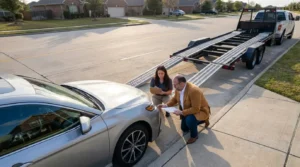
Downtown and central Austin were not laid out for 75-foot car haulers. Narrow residential streets in Clarksville, Hyde Park, and Travis Heights, plus the dense blocks around the UT campus, leave a driver nowhere to stop and no room to load. Meet points at wide lots off the highway are standard practice here, usually a shopping center or park and ride a few minutes from the address. Your coordinator confirms the spot before pickup day.
Suburban Austin is easier. Round Rock, Cedar Park, Pflugerville, Kyle, and Buda have the street width and driveway clearance for true door to door service in most neighborhoods.
Summer heat changes the schedule more than it changes the price. Through July and August, carriers stage early in the day and try to finish loading before the afternoon peak, so expect a morning pickup window during those months.
How SXSW and Formula 1 Affect Austin Car Shipping
Two events reshape carrier capacity in central Austin. SXSW fills the city in March, and the Formula 1 race at Circuit of the Americas does the same in October. During both, downtown access tightens, event traffic clogs the approaches, and carriers either avoid the core or charge for the time it costs them. Expect meet points further out from the center during those weeks.
Prices move $150-$300 with demand across the year, and those two windows sit at the top of the range. Book 2-3 weeks ahead if your dates fall inside them. The same advice applies to the start and end of the UT academic year, when student vehicles move in volume.
Outside those weeks, Austin pricing is steady. Our Texas car shipping guide covers how hurricane season on the Gulf Coast can shift Houston pickups by a day or two, which occasionally ripples into Austin scheduling.
Transport Options, Insurance, and What You Can Pack
Open versus enclosed. Open transport is the right call for most vehicles, and it is what every price on this page describes. Enclosed transport runs 40 to 60 percent over open and makes sense for exotics, classics, and low clearance cars that need a liftgate and full weather protection.
Vehicles that do not run. A non-running vehicle needs winch loading and a carrier equipped for it, which typically adds $100-$200. Tell your coordinator up front whether the car rolls, brakes, and steers, because it determines which trucks can take the load.
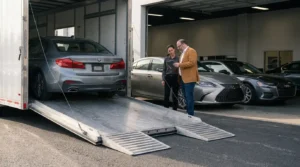
Insurance. Every carrier in the network carries active cargo insurance verified before dispatch, with coverage up to $2M. Your vehicle is inspected and documented at pickup and again at delivery, so any transit issue is straightforward to claim.
Personal items. You can leave up to 100 lbs in the car, in the trunk or below the window line. Carrier insurance covers the vehicle and not the contents, so keep valuables and documents with you.