How Much Does It Cost to Ship a Car in 2026?
Most open-carrier shipments price between $900 and $1,900 in 2026, with enclosed transport typically 40 to 60 percent higher.
By Dean Xeros, EVP of Business Development, Car Haul Direct · USDOT 4321158 · MC 1685969 · Blue Ash, OH
Shipping a car in 2026 costs $900 to $1,900 on an open carrier for most routes, with short regional hauls at the low end and coast-to-coast moves at the high end. Enclosed transport typically costs 40 to 60 percent more than open. Your final price comes down to six things: distance, vehicle size, transport type, season, pickup and delivery accessibility, and fuel surcharges.
Average Cost to Ship a Car in 2026
Prices below reflect 2026 market rates based on current fuel costs, carrier capacity, and seasonal demand patterns. These are realistic ranges, not best-case scenarios designed to get you on the phone.
| Route | Miles | Open transport | Enclosed transport |
|---|---|---|---|
| Miami to New York | 1,280 mi | $900-$1,400 | $1,260-$2,240 |
| Dallas to Los Angeles | 1,440 mi | $1,000-$1,400 | $1,400-$2,240 |
| Chicago to Seattle | 2,060 mi | $1,100-$1,500 | $1,540-$2,400 |
| Coast to coast | 2,800 mi | $1,400-$1,900 | $1,960-$3,040 |
How to read this table. The lower end of each range assumes a standard sedan, terminal-to-terminal service, booked 2 to 3 weeks in advance, during non-peak season. The upper end reflects larger vehicles, door-to-door service, and tighter lead times. Most customers land somewhere in the middle. Enclosed figures apply the standard 40 to 60 percent enclosed premium to the open range on the same lane.
Car Haul Direct provides access to $2M in supplementary cargo insurance on every shipment.
The 6 Factors That Drive Your Quote Up or Down
1. Distance
Distance is the biggest single variable, but the price-per-mile relationship is not linear. Short hauls under 500 miles cost more per mile than long hauls, because carriers cover fixed costs regardless of how far they go. On a 300-mile run you pay $1.17 to $1.83 per mile. On a 2,060-mile Chicago to Seattle run that drops to roughly $0.53 to $0.73 per mile.
2. Vehicle Size and Weight
A standard sedan occupies the same carrier space and falls within standard weight parameters. Full-size pickup trucks, lifted 4x4s, oversized SUVs, and extended-wheelbase vehicles add $75 to $200. Carriers have limited deck space, so larger vehicles displace smaller ones and increase your pro-rated share of trip economics.
3. Transport Type, Open or Enclosed
Enclosed transport typically costs 40 to 60 percent more than open. For most vehicles in good condition, open transport is the right call. Enclosed makes sense for exotics, high-end classics, low-production vehicles, or any vehicle where a paint chip or road debris strike would be a significant financial problem.
4. Seasonality
Car shipping prices follow predictable seasonal patterns. January through March, and late September through November, tend to offer the best pricing. Summer from June through August spikes because of residential moves and snowbird patterns. December spikes around the holidays, then drops sharply in early January.
5. Location Accessibility
Carriers run established lanes. Shipping from a major metro hub such as Miami, Dallas, Chicago, Los Angeles, or New York gives you competition and carrier availability. Rural addresses, narrow roads, or low-clearance bridges may require a surcharge for a relay vehicle, or meeting the carrier at an accessible point.
6. Fuel Surcharges
Fuel surcharges are real and they fluctuate. In 2026, diesel prices continue to affect carrier operating costs. Most reputable brokers build a fuel surcharge into the base rate rather than adding it as a surprise line item. At Car Haul Direct we include it. When a quote seems unusually low, check whether fuel is included.
Open Transport vs Enclosed: What Is the Price Difference?
Open transport puts your vehicle on a multi-level, open-air carrier, the same type of truck you see on the highway hauling new inventory to dealerships. These carriers hold 7 to 10 vehicles and operate constantly. That volume and frequency keeps costs manageable. Enclosed transport uses a covered trailer with walls and a roof. The carrier holds fewer vehicles, typically 2 to 6, runs fewer total loads, and commands a premium because of it.
One point worth making directly: the overwhelming majority of vehicles shipped on open carriers arrive without any damage whatsoever. Car Haul Direct coordinates both transport types through vetted, licensed carriers, and every load moves with $2M cargo insurance.
| Option | Best for | Typical cost | Protection |
|---|---|---|---|
| Open transport | Most standard vehicles | Baseline, the most affordable option | Standard |
| Enclosed transport | Luxury, classic, and exotic cars | Typically 40-60 percent more than open | Maximum |
When open transport is the right choice
- Standard sedans, trucks, and SUVs
- Vehicles in daily driver condition
- Customers who want competitive pricing without an unnecessary premium
- The same method automakers use to move new inventory to dealerships
When enclosed is worth the premium
- Vehicles valued over $80,000
- Classic or collector cars where any cosmetic damage is unacceptable
- Lowered vehicles with minimal ground clearance
- Vehicles being transported to or from auto shows
When Costs Spike: Peak Seasons and How to Avoid Them
Q1, January to March
The snowbird surge drives southbound loads from the Midwest and Northeast toward Florida and Arizona in January. The reverse happens in March and April. Florida-corridor routes price 15 to 25 percent higher during this window. If you are not a snowbird, this is a good time to ship in other corridors.
Q2, April to June
Spring moving season begins in April. College students, military PCS moves, and residential relocations all accelerate. Prices begin climbing in May and peak by late June.
Q3, July to August
Peak season across all corridors. Residential moving activity hits maximum volume. Supply of carriers tightens. Expect to pay 20 to 30 percent more than off-peak rates on popular routes.
Q4, September to November
A legitimate buyer’s window. Moving activity drops, carrier capacity frees up, and brokers compete harder for loads. Targeting October or November can save you $150 to $300 on a mid-length haul.
December is unpredictable. Early December prices spike briefly before Christmas, then drop sharply in the final week as carriers slow operations. The first two weeks of January also run low before the snowbird season restarts.
How to avoid the peak premium: book 2 to 3 weeks ahead of your target pickup date. Last-minute bookings, less than a week out, almost always cost more. Give your broker a 3-day pickup window rather than a hard date. That flexibility allows more carrier matching and typically reduces your price.
How to Get an Accurate Quote: What to Have Ready
A quote is only as accurate as the information behind it. Carriers set rates on real operational parameters, so vague information produces a vague price. Here is exactly what to have ready before you call or submit a quote request.
Vehicle specifics
- Year, make, and model. Not just “a truck”: a Ford F-150 Regular Cab and an F-350 Dually are priced differently
- Whether the vehicle is operational. Inoperable vehicles require a winch load and typically cost $100 to $200 more
- Modifications that affect height, length, or ground clearance
- Any aftermarket accessories that sit above the roofline
Pickup, timing, and transport preference
- Full addresses or zip codes for pickup and delivery
- Whether each location has street accessibility for a large carrier
- Your target pickup date and any hard deadline constraints
- Open or enclosed transport preference
- Whether you want top-load placement on an open carrier, which reduces fluid drip exposure
Our quote form collects all of this in under two minutes. No sales calls required before you see a number.
FAQ: Car Shipping Costs in 2026
How much does it cost to ship a car in 2026?
Most open-carrier shipments price between $900 and $1,900. Miami to New York runs $900-$1,400 open, Dallas to Los Angeles $1,000-$1,400, Chicago to Seattle $1,100-$1,500, and coast to coast $1,400-$1,900. Enclosed transport typically costs 40 to 60 percent more than open on the same lane.
Why do quotes from different brokers vary so much?
Some brokers quote low to win the booking, then struggle to find a carrier at that price, which leads to delays or renegotiation. Others build in adequate margin to actually secure a carrier reliably. Compare quotes critically: if one number is 25 percent lower than three others, that is a flag, not a deal.
Does it cost more to ship an SUV or truck than a car?
Yes. A standard sedan is the baseline. Full-size trucks and large SUVs add $75 to $200 to most quotes. Oversize vehicles such as duallies and extended cab long-bed combinations can add $200 to $400 depending on route.
How much more does enclosed transport cost than open?
Enclosed transport typically costs 40 to 60 percent more than open on the same lane. It makes sense for exotics, high-end classics, low-production vehicles, lowered cars with minimal ground clearance, and anything valued over $80,000. For most vehicles in good condition, open transport is the right call.
Is my personal car insurance valid during transport?
No. Your personal auto policy covers you while you are driving, not while a third party is transporting your vehicle. The carrier’s cargo insurance covers your vehicle during transport. Car Haul Direct carries $2M in supplemental cargo coverage. Verify coverage specifics with any carrier you book.
Can I put belongings in my car during transport?
Technically possible, but not recommended and often prohibited by carriers. Cargo inside the vehicle adds weight, can shift during transport, and is not covered by cargo insurance. If a carrier discovers undisclosed items, they can refuse the load or charge additional fees.
How long does car shipping take?
Allow 1 to 2 days of transit per 500 miles, plus 1 to 3 days for carrier pickup coordination. Miami to New York at 1,280 miles typically runs 3 to 5 transit days after pickup. Dallas to Los Angeles at 1,440 miles runs 4 to 5 days. Chicago to Seattle at 2,060 miles runs 5 to 8 days.
What happens if my car is damaged in transit?
Before your car loads, the driver conducts a Bill of Lading inspection and documents any pre-existing condition. At delivery you do the same inspection and note any new damage before signing. Do not sign a clean delivery receipt if you see damage. That signature matters.
Do I need to be present at pickup and delivery?
Someone needs to be present, either you or an authorized representative, to sign the Bill of Lading and hand over the keys at pickup, and to inspect the vehicle and sign at delivery. If you cannot be there personally, designate someone you trust with authority to inspect and sign on your behalf.
About the author. Dean Xeros is EVP of Business Development at Car Haul Direct. He oversees carrier relationships, pricing strategy, and logistics operations across the company’s national network, and has overseen more than 50,000 vehicle transports. USDOT 4321158 · MC 1685969 · Blue Ash, OH.
Ready to Get a Real Number?
Car Haul Direct is an FMCSA licensed broker, USDOT 4321158, and every load moves with $2M cargo insurance. We do not play the lowball-and-renegotiate game. The quote you get from us reflects what we will actually charge.
Related Guides
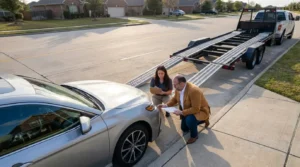
Vehicle Inspection at Pickup and Delivery in 2026: How to Document Condition and Avoid Disputes
Learn vehicle inspection at pickup and delivery best practices, bill of lading vehicle inspection steps, and how to document condition to avoid disputes.

Car Shipping Preparation Checklist: 15 Steps to Get Your Vehicle Ready for Transport
Use this car shipping preparation checklist with 15 steps to prepare car for shipping, avoid delays, and complete your vehicle shipping checklist.
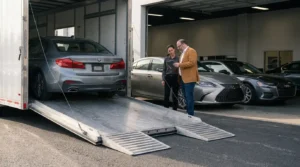
Lease Return Vehicle Transport: A Step-by-Step Guide for Dealers, Fleets, and Lessors
Learn lease return vehicle transport step by step, from inspection and pickup to remarketing transport and dealer vehicle transport.