Car Shipping Timeline
Car Shipping Timeline: What to Expect from Booking to Delivery
By Dean Xeros, EVP of Business Development, Car Haul Direct (USDOT 4321158 | MC 1685969)
Cargo insurance on every load
Customer satisfaction
Booking to Delivery at a Glance
Day 1
Getting a Quote and Booking
Days 1-7
Carrier Dispatch and Pickup Scheduling
Pickup Day
What to Do and What to Expect
In Transit
How Long Does It Take?
Delivery Day
What to Do When the Car Arrives
After Delivery
What to Do If There's a Problem
Day 1: Getting a Quote and Booking
The first thing you’ll do is get a quote. At Car Haul Direct, that takes about two minutes at carhauldirect.com/get-a-quote/. You’ll enter your pickup location, delivery location, vehicle type, and your preferred shipping window.
Your quote reflects real market rates. Pricing in auto transport is driven by fuel costs, route demand, and carrier availability. A route from Dallas to Atlanta prices differently than one from rural Montana to Miami. We give you a rate we can actually honor, not a lowball number designed to get you on the hook.
What happens immediately after you book:
Once you confirm your order and pay the deposit, you’ll receive a booking confirmation by email. That email includes your order number, the route details, your estimated pickup window, and a direct contact number for our dispatch team. Save it.
Your order enters our carrier network immediately. We begin actively matching your vehicle to a licensed, insured carrier whose route aligns with your pickup and delivery locations. This is not an automated algorithm that spits out the cheapest option. It’s a real matching process that prioritizes timing, carrier reliability, and route fit.
You’ll also receive a pre-pickup checklist by email. Read it. The five minutes you spend reviewing it will save you headaches on pickup day.
Days 1-7: Carrier Dispatch and Pickup Scheduling
This is the part that surprises people most. You’ve booked your shipment, so why isn’t someone calling to schedule pickup tomorrow?
Here’s why: auto transport operates on a carrier marketplace. Your vehicle will be moved by a licensed motor carrier, a trucking company that runs a specific route or region. Car Haul Direct brokers the match between your shipment and the right carrier. That carrier has to have space on their truck, be running your route during your window, and be available at a price that works for both sides.
On most standard routes, carrier assignment happens within one to three business days. On less common routes or during peak seasons (spring and summer are the busiest), it can take up to five to seven days. This is normal. It does not mean something went wrong.
Once a carrier accepts your load, you’ll get a call or text from our dispatch team with the carrier’s name, DOT number, and a pickup window, typically a two-to-four-hour range on your scheduled day. The driver will also call you directly, usually the evening before pickup, to confirm timing.
A few things to know during this window:
- You don’t need to be available around the clock. Our team handles the carrier coordination.
- If your timeline shifts, call us. We can adjust.
- 24/7 support is available at 888-884-5430. Use it if you have questions.
- If you need a vehicle picked up on a specific date with no flexibility, discuss that at booking. Expedited options exist.
Pickup Day: What to Do and What to Expect
Document your vehicle’s condition before the driver touches it.
Walk around the car. Take photos and short videos of every panel, the roof, the windshield, all four corners, the interior, and the undercarriage if you can access it. Time-stamp everything. This takes ten minutes and it’s the single most important thing you can do to protect yourself.
The Bill of Lading is your contract.
The driver will present a Bill of Lading (BOL), a condition report that lists any pre-existing damage to your vehicle. Review it carefully. If there’s a scratch on the rear bumper, it should be noted. If the driver’s description doesn’t match what you see, correct it before you sign. Do not sign a BOL that says “condition unknown” or leaves the damage section blank. Once you sign, that document becomes the baseline against which any delivery-day damage is measured.
Remove all personal items from the vehicle.
Auto transport carriers are not licensed to haul personal property. They move vehicles, not cargo. More importantly, your car’s weight affects how it loads onto the trailer. A trunk full of boxes adds weight and shifts distribution. Personal items are not covered by cargo insurance if they’re damaged or lost. Leave a quarter tank of gas. The driver needs fuel to load and unload the car, but a full tank adds unnecessary weight.
At pickup, you’ll hand over your keys.
The driver will load the vehicle, secure it, and provide you with a copy of the signed BOL. Keep it. You’ll need it at delivery.
In Transit: How Long Does It Take?
Transit time depends on distance and the carrier’s route. Below is a straightforward breakdown:
| Route Type | Distance | Estimated Transit Time |
|---|---|---|
| Short Haul | Under 500 miles | 1-3 days |
| Medium Haul | 500-1,000 miles | 2-4 days |
| Long Haul | 1,000-1,500 miles | 3-5 days |
| Extended Haul | 1,500-2,500 miles | 4-8 days |
| Coast to Coast | Over 2,500 miles | 7-10 days (8-11 from Northern California) |
These are real-world estimates, not best-case numbers. Carriers run multi-stop routes, and your vehicle is likely sharing a trailer with several others. The driver makes deliveries and pickups along the way, which affects when your car arrives.
Weather, traffic delays, and mandatory rest requirements (federal hours-of-service rules govern commercial drivers) can also affect transit time. If your delivery is time-sensitive, tell us at booking. We’ll give you an honest read on whether your timeline is realistic.
Delivery Day: What to Do When the Car Arrives
Inspect the vehicle before you sign anything.
Walk around the car the same way you did at pickup. Compare what you see to the photos you took. Compare it to the condition listed on your pickup BOL.
Look at:
- All body panels (doors, fenders, hood, trunk lid)
- The roof
- The windshield and all glass
- Bumpers and corners
- The underside if accessible
- The interior for any damage from loading equipment
Do this in daylight if possible. Turn on your phone flashlight for shadows and low-contrast areas.
If you see damage that wasn’t on the pickup BOL, document it and do not sign.
Note every issue on the delivery BOL before signing. Take photos and video with the driver present. Ask the driver to acknowledge the damage in writing on the BOL.
Do not sign a clean BOL if you see damage. Once you sign, disputing a claim becomes significantly harder. This is not a formality. It is the legal record of your vehicle’s condition at delivery.
If the damage is documented properly, your claim is straightforward. If you sign and then try to dispute later, it becomes a much longer process.
Start your vehicle before the driver leaves. Check that it runs, that lights function, and that nothing appears mechanically off from the transport process.
After Delivery: What to Do If There's a Problem
- Your order number
- Your signed pickup and delivery BOLs
- All photos and videos from both pickup and delivery
- A repair estimate from a licensed body shop
A few things to know about claims:
- Claims must be filed promptly. Don’t wait two weeks.
- The carrier’s insurer, not Car Haul Direct, processes the claim. We facilitate.
- Minor damage (small chips, hairline scratches) may fall under deductible thresholds depending on the carrier’s policy. Get a repair estimate first so you know where you stand.
- If you did not document damage at delivery, your claim will be harder to pursue. This is why inspection at delivery matters.
Our team is available 24/7 and will walk you through every step.
FAQ: Auto Transport Insurance Questions Answered
How far in advance should I book my shipment?
What if my pickup window passes and no carrier has been assigned?
Can I ship a non-running vehicle?
Is my vehicle insured during transport?
Can I put personal items in my car?
What's the difference between open and enclosed transport?
Do I have to be present at pickup and delivery?
What if my delivery address changes after I book?
More Car Shipping Guides
Practical guides on cost, insurance, carrier types, and what to expect when you ship a vehicle.
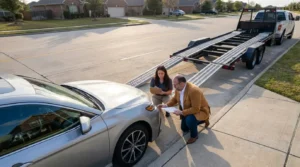
Vehicle Inspection at Pickup and Delivery in 2026: How to Document Condition and Avoid Disputes
Learn vehicle inspection at pickup and delivery best practices, bill of lading vehicle inspection steps, and how to document condition to avoid disputes.

Car Shipping Preparation Checklist: 15 Steps to Get Your Vehicle Ready for Transport
Use this car shipping preparation checklist with 15 steps to prepare car for shipping, avoid delays, and complete your vehicle shipping checklist.
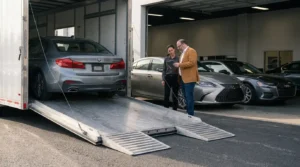
Lease Return Vehicle Transport: A Step-by-Step Guide for Dealers, Fleets, and Lessors
Learn lease return vehicle transport step by step, from inspection and pickup to remarketing transport and dealer vehicle transport.
Ready to Ship?
Car Haul Direct moves vehicles across the country every day, with 85-99% on-time delivery and a support team available around the clock at 888-884-5430.
Get your free quote in two minutes at carhauldirect.com/get-a-quote/
No commitment. No pressure. Just a straightforward rate for a straightforward service.