Nationwide Auto Transport · 24/7 Live Operations

Philadelphia Car Transport: Rates, Routes, and What to Know

Door-to-door vehicle transport with a dedicated coordinator, transparent pricing, and full insurance coverage.

$2M Insurance Coverage

Every shipment is fully insured with cargo coverage verified before pickup.

30+ Enclosed Carriers

A vetted enclosed fleet for classics, exotics, and high-value vehicles.

Real-Time GPS Tracking

Follow your vehicle from pickup to delivery with live location updates.

Transparent Pricing

Firm quotes with no hidden fees and no pressure tactics.

Dedicated Coordinator

One point of contact from booking to delivery, with real-time updates.

48-State Coverage

Vetted carriers on every major corridor in the continental United States.

Reviewed by Mike Fergusson, EVP Operations, Car Haul Direct

1-3

DAYS TO PICKUP, PHILADELPHIA METRO

$300-$1,900

OPEN TRANSPORT, BY DESTINATION

I-95 · I-76 · I-476

CARRIER CORRIDORS SERVING PHILADELPHIA

Key Takeaways

Typical cost: Open transport from Philadelphia runs $300-$450 to New York City, $550-$800 to Charlotte, $650-$950 to Chicago, $900-$1,400 to Florida, $900-$1,250 to Texas, and $1,400-$1,900 to Los Angeles. Enclosed transport typically adds 40-60 percent.

Transit time: Expect 1-2 days along the Northeast corridor, 2-3 days to Chicago, 2-4 days to the Carolinas, 3-5 days to Florida, 4-6 days to Texas, and 7-10 days to the West Coast.

Position: Philadelphia sits directly on I-95 between New York and Baltimore, with I-76 and the Pennsylvania Turnpike running west and I-476 linking the northern and southern suburbs. Carriers pass through constantly, which is why metro pickups usually dispatch within 1-3 days.

Seasonality: Snowbird traffic drives the Florida lanes. Southbound demand peaks October through December and northbound returns peak March through May, and prices move $150-$300 with the flow. Booking against the current usually costs less.

Savings tip: Flexible dates get you the best rate. Center City addresses usually stage from a nearby lot or a wider street in the surrounding neighborhoods, and agreeing to meet the driver there saves both time and money.

Process: You work with a dedicated coordinator, your vehicle moves on a vetted and insured carrier, nothing is due until a driver is assigned, and GPS tracking covers the trip.

Popular Routes to and from Philadelphia

Philadelphia is one of the easiest major cities in the Northeast to ship a car out of. I-95 runs straight through it, north toward New York and south toward Baltimore, Washington, and the Carolinas. I-76 and the Pennsylvania Turnpike carry westbound traffic toward Pittsburgh and the Midwest, and I-476 connects the northern and southern suburbs without routing a truck through Center City. The Port of Philadelphia adds steady vehicle volume through the region, which keeps carrier capacity high on these lanes.

Pickup and Delivery Logistics in Philadelphia

Most of the Philadelphia metro loads at the curb. Driveways in the northern and western suburbs, wide streets across Northeast Philadelphia, and open lots throughout South Jersey and northern Delaware all work for a full-size carrier without any special arrangement. That is the main reason pickup windows here run shorter than in New York City.

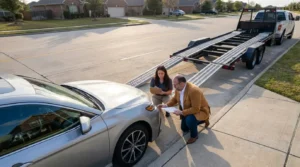
Center City is the exception. A 75-foot carrier cannot stop on most Center City Philadelphia streets, and the same is true of the tighter blocks in South Philadelphia, Fishtown, and University City. Drivers stage from a nearby lot or a wider street a few minutes away, and your coordinator confirms the spot before pickup day.

Philadelphia’s position helps on the delivery side too. Carriers running I-95 pass through constantly, and the metro sits close enough to New Jersey and Delaware that a driver can often serve Cherry Hill, Wilmington, and Trenton addresses on the same run. Metro pickups usually dispatch within 1-3 days. Western Pennsylvania origins like Pittsburgh and Erie connect through the mountains on I-76 and I-79, which usually adds a day and a small premium.

Philadelphia Car Transport FAQs

Open transport from Philadelphia to Florida typically runs $900-$1,400 for a standard running sedan. The 1,185-mile run to Miami takes 3-5 days down I-95, and Orlando is closer at 990 miles in 3-4 days. Enclosed transport typically adds 40-60 percent, roughly $360-$840 on this lane. The instant calculator gives you a live price for your exact vehicle and dates.
The 95-mile run up I-95 is a short haul, and short hauls price near the carrier minimum rather than by the mile. Expect $300-$450 for open transport on a standard running sedan, with most cars loading and delivering inside 1-2 days. Short lanes like this one fill fast when a carrier already has a load headed that way, so flexible dates help more than usual.
Not on most blocks. A 75-foot carrier cannot stop on most Center City Philadelphia streets, and the tighter parts of South Philadelphia, Fishtown, and University City are the same. Drivers stage from a nearby lot or a wider street, usually a few minutes away. Outside Center City, most of the metro loads at the curb or in the driveway.
Metro pickups usually dispatch within 1-3 days of booking. Philadelphia sits directly on I-95 with constant carrier traffic in both directions, so trucks are rarely scarce. Pittsburgh, Erie, and central Pennsylvania connect through the mountains on I-76 and I-79, which usually adds a day and a small premium.
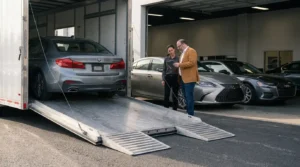
Transit time depends on the destination. Figure 1-2 days along the Northeast corridor, 2-3 days to Chicago, 2-4 days to the Carolinas, 3-5 days to Florida, 4-6 days to Texas, and 7-10 days to the West Coast. That clock starts when the vehicle is loaded, not when you book.
Yes. The port handles significant vehicle volume, and we move cars to and from it for importers, dealers, and private owners. Port pickups need the release paperwork and a contact on file before a driver is dispatched, so send those over as early as you can. The extra carrier capacity the port draws into the region tends to help pricing on ordinary moves too.
Usually a little, and the reason is access rather than distance. Philadelphia addresses are mostly reachable by a full-size carrier, so drivers load in the driveway or on the street instead of staging across a bridge. That saves the driver time, and time is what carriers price. The gap runs about $50 on a Midwest or Texas move, and the Florida lanes come out about even because both cities price off the same I-95 corridor.
Yes, up to about 100 lbs in the trunk or cargo area, below the window line. Carrier insurance covers the vehicle, not the contents, so keep valuables, documents, and electronics with you. Overloading beyond the allowance can trigger fees or a refused pickup at the truck.
Every carrier in our network carries active cargo insurance verified before dispatch, and coverage up to $2M is available. Your vehicle is inspected and documented at pickup and again at delivery, so any transit issue is straightforward to claim. You pay nothing until a driver is assigned to your order.

Nearby Cities We Serve

Related Pages

What Customers Say

Get Your Free Quote

Price your move instantly with our calculator: real shipment factors, not a mileage guess. A dedicated coordinator confirms your firm, all-in quote.

FROM THE BLOG

Car Shipping Guides