2,700-2,900
MILES, DEPENDING ON ENDPOINTS
7-10
DAYS IN TRANSIT, TYPICAL
$1,250-$1,800
OPEN TRANSPORT, BY ENDPOINT
Key Takeaways
Typical cost: $1,400-$1,800 for open transport on a standard sedan. Enclosed typically adds 40-60 percent. Full-size SUVs and pickups price toward the top of the range.
Transit time: 7-10 days door to door, covering 2,700-2,900 miles depending on which California metro you ship from.
Northern New Jersey carries the premium: Newark, Jersey City, and Bergen County sit inside the New York metro and price at the top of the range. Trenton and Cherry Hill run $100-$200 lower.
Street access is the real constraint: Hoboken, Jersey City, and much of Essex and Hudson County cannot take a 75-foot carrier, so deliveries meet at a nearby lot or a wider cross street.
Savings tip: shipping westbound outside January through March is the most reliable discount on this lane. Flexible delivery dates are the second.
Process: A dedicated coordinator assigns a vetted, insured carrier; you pay nothing until a driver is assigned, and GPS tracking covers the whole run.
The I-80 and I-78 Approaches
California to New Jersey is one of the densest destination lanes in the country, and the last hundred miles matter more than the first two thousand. The long haul runs straight across on I-80 through Nevada, Wyoming, Nebraska, and Iowa, then crosses Pennsylvania and enters New Jersey at the Delaware Water Gap. That approach feeds the northern half of the state directly, which is why carriers bound for Newark, Jersey City, Paramus, and the Meadowlands almost always finish this way. It also keeps them out of every New York City crossing, which saves both toll money and hours.
For destinations south of the Raritan, drivers peel onto I-78 through the Lehigh Valley and drop into Union, Middlesex, and Somerset counties, or continue toward I-95 and the New Jersey Turnpike for Trenton and Cherry Hill. The southern half of the state prices a little lower, partly because it is marginally closer and mostly because the delivery streets are wider and a full-size rig can actually reach the address.
Pickup windows in California metros run 1-3 days. Both directions of this lane are worth pricing separately.
Shipping East: California to New Jersey
Eastbound is the heavier and more expensive direction. New Jersey absorbs a large share of the relocation traffic aimed at the New York metro, because people priced out of Manhattan and Brooklyn land in Hudson, Bergen, and Essex counties instead. That demand peaks from May through September, and it overlaps with university terms at Rutgers, Princeton, and Seton Hall. Expect the top of the $1,400-$1,800 range during those months and book 2-3 weeks ahead.
Newark is the single most common delivery point on this lane, and the port is part of the reason. Vehicles arriving at Port Newark for export, or clearing customs inbound, frequently need a domestic carrier for the final leg, and coordinators handle that handoff routinely. If the timing between the vessel and the truck does not line up, the first 3-5 days of storage are free.
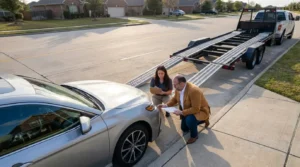
Away from the port, the constraint is street width rather than distance. Hoboken, Jersey City, and much of northern Essex County have narrow blocks, low overpasses, and parking rules that make a 75-foot carrier impossible, so your driver will arrange a nearby shopping center lot or a wider cross street. Your coordinator confirms the meeting spot before pickup day, so nothing gets improvised on arrival.
Shipping West: New Jersey to California
Westbound is the softer direction and usually the better value. Carriers who have run loaded into the Northeast need freight heading back toward the West Coast, and northern New Jersey is one of the easiest places in the country to find it. Rather than deadhead out of the densest freight market in the region, they discount. Off-peak westbound moves on this lane often land at $1,250-$1,500.
January through March is the exception. Relocation traffic out of the Northeast tightens capacity, and westbound pricing catches up with eastbound for those months. Outside that window, 3-5 days of lead time is usually enough to get dispatched.
Winter weather is a schedule risk in both directions rather than a price one. Snow and wind closures on I-80 across Wyoming and through the Poconos add a day or two on some December through March runs. That risk sits inside the 7-10 day estimate, and your coordinator updates you if a carrier reroutes south through I-70.
Popular City Pairs on This Lane
- Los Angeles to Newark - 2,790 miles, 8-10 days
- San Francisco to Newark - 2,900 miles, 8-10 days
- San Diego to Jersey City - 2,780 miles, 8-10 days
- Sacramento to Edison - 2,860 miles, 8-10 days
- Los Angeles to Cherry Hill - 2,730 miles, 7-9 days