1-3 DAYS
TO PICKUP, GREATER BOSTON
$300-$1,900
OPEN TRANSPORT, BY DESTINATION
$2M
INSURANCE COVERAGE
Key Takeaways
Typical cost: Open transport from Boston runs $300-$500 to New York City, $400-$650 to Philadelphia, $750-$1,050 to Chicago, $950-$1,500 to Miami, $1,000-$1,400 to Houston, and $1,400-$1,900 to Los Angeles.
Transit time: Figure 1-2 days on the Northeast Corridor, 3-4 days to Chicago, 4-6 days to Florida or Texas, and 8-11 days to the West Coast. Pickup in Greater Boston is usually 1-3 days from booking.
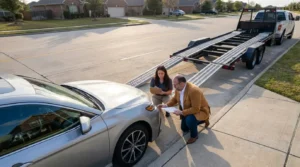
Neighborhood access: A 75-foot carrier cannot navigate Beacon Hill, the North End, or most downtown streets. Drivers set a meet point instead, on a wide street, in a shopping-center lot, or at a park-and-ride off the highway. Meeting the driver there often costs less than a door attempt.
Seasonality: Prices move $150-$300 across the year, and the university move-in wave in late August and early September tightens Boston capacity. Book 2-3 weeks ahead for peak windows.
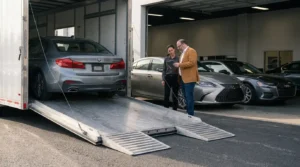
Process: You work with a dedicated coordinator, your vehicle moves on a vetted carrier with cargo insurance up to $2M, nothing is due until a driver is assigned, and GPS tracking covers the trip.
Popular Routes to and from Boston
Carriers stage around Boston on three corridors. I-90, the Massachusetts Turnpike, carries westbound freight toward Albany and the Midwest. I-95 and Route 128 form the beltway where most trucks load and unload without ever entering the city. I-93 runs north and south through the metro and links New Hampshire to the South Shore. That volume is why Greater Boston pickups usually land inside a 1-3 day window for most of the year. For lanes beyond the metro, see our Massachusetts car shipping guide.
| Lane | Open transport | Transit | Miles |
|---|---|---|---|
| Boston to New York City | $300-$500 | 1-2 days | 215 |
| Boston to Philadelphia | $400-$650 | 1-2 days | 305 |
| Boston to Chicago | $750-$1,050 | 3-4 days | 985 |
| Boston to Miami | $950-$1,500 | 4-6 days | 1,495 |
| Boston to Houston | $1,000-$1,400 | 4-6 days | 1,850 |
| Boston to Los Angeles | $1,400-$1,900 | 8-11 days | 3,000 |
Ranges cover a standard running sedan on open transport with flexible dates. Enclosed transport runs 40 to 60 percent over open, which on the Miami lane is about $450-$600 more. A vehicle that does not run typically adds $100-$200 for winch loading.
Pickup and Delivery in Boston Neighborhoods
Boston’s oldest neighborhoods were laid out before trucks existed. A 75-foot car carrier cannot navigate Beacon Hill, the North End, or most downtown streets, and narrow one-ways, resident permit parking, and low clearances rule out door service in the urban core. The standard practice is a meet point. You and the driver agree on a wide street, a shopping-center lot, or a park-and-ride off the highway, usually a short drive from your address. Your coordinator confirms the exact spot before pickup day.
Meeting a driver at a staging point often costs less than a door attempt. Carriers price in the time and risk of working a tight street, so a lot off I-93 or Route 128 keeps the load moving and keeps the quote down. Outside the core the picture changes. Cambridge, Somerville, Quincy, Newton, and the suburbs along Route 128 usually have the street width for direct door-to-door service.
Cape Cod and the islands add about a day. Bridge traffic and ferry scheduling slow the final leg, so carriers often stage vehicles on the mainland and run the last stretch separately.
What Moves the Price in Boston
Distance sets the base and timing sets the rest. Prices swing $150-$300 across the year on the same lane. The sharpest window in Boston is the university move-in wave. Boston and Cambridge absorb tens of thousands of students in late August and early September, inbound vehicles pile onto the same corridors, and carrier capacity tightens. Rates lift for those weeks. If your shipment falls in that window, book 2-3 weeks ahead and expect less flexibility on dates.
Winter is the other factor. Budget an extra day between December and February, since New England storms push pickups and deliveries with little warning. Rates themselves hold fairly steady through the winter, but schedules do not.
Vehicle and carrier type change the number too. Enclosed transport runs 40 to 60 percent over open transport and suits classics, exotics, and low-clearance cars. A vehicle that does not run typically adds $100-$200 for winch loading, and it still needs to roll, steer, and brake. Cargo insurance up to $2M is verified before dispatch. You can leave up to 100 lbs of personal items in the trunk or below the window line, though the coverage applies to the vehicle and not the contents. Statewide lane pricing is set out in our Massachusetts car shipping guide.
Boston Car Transport FAQs
Nearby Cities We Serve
- Cambridge
- Somerville
- Quincy
- Newton
- Brookline
- Worcester