Sakaem Logistics arranges vehicle shipping, giving you a brokerage option for moving a car. For recurring dealer trades, auction purchases, and fleet transfers, the deciding issue is how pickup, shipment updates, and delivery documentation fit your operation—not simply whether a company can quote a route. The best Sakaem Logistics alternative in 2026 is Car Haul Direct if you need broker-coordinated commercial vehicle moves; a direct carrier is the alternative if you want to manage the relationship with the truck operator yourself.
- Compare Sakaem Logistics alternatives around pickup coordination, transport type, shipment updates, and delivery documentation.
- CHD is an auto transport brokerage option for recurring dealership, auction, and fleet moves.
- A direct carrier suits buyers prepared to manage carrier selection and route coordination themselves.
- Confirm expedited availability, pickup access, and applicable insurance terms before approving vehicle shipping.
Why this matters
A dealer trade is not finished when someone accepts a shipping request. The releasing location needs instructions, the receiving location needs a delivery contact, and your team needs to know who handles changes between those points.
The right alternative depends on the work you want to keep in-house. A brokerage coordinates transport with carriers; a direct-carrier arrangement puts you in contact with the operating company. Neither purchasing model removes the need to confirm equipment, access, timing, and documentation.
For your 2026 provider review, start with a representative shipment rather than a broad request for nationwide service. Give each provider the same route, vehicle details, transport type, and timing requirements. Comparable instructions make the responses useful.
Sakaem Logistics alternatives at a glance
This comparison separates a named brokerage alternative from a different purchasing model. The direct-carrier option is not a recommendation of a particular carrier; you still need to qualify the operator for your shipment.
| Option | Best for | Main role | How it differs from Sakaem Logistics | Main limitation |
|---|---|---|---|---|
| Sakaem Logistics | Buyers assessing a vehicle-shipping brokerage | Arranges vehicle transport | Baseline option for your comparison | Confirm the commercial workflow against your actual requirements |
| CHD | Dealerships, auctions, and fleets seeking coordinated vehicle moves | Brokerage coordinating carriers, pickup planning, shipment status, and delivery | An alternative brokerage with recurring commercial moves among its stated services | Does not own the transport trucks; shipment requirements need confirmation |
| Direct carrier | Buyers who want the relationship with the truck operator | Operates the equipment used for the shipment | Changes the purchasing model from brokerage coordination to direct operator engagement | You manage carrier selection and determine route and equipment fit |
Choose by responsibility, not by the length of a service list. Ask who confirms the releasing location, who communicates a pickup change, and who collects the delivery paperwork. An answer that identifies the responsible party is more useful than a general promise of good service.
1. CHD: best for recurring commercial vehicle moves
CHD is a nationwide auto transport brokerage that coordinates carriers for individual shipments and recurring commercial moves. Its stated services include open, enclosed, expedited, and door-to-door transport. For dealerships, auctions, and fleets, the relevant fit is pickup planning, shipment-status coordination, and delivery management.
Best for: Dealer trades, auction purchases, fleet transfers, and remarketing moves where you want a brokerage to coordinate transport.
Where CHD shines
- Commercial shipment scope: Recurring dealer, auction, and fleet moves are part of its stated offering.
- Transport choices: Open and enclosed options let you specify the transport format before carrier coordination begins.
- Coordination support: The team helps customers plan pickup, follow shipment status, and manage delivery.
- Nationwide scope: You can discuss routes across the United States rather than limit the conversation to a single local move.
Where CHD falls short
- It is not a truck-owning carrier. If your procurement requirement is a direct contract with the operating company, the brokerage model is not that arrangement.
- Expedited service needs confirmation. A request for urgent pickup is not a guaranteed truck assignment or delivery deadline.
- Special requirements need review. Restricted access, unusual loading needs, and shipment-specific insurance questions belong in the planning conversation.
CHD versus Sakaem Logistics
| Decision point | CHD | Sakaem Logistics |
|---|---|---|
| Provider model | Transport brokerage coordinating carriers | Vehicle-shipping brokerage |
| Recurring commercial moves | Included in the stated service scope | Confirm arrangements for your dealer or fleet workflow |
| Transport requirements | Open, enclosed, expedited, and door-to-door services are stated | Confirm the requested format for the route and vehicle |
| Operational handoffs | Pickup planning, shipment status, and delivery coordination are stated | Confirm contacts, update process, and delivery-document handling |
This comparison does not establish that Sakaem Logistics lacks a service. It identifies the questions to resolve before you change providers.
For a 2026 commercial account discussion, describe the movement pattern as well as the immediate shipment. A recurring auction-to-lot move needs different instructions from a dealer trade involving changing release contacts. Explain where vehicles originate, where they go, and how your receiving team accepts them.
Verdict: Buy—choose CHD when broker-coordinated recurring vehicle moves match your operating needs, after confirming the shipment requirements.
2. Direct carrier: best for direct operator coordination
A direct carrier is an alternative purchasing model, not another brokerage brand. You select and engage the company operating the transport equipment, then agree on the route, loading requirements, communication, and documentation.
Best for: Commercial buyers who want direct operator contact and have someone responsible for carrier qualification and shipment coordination.
Where a direct carrier shines
- Direct operating relationship: You can discuss equipment and loading requirements with the company handling the move.
- Clear procurement preference: The model fits a purchasing policy that specifically requires engaging the operating carrier.
- Internal control: Your team chooses which carrier to assess and what shipment instructions to agree upon.
Where a direct carrier falls short
- Selection stays with you. You need to qualify the company and confirm that its equipment suits the vehicle.
- Route fit requires checking. One operator's service scope does not establish a solution for every origin and destination.
- Coordination stays with your team. A direct relationship does not remove release checks, access planning, or delivery-document review.
Direct carrier versus Sakaem Logistics
| Decision point | Direct carrier | Sakaem Logistics |
|---|---|---|
| Contracting approach | Engage the operating company | Engage a brokerage arranging transport |
| Carrier selection | Your team selects the operator | Confirm the brokerage's carrier-assignment process |
| Equipment discussion | Confirm with the operating company | Confirm how requirements reach the assigned carrier |
| Route coverage | Depends on the operator you select | Confirm the requested shipment through the brokerage |
Before selecting this model in 2026, decide who on your team owns carrier qualification and changes during transit. Direct engagement is a fit decision, not evidence of better shipment performance.
Verdict: Hold—use a direct carrier only when your team is prepared to manage the operating relationship and confirm route fit.
Why people switch from Sakaem Logistics
A switch needs a specific operational reason. Use the following decision triggers to assess your own requirements; they are not claims about Sakaem Logistics customer experiences or service failures.
Your work has become recurring
A single auction purchase and a recurring inventory-movement account require different planning. For recurring moves, define release contacts, receiving hours, shipment-update responsibilities, and the paperwork your team needs after delivery.
Choose an alternative when its confirmed coordination process fits those requirements better. Do not replace one provider with another while leaving the operating instructions undefined.
You need a different contracting model
If your purchasing policy calls for a direct carrier relationship, comparing more brokerages will not solve that requirement. Evaluate operating carriers instead, with the route and vehicle details in hand.
If you prefer a brokerage, compare how each one handles assignment, contact changes, and delivery coordination. Keep the evaluation focused on responsibilities you can confirm.
The vehicle requires a different transport plan
Open transport carries vehicles on an exposed trailer; enclosed transport places them inside a trailer. The choice changes weather exposure and the equipment you request, but it does not establish insurance coverage or eliminate handling risk.
Use the enclosed car transport guide when the vehicle's handling requirements call for evaluating enclosed options. Confirm loading needs and vehicle eligibility separately rather than treating “enclosed” as a complete specification.
Your timing needs require a fresh assessment
An urgent inventory need changes the scheduling discussion. Provide the release date, receiving window, and the business consequence of delay, then ask what the provider can confirm.
Expedited availability depends on the shipment arrangement. Do not assume that changing providers turns an estimated schedule into a guaranteed deadline.
How to compare quotes without losing the operating details
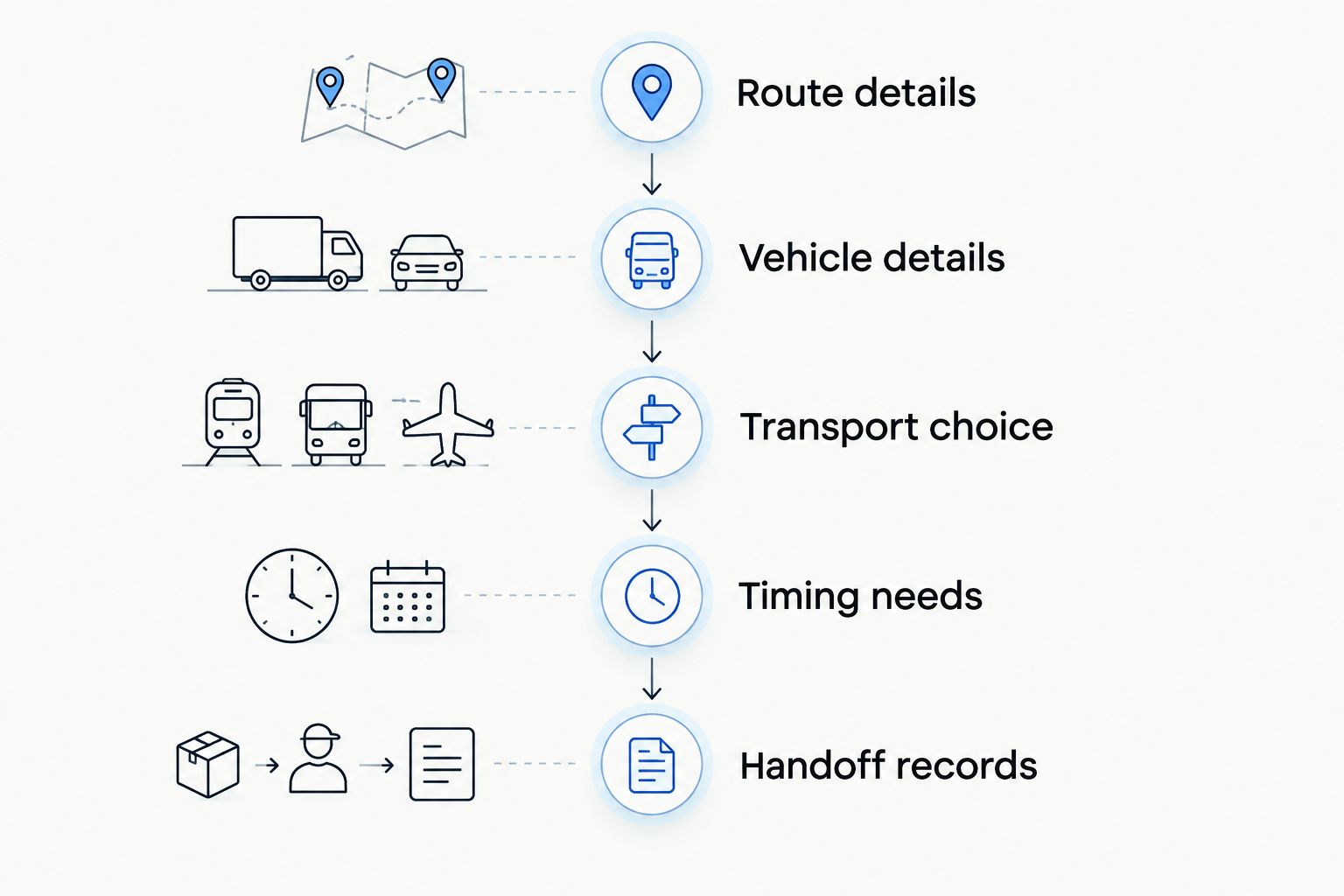
A useful 2026 comparison starts with one shipment brief sent consistently to every provider. That brief should describe the move well enough for the provider to identify questions before you approve it.
Route details
Provide 2 addresses: pickup and delivery. Add the releasing and receiving contacts, site hours, appointment rules, and access restrictions. A dealership address alone does not tell a driver which entrance or staging area to use.
Vehicle details
Provide 1 vehicle identification number per vehicle, plus make, model, operating condition, and any modification affecting loading. Tell the provider if the vehicle does not run, steer, or brake normally. Do not wait until pickup to disclose a loading issue.
Transport choice
Specify open or enclosed transport and explain the reason for the choice. Identify low clearance or other handling requirements separately. The provider needs the actual constraint, not only a general request for careful transport.
Timing needs
Separate the earliest release date from your preferred delivery timing. Identify fixed receiving hours and any appointment requirement. Ask which dates are estimates and what remains subject to carrier confirmation.
Handoff records
Plan 2 condition records: one at pickup and one at delivery. Agree on the inspection process, photographs, signatures, and who retains the documents. Confirm how your receiving team reports a discrepancy without delaying that discussion until the vehicle arrives.
A quote comparison should also identify what happens if the release date, vehicle condition, or location changes. Ask whether the provider needs to reassess the arrangement and who communicates the revised instructions. Changes deserve a new confirmation, not an assumption that the original plan still applies.
For recurring work, use a representative route and describe exceptions your team already encounters. Keep the discussion about confirmed responsibilities rather than promised savings or unverified delivery performance.
Discuss recurring vehicle moves
Bring your routes, vehicle details, transport requirements, and pickup coordination needs.
When staying with Sakaem Logistics is the right call
Stay with Sakaem Logistics when its confirmed shipment arrangement meets your route, equipment, communication, and documentation requirements. A new provider is not automatically a better fit because it appears on an alternatives page.
The advantage of staying is continuity when the current arrangement works. The limitation is that familiarity does not confirm suitability for a new route or different vehicle. Recheck the requirements when the shipment changes, even if you keep the same brokerage.
Hold—not every shipment needs a provider change. Resolve a clearly identified gap before switching; otherwise, keep the arrangement that satisfies your documented needs.
FAQ
What’s the best Sakaem Logistics alternative for dealerships in 2026?
CHD is a Sakaem Logistics alternative for dealerships that need broker-coordinated dealer trades, auction purchases, and recurring vehicle moves. Confirm the route, pickup process, shipment updates, and delivery-document requirements before selecting a provider.
Is CHD a carrier or a brokerage?
CHD is a transport brokerage that coordinates carriers, not a company claiming to own the transport trucks. Its team helps customers plan pickup, follow shipment status, and manage delivery.
Is a direct carrier better than a transport broker?
A direct carrier is the better fit when you specifically want to engage the operating company and manage that relationship yourself. A brokerage fits buyers who want carrier coordination; neither model alone establishes better delivery performance.
Should a dealership choose open or enclosed transport?
Choose open or enclosed transport according to the vehicle’s exposure and handling requirements. Open trailers expose vehicles to the elements, while enclosed trailers place them inside; confirm loading suitability and applicable insurance terms separately.
Can expedited auto transport guarantee my pickup date?
An expedited request does not by itself guarantee a pickup date. Confirm carrier assignment, release readiness, access requirements, and any timing commitment before relying on the schedule.
What should I send when requesting a commercial transport quote?
Send pickup and delivery details, vehicle identification and operating condition, transport type, and timing requirements. Include release contacts, receiving hours, access restrictions, and the delivery paperwork your team needs.
Does enclosed transport automatically include full vehicle coverage?
Enclosed transport does not automatically establish full vehicle coverage. Confirm the applicable policy limits, exclusions, deductibles, and vehicle eligibility for the assigned shipment.
When should I stay with Sakaem Logistics instead of switching?
Stay with Sakaem Logistics when its confirmed arrangement meets your shipment and coordination requirements. Reassess the provider when the route, vehicle, timing, or operating workflow changes, rather than switching without a specific reason.
One last thing
A door-to-door request still needs an access check. Tell the provider about gates, restricted entrances, tight turns, and receiving-hour limits before the pickup plan is set.
Confirm the usable loading location, not just the street address. If the truck cannot safely access the requested site, agree on the alternative handoff location before dispatch.
Related guides
- Auto transport for dealerships: complete guide
- Auction car transport companies
- Fleet vehicle transport companies