Instead of manually chasing an ADESA purchase from buyer paperwork to carrier pickup, use an ADESA auction vehicle transport workflow that connects release confirmation, transport coordination, receiving inspection, and reconditioning. This 2026 guide shows you how to move an auction purchase toward showroom readiness without treating a sale confirmation as permission to collect the vehicle.
- CHD is best for dealerships seeking brokerage coordination for auction vehicle transport, with carriers performing the haul.
- An ADESA auction vehicle transport workflow starts with confirmed release requirements, not just a winning bid.
- Choose open or enclosed transport by vehicle handling needs; confirm expedited feasibility separately.
- Keep auction records, pickup documentation, and delivery evidence together before sending a vehicle into reconditioning.
Why this matters
Car Haul Direct is best for dealerships seeking brokerage coordination for auction vehicle transport. CHD coordinates carriers rather than owning the trucks, so your dealership still needs named owners for auction release, receiving inspection, and reconditioning.
Start with Car Haul Direct for the brokerage’s transport services, then use the controls below to define your dealership’s responsibilities. Transport coordination does not replace auction authorization or your internal retail-readiness checks.
Your 2026 process needs separate answers to two questions: can the vehicle leave the auction, and can your dealership accept it? A carrier assignment answers neither by itself. An incomplete release can block collection, while an unstaffed receiving location leaves the driver without an authorized handoff.
Before you start
- Auction access and release confirmation: Have an authorized buyer contact obtain the purchase record, payment status, release instructions, pickup location, applicable collection deadline, and any required transporter authorization. Confirm current requirements with the specific ADESA location; do not assume every location follows an identical process.
- Vehicle and route details: Gather the VIN, year, make, model, operability, keys status, visible damage, modifications, loading needs, origin contact, destination contact, and receiving hours. Identify whether delivery belongs at your showroom, holding lot, or reconditioning facility.
- The gotcha: purchase confirmation is not release confirmation. Verify that outstanding holds and required documents are resolved before authorizing carrier collection. Also confirm whether the vehicle’s title paperwork follows a separate process; receiving the vehicle does not establish that your retail paperwork is complete.
Use a shared worksheet, your inventory system, or another controlled record. The field names below are suggested internal labels, not ADESA interface labels or a claim that any software connection exists.
Choose the transport configuration
Choose the transport type before requesting a carrier assignment. Tell the coordinator what the vehicle needs, rather than selecting a service name and leaving the loading details for pickup day.
| Option | Best for | Advantage | Limitation to address |
|---|---|---|---|
| Open transport | Dealer inventory without an enclosed-handling requirement | Moves the vehicle on an open carrier | Exposure to weather and road conditions; confirm suitability for the vehicle |
| Enclosed transport | Vehicles whose handling plan calls for an enclosed trailer | Places the vehicle inside a trailer during transport | Confirm equipment, loading clearance, and route fit rather than assuming all enclosed equipment is equivalent |
| Expedited coordination | Purchases with a timing need that requires priority review | Focuses planning on the requested pickup or delivery window | Carrier and route feasibility require confirmation; urgency is not a guaranteed schedule |
Open and enclosed describe transport equipment. Expedited describes a timing request, not a separate kind of trailer. Keep those decisions separate in your transport record.
CHD offers these transport options through carrier coordination. The brokerage model gives your dealership a coordination contact, but it does not remove carrier-specific loading requirements, auction release rules, or the need to confirm shipment terms.
For your 2026 transport checklist, record the reason for your selection. A note such as low clearance or enclosed handling requested gives the coordinator something actionable; a vague instruction to handle carefully does not.
Purchase and release record
- Create the vehicle record. Enter the VIN, auction purchase reference, selling location, dealership stock identifier if assigned, and intended destination. For vehicles using the standardized 17-character VIN, match the complete identifier across your purchase record and transport request; investigate any discrepancy before collection.
- Assign release ownership. Name the dealership employee responsible for confirming payment clearance, resolving auction holds, and providing the required release material. Record the auction contact’s instructions rather than relying on a forwarded message without context.
- Record collection conditions. Add collection hours, appointment requirements if applicable, transporter authorization, keys location, and the auction’s instructions for accessing the vehicle. Record any deadline supplied by the auction without converting it into an assumed carrier commitment.
Expected result: Your transport coordinator has an identifiable vehicle and an explicit release position: confirmed ready, or blocked with a named person responsible for clearing the issue.
Keep the release evidence with the vehicle record. If someone updates the status by phone, document who confirmed it and when. An internal ready label is useful only when the supporting confirmation remains accessible to the person arranging pickup.
Carrier coordination and pickup instructions
- Send the transport brief. Provide the route, selected equipment type, requested timing, vehicle condition, release requirements, and both location contacts. State whether the vehicle starts, rolls, steers, and brakes; do not use running as a substitute for explaining its actual condition.
- Confirm the collection plan. Ask the coordinator to confirm carrier acceptance, the pickup window, loading requirements, auction access instructions, and the contact for exceptions. Treat requested dates as requests until the relevant arrangements are confirmed.
- Agree on evidence requirements. Request pickup condition documentation and transport paperwork identifying the vehicle. Confirm how your dealership will receive shipment updates and delivery documentation; do not assume a live tracking feed or automatic system update exists.
Expected result: The carrier has an executable collection plan, and your dealership knows which events require an update.
Before dispatch, ask the coordinator to confirm applicable carrier insurance documentation and shipment terms. Verify policy limits, exclusions, deductibles, vehicle eligibility, and any special handling provisions relevant to this move. Do not treat the word insured as a complete coverage explanation.
For CHD auction vehicle transport coordination, provide changes through the agreed contact rather than sending conflicting instructions separately to the auction and driver.
Receiving and condition documentation
- Prepare the receiving location. Name the authorized receiver and confirm receiving hours, truck access, unloading arrangements, key handling, and an exception contact. If showroom access is unsuitable, agree on an appropriate delivery location before the driver arrives.
- Inspect at the handoff. Match the VIN, review the vehicle’s visible condition, and compare the delivery findings with available pickup documentation. Photograph relevant areas and record discrepancies on the delivery documentation before signing; do not sign an unqualified clean receipt when visible discrepancies remain unresolved.
- Route exceptions immediately. Send damage concerns, missing keys, or vehicle-identity discrepancies to the transport coordinator with the supporting records. Follow the applicable reporting and claims instructions; do not assume a universal reporting deadline or guaranteed claim outcome.
Expected result: Your dealership has a documented receipt, an accountable vehicle custodian, and a clear exception record where needed.
Keep 3 evidence sets together: auction condition information, carrier pickup documentation, and dealership delivery findings. They describe different moments. An auction report alone does not establish the vehicle’s condition when the carrier collected it.
Retain original files where possible. A compressed screenshot or cropped image can omit the context needed to understand a disputed condition.
Reconditioning and retail release
- Open the reconditioning intake. Transfer the received vehicle to your designated inspection process. Record keys, accessories, warning indicators, visible issues, and the location where the vehicle is parked; keep transport exceptions attached rather than burying them in a separate message thread.
- Separate physical and paperwork readiness. Track mechanical inspection, cosmetic work, detailing, and your dealership’s required documentation as distinct tasks. Assign an owner to each unresolved item instead of marking the entire vehicle ready after unloading.
- Authorize the showroom handoff. Have the responsible dealership employee confirm completion of your retail-readiness requirements before moving the unit into sellable inventory. Update the inventory location and make the receiving and reconditioning records accessible to the sales team.
Expected result: The vehicle reaches your dealership’s showroom-ready status through a documented decision, not an assumption based on delivery.
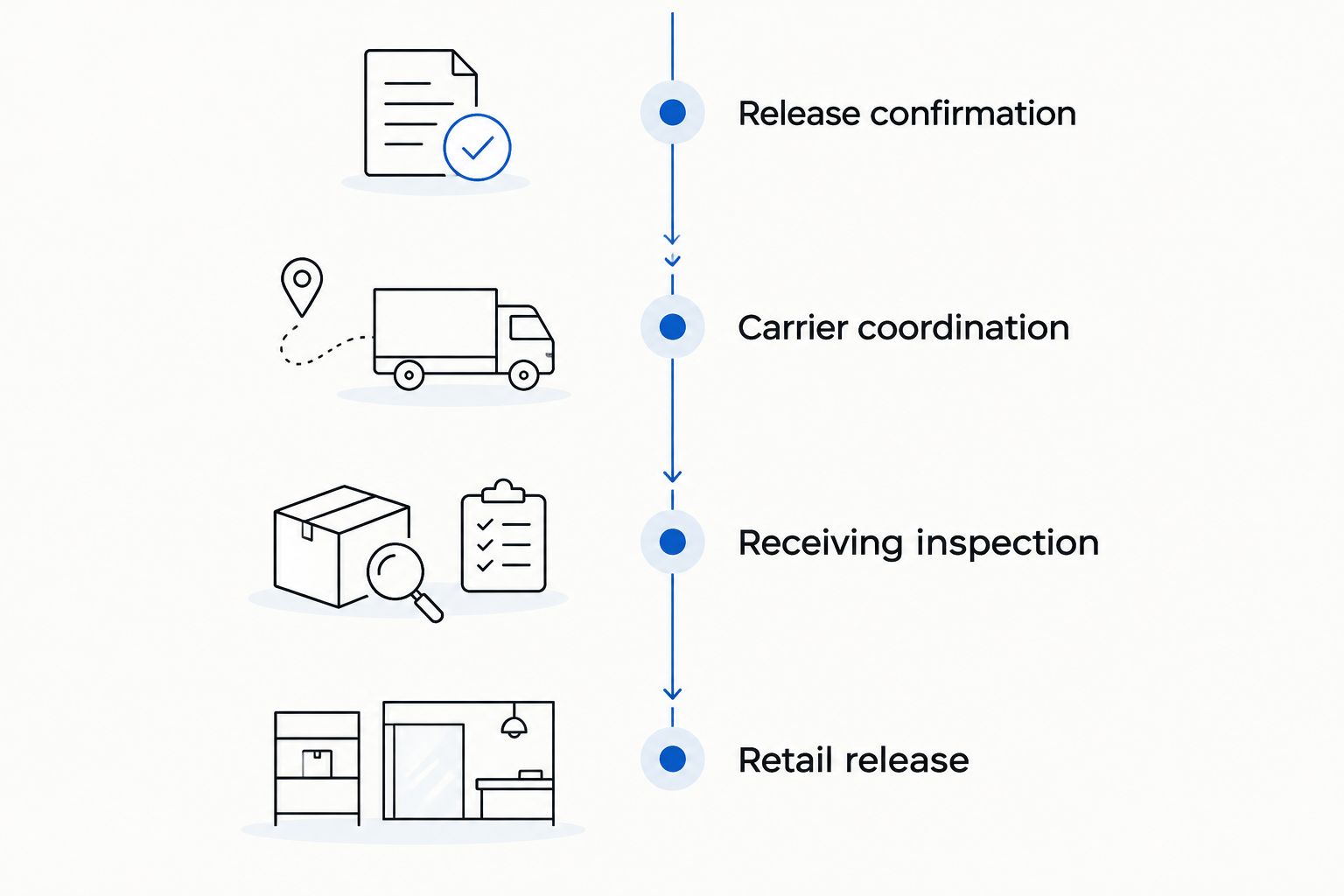
Your 2026 workflow should preserve 2 distinct handoffs: carrier to dealership receiver, then reconditioning to retail inventory. The first establishes receipt; the second establishes your internal readiness decision. Neither substitutes for the other.
The sequence below summarizes those gates. Keep an exception open at the stage where it occurs rather than advancing the vehicle simply because another department has started work.
Repeat the workflow when purchase details change
For recurring auction buying, reuse the same record structure for each vehicle. Best for dealer groups with repeated purchases: a shared intake process makes release status, destination, and exception ownership visible without treating different vehicles as interchangeable.
Use an update-controlled variant whenever the auction changes a release status, your dealership changes the destination, or a condition issue changes the equipment needed:
- Record the changed detail, its source, and the time of confirmation.
- Notify the transport coordinator and identify the affected pickup or delivery instruction.
- Obtain acknowledgment before treating the new plan as accepted.
- Update the receiving team and retain the previous instruction in the record.
The advantage is a consistent change trail. The limitation is that someone must own the record; copying more people into email does not establish responsibility.
For a 2026 platform project, CHD offers API and white-label transport solutions for business partners, with scope and availability confirmed for each integration. Validate supported fields, status events, exception handling, and document exchange before promising automation. This manual workflow does not establish an ADESA integration or universal compatibility with your inventory software.
Troubleshooting
The carrier arrives, but the auction will not release the vehicle
Stop the collection attempt and identify the exact hold or missing authorization with the auction. Have the assigned dealership owner resolve it, then obtain fresh release confirmation before requesting another attempt. Do not ask the driver to negotiate buyer-account issues.
The vehicle cannot load as described
Report the actual condition immediately: no keys, inability to steer, damaged wheels, low clearance, or another obstruction. Ask the coordinator to reassess equipment and loading feasibility. Do not approve an improvised loading method simply to preserve the original schedule.
The receiving site cannot accept the truck
Contact the coordinator before redirecting the driver. Confirm a suitable location, an authorized receiver, and any effect on the shipment arrangements. A nearby address is not automatically a safe unloading location or an accepted destination change.
Delivery findings differ from the auction report
Compare auction, pickup, and delivery evidence rather than assigning responsibility from the auction report alone. Document the discrepancy and follow the applicable notification process. Keep transport-related concerns separate from pre-existing auction condition issues until the evidence supports a conclusion.
The vehicle arrived but remains unavailable for retail
Check the reconditioning queue and paperwork tasks separately. Name the blocking item and its owner. Do not reopen a completed transport task to conceal an unresolved inspection, documentation, or internal inventory problem.
Customize your workflow
Add exception fields that match your purchases: loading restrictions, alternate delivery location, separate title follow-up, or a required enclosed-handling review. Keep routine intake short enough that your buyers actually complete it, then request additional details when the vehicle warrants them.
For recurring moves, define who authorizes changes and how shipment updates reach the receiving team. Agree on that process before increasing volume; a status message has little value if nobody owns the next action.
Discuss recurring vehicle moves
Define auction pickup, receiving contacts, and shipment update requirements for your dealership.
FAQ
What is the best ADESA auction vehicle transport workflow for a dealership?
Use separate gates for auction release confirmation, carrier coordination, receiving inspection, and retail release. Assign an owner to each gate and keep the supporting records with the vehicle.
Can I arrange transport as soon as I win an ADESA auction vehicle?
You can begin transport planning after purchase, but collection requires confirmation that the vehicle is authorized for release. Confirm payment status, holds, required documents, and location-specific collection instructions before dispatch.
Is open or enclosed transport better for an auction purchase?
Open transport fits inventory without an enclosed-handling requirement; enclosed transport fits vehicles whose handling plan calls for an enclosed trailer. Confirm operability, clearance, loading equipment, and route requirements before selecting either option.
Does CHD own the trucks moving auction vehicles?
No. CHD is a transport brokerage that coordinates carriers and helps customers plan pickup, follow shipment status, and manage delivery.
Can expedited transport guarantee my auction pickup date?
An expedited request does not establish a guaranteed pickup date. Confirm route feasibility, carrier acceptance, auction release, and the actual collection window before relying on a schedule.
What documents should my dealership keep after delivery?
Keep the auction purchase and release records, available auction condition information, pickup documentation, delivery paperwork, and relevant photographs. Retain exception correspondence and your internal reconditioning and retail-release records alongside them.
Can this workflow connect automatically to my dealership software?
Automatic connections require confirmation of the specific integration and supported workflow. CHD offers API and white-label transport solutions for business partners, but this guide does not establish compatibility with ADESA or a particular dealership system.
One last thing
Do not make delivered your final inventory status. A signed transport receipt establishes a handoff, not showroom readiness. Give retail release its own owner and completion record so your sales team sees a vehicle that has passed your dealership’s checks, not merely one that reached the lot.
Related guides
- Auto transport for dealerships
- Auto transport for independent dealers
- Auto transport for remarketing companies