Best for broker-coordinated expedited enclosed car transport: Car Haul Direct. Best for direct dispatch discussions: an enclosed carrier serving your route; best for a shipment without a hard deadline: standard enclosed transport. This 2026 guide explains which booking approach fits your dealership move and what to confirm before committing.
- CHD coordinates expedited enclosed car transport with carriers; confirm the route, equipment, and timing before booking.
- Direct enclosed carriers suit buyers who want to discuss dispatch with the business operating the truck.
- Standard enclosed transport suits flexible dates, not a fixed expedited delivery requirement.
- Enclosed shipping describes the trailer; expedited shipping describes the scheduling request. Neither establishes a delivery guarantee.
Why this matters
An enclosed trailer addresses exposure during transport. An expedited request addresses timing. You need both requirements accepted for the same shipment—not an enclosed quote followed by an assumption that pickup will happen sooner.
For a dealership moving a sold vehicle or auction purchase in 2026, start with the origin, destination, vehicle, release status, and required delivery date. Then establish whether the deadline applies to collection, arrival, or both. Those are different commitments.
CHD is a transport brokerage for dealerships that need carrier coordination for expedited enclosed car transport. The carrier operates the truck; the brokerage coordinates the transport arrangement. Keep those responsibilities clear when discussing dispatch, shipment updates, and delivery documentation.
What makes the best expedited enclosed transport option
Choose the booking approach against these criteria before comparing sales language:
- Route fit: The carrier must serve the actual pickup and delivery locations, including access restrictions.
- Vehicle fit: Confirm dimensions, operating condition, clearance, modifications, and loading requirements.
- Timing clarity: Separate the requested pickup window from the requested delivery window and identify what is confirmed.
- Release readiness: Establish who authorizes collection, where the keys are, and when the vehicle can leave.
- Documented responsibility: Identify the broker, carrier, update contact, condition-record process, and applicable insurance terms.
- Exception handling: Ask what happens when release, loading access, traffic, or equipment problems change the plan.
Give the coordinator 2 contact roles: one at pickup and one at delivery. Provide a backup where possible. A correct address does not replace someone who can release the vehicle or accept it when the driver arrives.
Expedited enclosed transport options at a glance
These are booking approaches, not a ranking of independently tested carriers. Standard enclosed transport appears as the alternative when your dates are flexible—not as an expedited service.
| Option | Best for | Standout feature | Key limitation |
|---|---|---|---|
| CHD brokerage coordination | Dealerships needing help arranging the move | Carrier coordination, pickup planning, shipment status, and delivery management | Route-specific timing and handling require confirmation |
| Direct enclosed carrier | Buyers wanting direct dispatch discussions | Communication with the company operating the truck | Its route and equipment must fit your shipment |
| Standard enclosed booking | Protected transport without a hard deadline | Enclosed transport without an expedited scheduling requirement | Does not address an urgent delivery requirement by itself |
1. CHD: best for dealership transport coordination
CHD arranges nationwide vehicle transport through carriers, including enclosed and expedited services. For a dealership shipment, the useful starting point is a complete transport request: route, vehicle details, release instructions, handling needs, and target dates. Confirm the combined enclosed and expedited arrangement for that particular move.
CHD pros:
- Coordinates with carriers rather than leaving you to organize the transport relationship alone.
- Helps plan pickup around the vehicle's release requirements.
- Supports shipment-status follow-up and delivery coordination.
- Serves dealerships and recurring commercial vehicle moves.
CHD cons:
- A brokerage does not operate the assigned truck; identify the carrier and dispatch responsibilities.
- An expedited request still requires route-specific confirmation rather than an assumed deadline.
Best for: Dealership teams that need someone to coordinate a time-sensitive enclosed shipment while they manage the sale, release, or receiving process.
For exotic inventory, provide the handling information before dispatch—not after the truck arrives. The guide to auto transport for exotic car dealerships addresses that buyer's transport context.
Verdict: Buy this coordination approach when you need help arranging the move; confirm the carrier, equipment, and timing before authorizing dispatch.
2. Direct enclosed carrier: best for direct dispatch discussions
A direct enclosed carrier operates the truck transporting the vehicle. This approach puts your scheduling and equipment questions with the operating company, provided you are actually booking with the carrier rather than another intermediary.
Ask who will haul the vehicle and whether that company accepts your exact route, dates, and loading requirements. A direct relationship does not itself establish faster pickup or a firm arrival commitment.
Direct enclosed carrier pros:
- Lets you discuss loading requirements with the operating company.
- Provides a direct route for questions about the assigned equipment.
- Gives an experienced transport buyer control over the carrier relationship.
Direct enclosed carrier cons:
- The company's route and equipment must match your shipment.
- You handle the carrier selection and coordination yourself.
- You still need written clarity on timing, documentation, and exceptions.
Best for: A dealership transport manager who wants to manage dispatch discussions directly and can evaluate the carrier's proposed plan.
Ask whether the proposed equipment will handle your vehicle's clearance and condition. Do not treat the word enclosed as confirmation of a liftgate, a particular ramp arrangement, or special loading capability.
Verdict: Buy the direct-carrier approach when the operating company confirms the route and handling plan; hold if the discussion remains at the quote stage.
3. Standard enclosed booking: best for flexible delivery dates
Standard enclosed booking separates the trailer requirement from the urgency requirement. You still request enclosed transport, but you do not ask the provider to plan around an expedited deadline.
This is the relevant alternative when your dealership wants enclosed shipping but can receive the vehicle within an agreed flexible window. It is not a substitute for an accepted time-sensitive transport plan.
Standard enclosed booking pros:
- Preserves the enclosed-trailer requirement.
- Fits inventory moves that do not depend on a fixed arrival date.
- Lets you discuss scheduling flexibility without presenting every move as urgent.
Standard enclosed booking cons:
- Does not establish expedited pickup or delivery.
- Does not suit a customer handover that depends on an unconfirmed arrival date.
Best for: Dealership inventory transfers where enclosed handling matters more than a specific delivery deadline.
For a 2026 booking, tell the provider which dates are genuinely flexible. A vehicle that must arrive before a scheduled customer collection is not a flexible shipment simply because pickup can happen on several days.
Verdict: Buy standard enclosed transport for flexible dates; skip it when an urgent arrival is a nonnegotiable requirement.
How the options are ranked
The ranking follows the buyer's task: coordinated dealership shipping first, direct management of the operating carrier second, and flexible enclosed transport third. Route fit, vehicle handling, timing clarity, release readiness, and documented responsibility determine the choice.
No booking model wins every shipment. The right option is the one that can confirm your actual requirements without blurring an estimate into a commitment.
How expedited enclosed car transport works
Use this sequence for your 2026 shipment. Keep the same information attached to the request as it moves from quotation to dispatch and delivery.
Define the request
Provide pickup and delivery locations, vehicle identification, make and model, operating condition, and required dates. Explain why the deadline matters: a sold-unit handover, auction release, or transfer to another dealership.
List modifications, low clearance, unusual dimensions, or loading limitations. State whether the vehicle starts, steers, rolls, and brakes; those details affect the loading discussion.
Confirm the plan
Ask for enclosed equipment and expedited scheduling together. Separate the 2 timing windows: pickup and delivery, and ask which parts of the proposed schedule are estimates.
Confirm loading suitability, access, carrier identity, and the communication process. If a dedicated movement is proposed, get its scope in writing rather than assuming expedited means an exclusive truck.
Release the vehicle
Confirm that the vehicle is authorized for collection, keys are accessible, and the releasing party knows the arrangement. For an auction pickup, check the release requirements and collection hours with the facility.
Review the condition record at loading. Retain clear photographs and a copy of the transport documentation so the receiving team can compare the vehicle at delivery.
Track the move
Establish who provides status updates and who should receive them. Tell the coordinator immediately if the receiving location changes its hours or the dealership needs a different delivery contact.
Treat a revised estimate as a reason to update the receiving plan. Do not schedule a customer handover around an arrival time that has not been confirmed.
Document delivery
Have the receiving contact inspect the vehicle and review the delivery record. Record visible discrepancies on the transport documentation and retain supporting photographs.
Follow the applicable reporting process promptly if you identify a problem. Delivery documentation records what happened; it does not replace the terms of the carrier's policy or transport agreement.
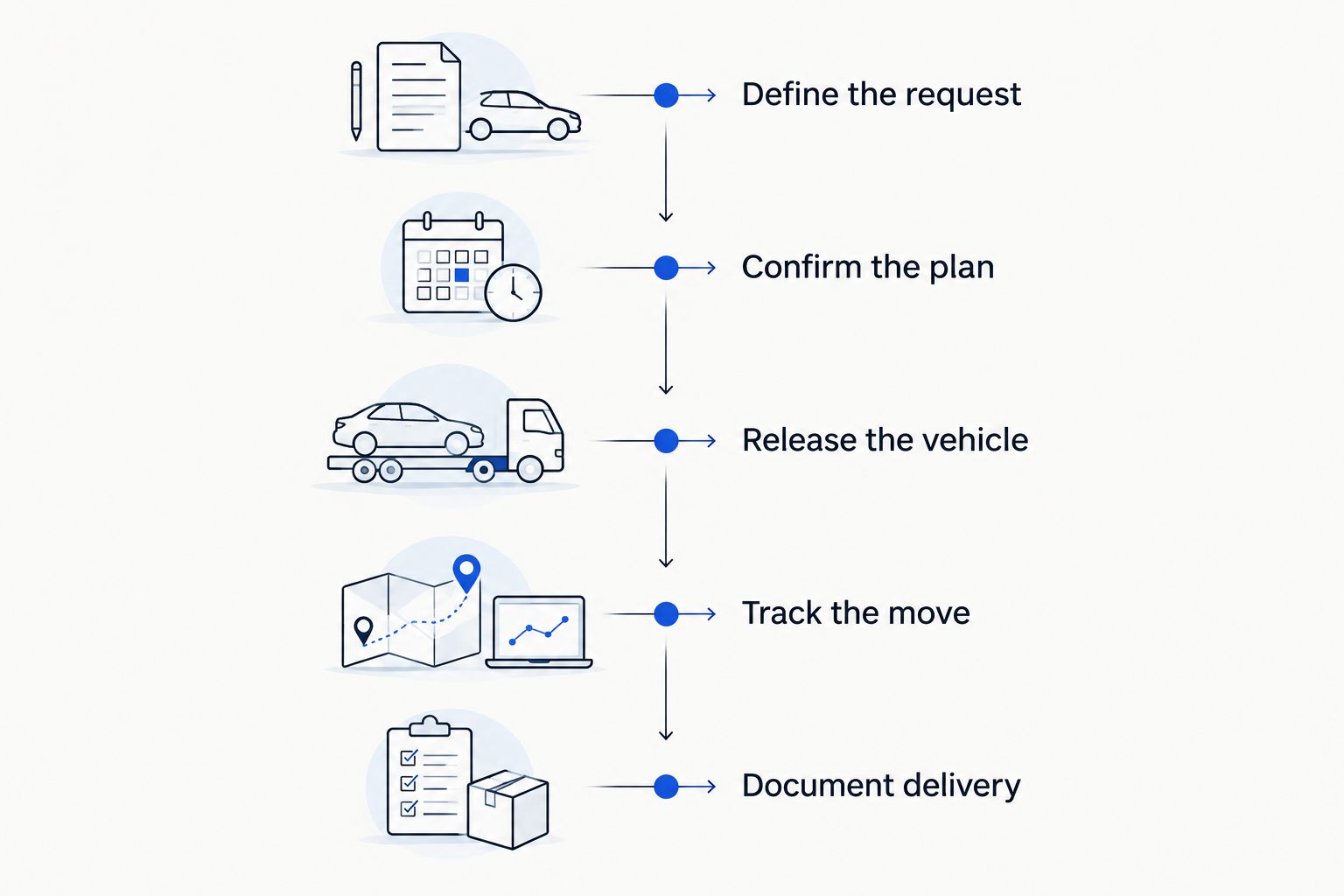
Keep 3 checkpoints in your shipment record: release, loading, and delivery. Each should identify the responsible contact and the documents your team needs. This makes the next action clear when a vehicle changes hands.
What expedited does—and does not—mean
Expedited describes a scheduling request. It does not, by itself, mean nonstop driving, an exclusive trailer, immediate collection, or a guaranteed arrival.
Ask the provider to explain the proposed arrangement in plain language. Will the vehicle travel with other vehicles? Is the urgency attached to pickup, delivery, or both? What happens if the releasing facility cannot hand over the vehicle as planned?
Enclosed transport also has limits. It places the vehicle inside a trailer, but it does not establish a damage-free guarantee or confirm insurance terms. Verify the applicable policy limits, exclusions, deductibles, vehicle eligibility, and claim procedure for the assigned carrier.
What changes the transport quote
For an expedited enclosed transport request in 2026, provide the route, vehicle size and condition, loading requirements, requested dates, and location access. Ask the provider to explain which assumptions the quote uses and which changes require a revised arrangement.
Keep the request consistent when comparing proposals. An enclosed shipment with flexible collection is not the same service as an enclosed shipment with a requested urgent pickup and a specific receiving deadline.
Check the transport agreement for cancellation, failed collection, storage, and changed-instruction terms. Do not assume the original arrangement covers an unreleased vehicle or a destination that cannot receive the truck.
Which booking approach should you choose?
Choose brokerage coordination when your dealership needs help connecting the route, vehicle requirements, carrier, and receiving plan. Choose a direct enclosed carrier when you want to manage that operating relationship yourself. Choose standard enclosed transport only when the deadline is flexible.
Before proceeding, send the route, vehicle details, release status, handling requirements, and requested pickup and delivery windows. For recurring dealership moves, also explain who approves each shipment and who receives delivery documentation.
Discuss recurring vehicle moves
Share your routes, vehicle requirements, release process, and receiving needs.
FAQ
Who arranges expedited enclosed car transport?
Transport brokerages arrange shipments with carriers, and direct enclosed carriers operate the trucks. Confirm that the provider accepts both enclosed equipment and your requested timing for the specific route.
Is expedited enclosed car transport guaranteed to arrive by my deadline?
The word expedited does not establish a delivery guarantee. Ask which timing commitments appear in the transport agreement and which dates remain estimates.
Does expedited shipping mean my vehicle gets its own trailer?
No. Expedited scheduling does not establish exclusive use of a truck or trailer. If you require a dedicated movement, request it explicitly and confirm the arrangement in writing.
What should a dealership provide for an enclosed transport quote?
Provide the route, vehicle details, operating condition, handling requirements, release status, and requested pickup and delivery windows. Include pickup and receiving contacts and any location-access restrictions.
Can an enclosed carrier transport a nonrunning vehicle?
A nonrunning vehicle requires confirmation of suitable loading equipment and handling. Explain whether it starts, steers, rolls, and brakes before accepting the proposed transport plan.
Does enclosed transport include insurance for the vehicle’s full value?
Enclosed transport does not establish a particular coverage amount. Verify the assigned carrier’s applicable limits, exclusions, deductibles, vehicle eligibility, and claim procedure before shipment.
How do I compare expedited enclosed transport quotes in 2026?
Compare proposals using the same route, vehicle condition, equipment requirement, and timing request. Review release assumptions, access restrictions, communication responsibilities, and agreement terms—not just the quoted transport amount.
One last thing
An urgent truck booking cannot fix a vehicle that is not authorized for release. Before asking for a tighter pickup window, confirm the releasing party has the authority, keys, instructions, and access needed to hand over the vehicle.
Make release readiness your first check, not your last phone call. That recommendation applies whether you book through a brokerage or directly with the operating carrier.
Related guides
- Best enclosed car transport companies
- Best expedited auto transport companies
- Auto transport for dealerships: complete guide