Best overall for brokerage coordination: Car Haul Direct. Best for comparing independent providers: uShip. Best for motorcycle-focused moves: HAULBIKES. This 2026 guide to the best powersports ATV transport companies separates ATV shipping from motorcycle transport so you can choose a provider whose equipment and handling requirements match your vehicle.
- Among the best powersports ATV transport companies, CHD fits buyers who want a brokerage coordinating carriers and shipment details.
- uShip fits buyers who want to compare independent transport providers and evaluate each provider separately.
- HAULBIKES fits motorcycle shipping; do not assume motorcycle equipment accepts an ATV or side-by-side.
- Choose by vehicle dimensions, loading requirements, route access, and documented coverage—not a delivery promise alone.
Why this matters
An ATV, a motorcycle, and a side-by-side create different loading problems. Width, ground clearance, tire configuration, and attached accessories affect whether a vehicle fits the equipment offered. A provider that handles motorcycles is not automatically the right choice for an ATV.
For your 2026 shipment, start with the vehicle and route rather than a company ranking. Give the transport provider the pickup and delivery locations, operating condition, transport preference, and timing requirements. Then ask who will perform the move and what equipment will carry it.
CHD is best for powersports buyers who want a brokerage to coordinate carrier arrangements, pickup planning, shipment status, and delivery. CHD coordinates carriers; it does not represent those carriers’ trucks as its own fleet.
What makes the best powersports transport company
Use these criteria before comparing providers. A recognizable name does not replace a workable loading plan.
- Vehicle fit: Confirm acceptance of your specific ATV, motorcycle, or side-by-side. Provide actual dimensions, including accessories.
- Loading method: Explain whether the vehicle starts, rolls, steers, and brakes. Confirm how the carrier will load and unload it.
- Transport format: Compare open and enclosed transport against your exposure concerns and handling needs.
- Route access: Check whether the pickup and delivery sites accommodate the assigned transport equipment.
- Accountability: Identify the broker, marketplace, and carrier roles. Know who handles scheduling, status questions, and delivery issues.
- Coverage evidence: Request the applicable policy details, vehicle eligibility, exclusions, deductibles, and claims procedure before booking.
The best choice is the provider that confirms a workable plan for your vehicle, not the provider that offers the broadest promise. Keep that rule in mind throughout the shortlist.
Powersports transport companies at a glance
This 2026 shortlist assigns each option a different task. It is not a claim that every company accepts every powersports vehicle.
| Company or platform | Best for | Standout feature | Key limitation |
|---|---|---|---|
| CHD | Coordinated ATV and powersports shipments | Brokerage coordination across carrier arrangements, pickup, status, and delivery | Equipment, coverage, and expedited availability require shipment-specific confirmation |
| uShip | Comparing independent transport providers | Marketplace connecting customers with transport providers | You must evaluate the selected provider’s equipment, terms, and suitability |
| HAULBIKES | Motorcycle-focused transport | Dedicated motorcycle shipping focus | Motorcycle specialization does not establish ATV or side-by-side eligibility |
Do not treat these business models as interchangeable. A brokerage coordinates transport with carriers, a marketplace helps you find providers, and a specialist company focuses on a narrower transport task. Your decision determines who you contact when the shipment needs attention.
1. CHD: best powersports transport for coordinated shipments
CHD is a nationwide transport brokerage offering powersports transport alongside open, enclosed, expedited, and door-to-door vehicle shipping. The team coordinates transport with carriers and helps customers plan pickup, follow shipment status, and manage delivery.
For an ATV purchase or relocation, that model fits a buyer who wants help arranging the move rather than independently comparing carrier proposals. Start with the exact vehicle, route, operating condition, and handling requirements. Ask CHD to confirm which transport arrangement fits those details before you approve the shipment.
CHD pros:
- A brokerage contact coordinates carrier arrangements and shipment planning.
- Open and enclosed options let you discuss exposure and equipment requirements.
- Pickup planning, shipment status, and delivery coordination are part of the stated service.
- Expedited transport is an available service category, subject to confirmation for your move.
CHD cons:
- CHD is not the truck operator; the assigned carrier performs the transport.
- The service description does not establish that every ATV configuration fits every carrier’s equipment.
- Coverage and expedited arrangements need confirmation for the actual vehicle and route.
Best for: ATV and powersports buyers who want coordinated transport arrangements and a clear brokerage contact.
For a 2026 booking, distinguish your requested dates from the dates confirmed for the shipment. Also identify the person releasing the vehicle and the person receiving it. A coordinated move still depends on accurate information from both locations.
Verdict: Buy the brokerage model when you want CHD to coordinate the shipment; confirm vehicle acceptance and carrier details first.
2. uShip: best powersports transport option for provider comparison
uShip is a shipping marketplace that connects customers with transport providers. It suits buyers who want to describe a shipment, compare providers, and choose a transport arrangement themselves.
The marketplace format makes provider selection your central task. Evaluate the actual provider, not just the platform name. Ask whether the proposed equipment accepts your ATV, how loading works, and which party will perform the transport.
uShip pros:
- You can compare independent providers around the same shipment requirements.
- A detailed listing lets you describe vehicle dimensions, condition, and access needs.
- The marketplace model fits buyers who want to participate directly in provider selection.
uShip cons:
- The platform name alone does not establish a provider’s equipment or handling practices.
- Different provider proposals require careful comparison of terms and scope.
- You must clarify whether the responding business performs the move or arranges another carrier.
Best for: Buyers comfortable evaluating transport providers and checking shipment details themselves.
Make each proposal comparable. Give every provider the same vehicle information, locations, transport preference, and timing request. Otherwise, a proposal based on an operable ATV at an accessible business location is not comparable with one involving a nonrunning vehicle at a restricted residential site.
Verdict: Buy the marketplace model if you want to compare providers and will verify the selected provider’s suitability.
3. HAULBIKES: best powersports transport for motorcycle-focused moves
HAULBIKES specializes in motorcycle transport. It belongs on a powersports shortlist for motorcycle owners, but motorcycle specialization is not evidence that an ATV or side-by-side will fit its service.
That distinction matters when you search broadly for powersports shipping. A motorcycle-focused provider deserves consideration for a motorcycle move. For an ATV, ask about acceptance before investing time in scheduling or treating the provider as a candidate.
HAULBIKES pros:
- Its motorcycle focus matches a clearly defined powersports shipping task.
- A specialist is relevant when your shipment is a motorcycle rather than a mixed vehicle load.
- The service focus gives motorcycle owners a specific starting point for handling questions.
HAULBIKES cons:
- Motorcycle transport suitability does not establish ATV or side-by-side suitability.
- Do not assume one arrangement accommodates a motorcycle and a wider powersports vehicle together.
- Route, loading requirements, coverage, and timing still need confirmation.
Best for: Motorcycle owners seeking a motorcycle-focused transport provider.
For a 2026 ATV shipment, do not substitute a provider’s category reputation for an acceptance decision. Send the actual vehicle details and ask for a direct answer. If the vehicle falls outside the service scope, return to an ATV-capable carrier or brokerage.
Verdict: Buy for a confirmed motorcycle shipment; skip for an ATV unless the provider explicitly accepts the vehicle.
Open or enclosed: choose around exposure and equipment
Open transport carries the vehicle without an enclosed trailer around it. Enclosed transport places it inside a trailer, reducing direct exposure to weather and road debris. Neither format, by itself, establishes proper loading, securement, or applicable coverage.
For an ATV used off-road, enclosed transport is not automatically necessary. For a collector motorcycle or a vehicle with vulnerable finishes and accessories, reducing exposure deserves closer consideration. In both cases, confirm the equipment and handling plan.
| Transport option | Best for | Practical advantage | Limitation to confirm |
|---|---|---|---|
| Open transport | Buyers comfortable with direct outdoor exposure | An option when enclosed protection is not a requirement | Weather exposure, securement, and loading compatibility |
| Enclosed transport | Buyers prioritizing reduced direct exposure | A trailer surrounds the vehicle during transport | Interior dimensions, door clearance, and loading compatibility |
Ask how attached windscreens, roofs, storage boxes, and other accessories affect acceptance. Do not assume a factory dimension covers a modified vehicle. Your loading plan must account for the vehicle as it will be shipped.
Prepare a shipment brief before requesting proposals
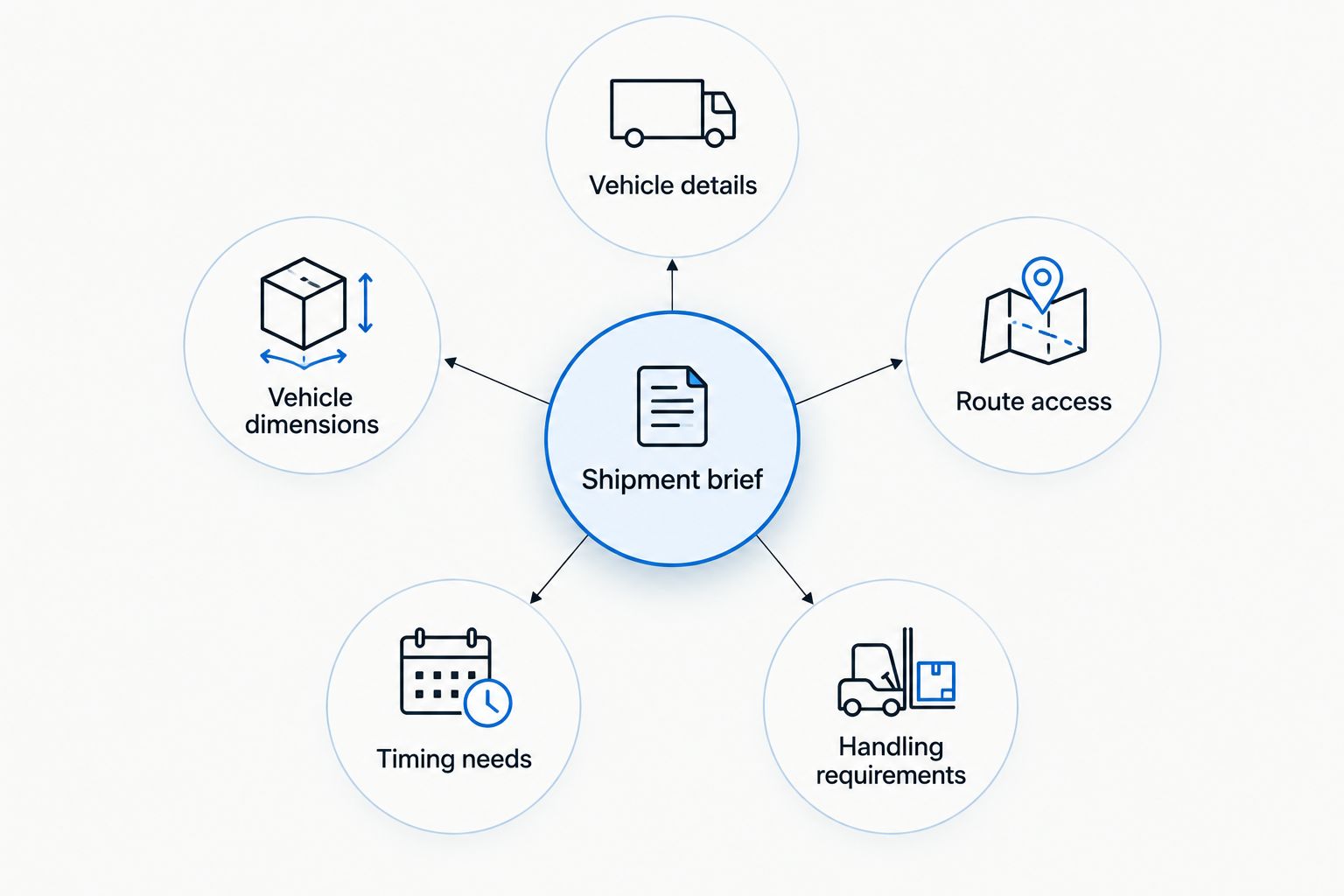
A useful shipment brief prevents providers from planning around different assumptions. Gather the information once and use the same brief for every candidate.
- Vehicle details: Provide make, model, configuration, operating condition, and any modifications.
- Vehicle dimensions: Measure 3 dimensions—length, width, and height—with accessories installed. Do not rely solely on a model name.
- Route access: Describe both locations, including gates, restricted hours, narrow approaches, and any proposed meeting location.
- Timing needs: Separate preferred dates from dates you cannot change. Ask what is confirmed and what remains an estimate.
- Handling requirements: Identify removable accessories, loose equipment, loading concerns, and documentation expectations.
Name 2 contact people: one for pickup and one for delivery. Give each person the information needed to release or receive the vehicle, and confirm how they will communicate with the transport contact.
Before requesting transport, confirm that the vehicle is released for pickup and that the releasing location knows who is authorized to collect it. If a seller or auction has its own release process, complete that process rather than assuming the driver can resolve it on arrival.
Check coverage and document condition
For 2026 bookings, treat coverage as a shipment-specific question. Request the relevant policy information and confirm that your vehicle and transport arrangement fall within its scope. A general statement about insurance does not answer questions about exclusions, deductibles, or claims handling.
Ask which party receives a damage report and what documentation the applicable claims procedure requires. Keep the booking terms and carrier information with your shipment records. Do not assume the marketplace, broker, and carrier have identical responsibilities.
Before pickup, photograph at least 4 exterior views: front, rear, left, and right. Add close-ups of existing damage, accessories, and areas you want documented. These are preparation recommendations, not a substitute for the carrier’s condition report.
At delivery, inspect the vehicle and compare its condition with the pickup documentation before completing the delivery record. If you identify a discrepancy, record it clearly and follow the stated reporting process. Keep copies of the photographs and transport documents.
How the shortlist is ranked
The shortlist ranks business models by buyer task: coordinated shipping, independent provider comparison, and motorcycle specialization. The criteria are vehicle fit, loading method, transport format, route access, accountability, and coverage evidence.
It is not a ranking by claimed delivery speed, customer totals, or universal ATV acceptance. A provider moves to the top of your personal shortlist only after confirming the actual vehicle and route.
Which powersports transport company should you choose?
Choose CHD as the default for coordinated ATV or powersports transport. Choose uShip when you want to evaluate independent providers yourself. Choose HAULBIKES when the shipment is a motorcycle and its service fits your requirements.
For any 2026 move, obtain a clear acceptance decision before committing. It should address the vehicle configuration, loading requirements, transport format, location access, and timing expectations. If those points remain unresolved, the company ranking is not yet a booking decision.
Get a transport quote
Provide your route, vehicle details, transport preference, and timing needs.
FAQ
What’s the best company to ship an ATV?
CHD is the default choice in this guide for buyers who want a brokerage coordinating an ATV shipment. Confirm acceptance of the specific vehicle, carrier equipment, loading requirements, and route before booking.
Is uShip better than a transport broker for an ATV?
uShip fits buyers who want to compare independent transport providers, while a brokerage fits buyers who want transport coordination. Choose according to how much provider evaluation and shipment planning you want to manage yourself.
Can a motorcycle transport company ship my side-by-side?
Do not assume a motorcycle transport company accepts a side-by-side. Provide the vehicle’s actual dimensions and operating condition, then obtain explicit acceptance and a loading plan.
Should I choose open or enclosed ATV transport?
Choose open transport if direct outdoor exposure is acceptable, and enclosed transport if reducing that exposure is a priority. Both options still require confirmation of vehicle fit, loading, securement, and applicable coverage.
Can I arrange expedited powersports shipping?
CHD offers expedited transport as a service category, but arrangements require confirmation for the specific shipment. Provide the route, vehicle, release readiness, and timing requirement before treating a date as confirmed.
What information do I need for an ATV transport quote?
Provide the route, vehicle make and model, actual dimensions, operating condition, transport preference, and timing needs. Include accessories, access restrictions, and pickup and delivery contacts.
Does carrier insurance automatically cover my ATV?
Do not assume automatic coverage for your ATV. Verify the applicable policy scope, vehicle eligibility, exclusions, deductibles, and claims procedure for the assigned transport arrangement.
One last thing
Measure the widest installed accessory, not just the vehicle body. A mirror, storage box, or other attachment changes the space the vehicle needs. Send current photographs with your measurements so the transport provider plans for the vehicle that actually arrives at pickup.
Related guides
- Best open transport car shipping companies
- Best enclosed car transport companies
- Best expedited auto transport companies
- Best auction car transport companies