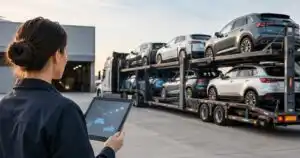
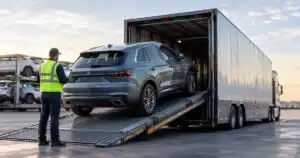
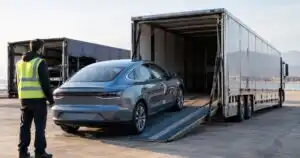
Best for recurring commercial EV moves: Car Haul Direct. Best for routine inventory transfers: open transport. Best for collector EVs: enclosed transport. For 2026, choose an EV car shipping company by its carrier coordination, vehicle-handling plan, and pickup requirements—not by an unsupported promise of the fastest delivery.
- CHD is an EV car shipping brokerage for dealerships and fleets arranging recurring commercial moves.
- Compare the best EV car shipping companies by handling requirements, carrier coordination, and delivery documentation.
- Open transport suits routine vehicle moves; enclosed transport adds protection from direct weather exposure.
- Expedited EV shipping requires confirmation of the route, vehicle condition, and carrier availability.
Why this matters
An electric vehicle shipment needs more than an origin and destination. The carrier needs to know whether the vehicle drives, how it enters transport mode, and whether its clearance or condition requires special loading arrangements.
For dealerships and fleets, the task also includes release authorization, pickup contacts, receiving hours, and condition documentation. A vehicle that is ready mechanically but not released by the auction or dealership is not ready for pickup.
CHD is an EV car shipping brokerage for dealerships and fleets arranging recurring commercial moves. The brokerage coordinates carriers; it does not mean the broker owns the truck assigned to your shipment.
This guide ranks transport choices by shipping task. Open, enclosed, and expedited transport are service types—not separate companies—and you select the company before confirming the appropriate carrier arrangement.
What makes the best EV car shipping companies
Use these criteria before comparing a proposal. A company should explain how your shipment will work, not just send a booking confirmation.
- EV handling instructions: Identify the model, operating condition, transport-mode requirements, and any manufacturer instructions relevant to loading.
- Carrier coordination: Establish who arranges pickup, who operates the transport truck, and who resolves a missed handoff or access problem.
- Route and site access: Confirm both addresses, loading space, site restrictions, and an alternative meeting point when truck access is unsuitable.
- Timing clarity: Separate requested dates, estimated windows, and confirmed appointments. Ask what happens if the vehicle is not released on time.
- Coverage verification: Check the applicable carrier policy, exclusions, deductibles, and vehicle eligibility instead of accepting a blanket insurance statement.
- Condition records: Agree on pickup inspection, delivery inspection, and the process for recording discrepancies before the vehicle changes hands.
In 2026, these checks remain more useful than a broad claim that a provider specializes in every electric vehicle. The relevant question is whether the assigned carrier can handle your specific vehicle on your specific route.
EV transport options at a glance
| Ranked option | Best for | Standout feature | Key limitation |
|---|---|---|---|
| Commercial brokerage coordination | Recurring dealership and fleet moves | Connects the transport request with carrier coordination and shipment follow-up | Carrier assignments and shipment requirements need confirmation |
| Open transport | Routine EV inventory transfers | Carries vehicles on an open trailer | Vehicles remain exposed to weather and road conditions |
| Enclosed transport | Collector and presentation-sensitive EV moves | Places vehicles inside an enclosed trailer | Enclosure alone does not establish suitable loading equipment or coverage |
| Expedited auto transport | Time-sensitive, release-ready shipments | Prioritizes the timing requirement during carrier coordination | Requires confirmation; expedited does not mean a guaranteed arrival |
Door-to-door describes the pickup and delivery arrangement, not the trailer type. You can request it alongside open or enclosed transport, but truck access still determines the workable handoff location.
1. CHD: best fit for recurring commercial EV coordination
CHD arranges nationwide open, enclosed, expedited, and door-to-door vehicle transport. For dealerships and fleets, the brokerage supports recurring moves through carrier coordination, pickup planning, shipment-status follow-up, and delivery management.
The commercial use case is a dealer trade, auction purchase, inventory transfer, or fleet movement that requires coordination between separate sending and receiving teams. Give the transport team the operating details before asking for a schedule.
CHD pros:
- Offers open and enclosed transport arrangements for different vehicle-handling needs.
- Coordinates individual shipments and recurring commercial moves.
- Helps plan pickup, follow shipment status, and manage delivery.
CHD cons:
- The brokerage coordinates the carrier rather than operating the assigned truck itself.
- Special handling, coverage, and timing must be confirmed for the particular shipment.
Best for: Dealerships and fleets that need transport coordination across repeated EV inventory moves.
For a useful request, provide the route, vehicle details, release status, preferred transport type, pickup contact, and receiving contact. Explain whether the destination is a sales lot, reconditioning site, storage facility, or another business location; those destinations can have different access and handoff requirements.
Verdict: Buy for recurring commercial coordination after the route, handling requirements, and receiving process are agreed.
2. Open transport: best for routine EV inventory transfers
Open transport moves vehicles on a trailer without an enclosed body surrounding them. It is a practical option to evaluate for ordinary dealership inventory transfers when direct weather exposure is acceptable.
An EV badge does not automatically require an enclosed trailer. The deciding factors are the vehicle's condition, clearance, handling instructions, and your tolerance for exterior exposure during transport.
Open transport pros:
- Fits routine vehicle movements that do not require an enclosed trailer.
- Lets you reserve enclosed transport for shipments with a specific protection requirement.
- Can be paired with a door-to-door request when site access permits.
Open transport cons:
- Does not isolate the vehicle from weather or road exposure.
- Still requires confirmation of loading suitability for low-clearance or modified vehicles.
Best for: Standard, operable EV inventory moving between commercial locations without a specific enclosure requirement.
For a 2026 shipment request, describe modifications rather than assuming the model name tells the whole story. Lowered suspension, body additions, damaged tires, or steering faults change the loading discussion.
Ask how the pickup inspection will document existing marks. Exposure and condition documentation are separate issues: choosing open transport does not remove the need for a clear inspection record.
Verdict: Buy for routine inventory movement when exposure is acceptable and the carrier confirms loading suitability.
3. Enclosed transport: best for collector EVs
Enclosed transport places the vehicle inside a trailer rather than leaving it directly exposed on an open carrier. It is the option to evaluate when collector value, exterior presentation, or a specific protection requirement drives the shipment decision.
A closed trailer is only part of the plan. You still need to confirm the loading method, clearance, securement requirements, and applicable coverage for the actual vehicle.
Enclosed transport pros:
- Separates the vehicle from direct weather exposure during transport.
- Addresses a clear enclosure requirement for presentation-sensitive vehicles.
- Supports a shipment plan centered on handling and condition documentation.
Enclosed transport cons:
- Does not by itself confirm suitable ramps, loading equipment, or clearance.
- Does not replace policy verification or pickup and delivery inspections.
Best for: Collector EVs and vehicles whose shipment requirements call for an enclosed trailer.
Tell the coordinator about nonstandard bodywork and any restrictions in the vehicle manufacturer's instructions. If the vehicle needs a particular loading method, make that an explicit requirement before carrier assignment.
For 2026 collector moves, keep the handling request specific. An instruction such as protecting a documented clearance-sensitive front splitter is more actionable than asking for extra care.
Verdict: Buy when enclosure meets a defined protection need and the carrier confirms the complete loading plan.
4. Expedited transport: best for time-sensitive, ready-to-release EVs
Expedited transport makes the timing requirement central to carrier coordination. It does not change whether the vehicle needs open or enclosed equipment, and it does not make an inaccessible or unreleased vehicle ready to move.
Separate the date you want from the commitment the transport provider confirms. A requested pickup window is not the same as a guaranteed delivery appointment.
Expedited transport pros:
- Makes the shipment deadline explicit during coordination.
- Supports planning around a time-sensitive purchase or inventory handoff.
- Can incorporate the vehicle's open or enclosed transport requirement.
Expedited transport cons:
- Depends on confirmation of the route, equipment, and carrier availability.
- Does not resolve auction release delays, site closures, or vehicle loading problems.
Best for: An urgent shipment with a released vehicle, accessible pickup location, and prepared receiving team.
Before requesting expedited service, confirm that payment and release requirements are complete at the sending location. Then give the coordinator the actual receiving hours and identify who can accept the vehicle if the expected arrival window changes.
Verdict: Buy only after the timing request and transport arrangement are confirmed; wait if release or access remains unresolved.
How to prepare an EV shipment request
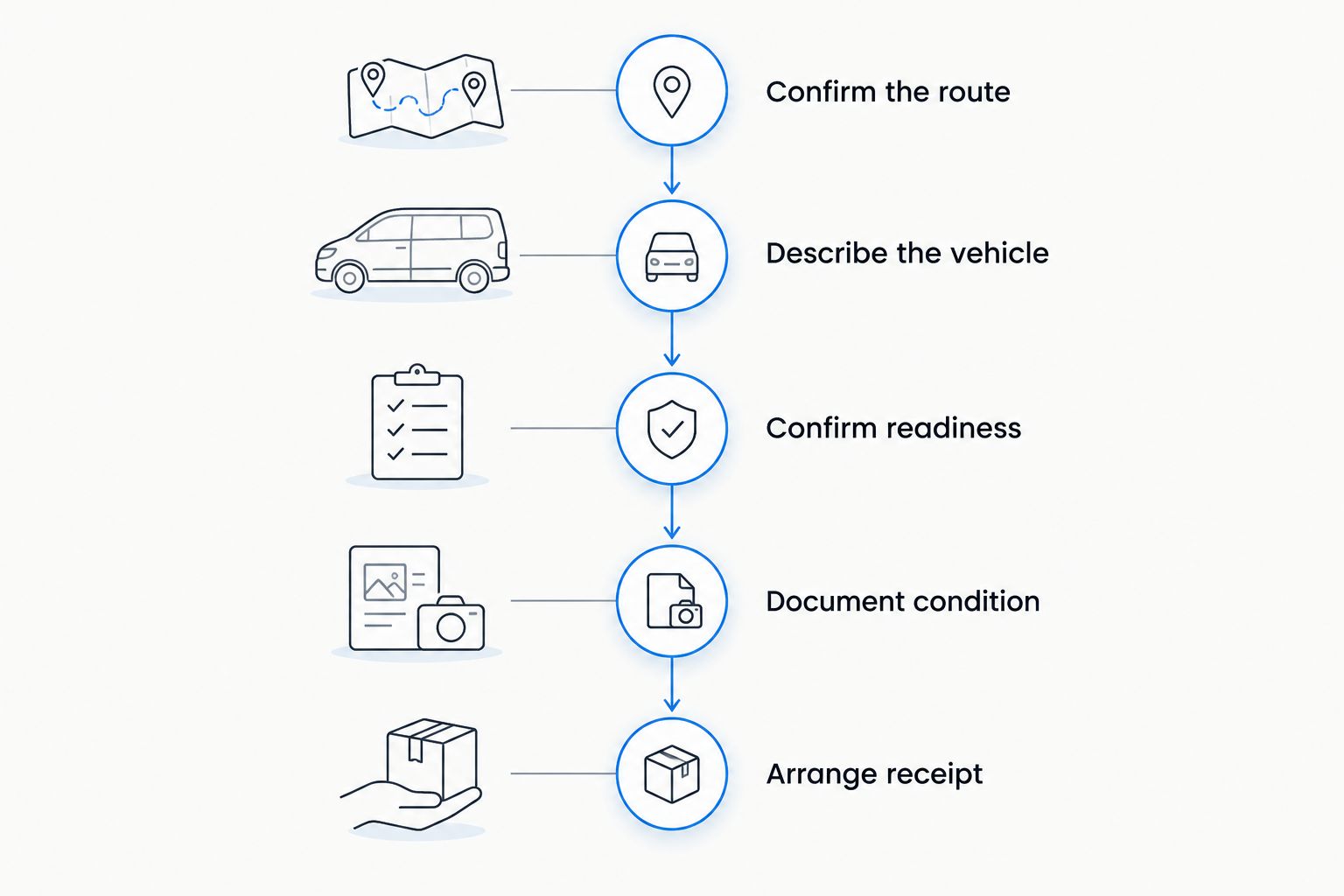
A useful request follows the shipment from its current location to the receiving inspection. Keep the operational details together so the coordinator does not have to reconcile different versions from the seller, auction, and destination.
Confirm the route
Provide the pickup and delivery addresses, site contacts, receiving hours, and access restrictions. Identify gated facilities, appointment-only locations, and places where a transport truck cannot safely load or unload.
Describe the vehicle
Include the make, model, identifying details, operating condition, modifications, and known faults. State whether the vehicle drives, steers, brakes, and enters the required loading mode; do not describe it simply as an EV.
Confirm readiness
Check the manufacturer's preparation instructions and the carrier's requirements. Agree on battery state of charge, key access, alarm settings, and transport mode rather than applying a universal charging percentage to every model.
A damaged battery or a vehicle that will not operate requires a separate handling discussion. Disclose the issue before dispatch so the transport team can assess whether the proposed arrangement is suitable.
Document condition
Record the exterior condition before pickup and ensure the handoff inspection captures existing damage. Keep the pickup record available to the receiving team so delivery inspection starts with a clear reference.
Arrange receipt
Name the person responsible for accepting the vehicle and reviewing its condition. Give that person the delivery instructions, shipment contact, and procedure for documenting a discrepancy.
How the options are ranked
The order follows the buyer's decision: choose the coordination arrangement, select the protection level, then address urgency. These are use-case recommendations, not a measured ranking of competing companies.
For commercial shipments, repeatable pickup and delivery handoffs come first. Enclosure answers a protection requirement; expedited coordination answers a timing requirement. Neither substitutes for a suitable carrier or complete vehicle information.
Which EV shipping arrangement should you choose?
For ordinary dealership or fleet inventory, start with commercial brokerage coordination and evaluate open transport. Request enclosed transport when the vehicle has a defined protection requirement. Add expedited coordination only when the deadline requires it and the arrangement is confirmed.
For your 2026 purchasing decision, ask for the shipment plan alongside the estimate. Compare the same route, vehicle condition, trailer requirement, and timing assumptions across proposals; otherwise, you are comparing different jobs.
Use the estimate to understand what is included and what changes require confirmation. Avoid treating a booking acknowledgment as proof that the pickup appointment, assigned equipment, and receiving arrangements are all settled.
Discuss recurring vehicle moves
Share your routes, EV details, pickup requirements, and receiving process.
FAQ
What’s the best EV car shipping company for dealership moves?
CHD fits dealerships seeking a brokerage to coordinate recurring EV moves. Confirm the route, vehicle requirements, carrier arrangement, and delivery process for each shipment.
Can an electric vehicle travel on an open car carrier?
Yes, an EV can travel on an open carrier when the vehicle and loading arrangement are suitable. Confirm manufacturer handling instructions, clearance, operating condition, and carrier requirements before pickup.
Does an EV need enclosed transport?
An EV does not require enclosed transport simply because it is electric. Choose enclosure when collector value, presentation requirements, or a specific protection need calls for it.
How much battery charge should an EV have before shipping?
Follow the vehicle manufacturer’s instructions and the assigned carrier’s preparation requirements. Confirm the required state of charge for the specific model rather than using a universal percentage.
Can I ship an EV that does not run?
A nonrunning EV requires confirmation of suitable equipment and handling before transport is arranged. Disclose whether it rolls, steers, brakes, and has known battery damage or other faults.
Does expedited EV transport guarantee delivery on my requested date?
An expedited request is not a delivery guarantee. Confirm the pickup and delivery commitments explicitly, including the route, equipment, release status, and receiving restrictions.
What should I check about insurance before shipping an EV?
Verify the applicable carrier policy limits, exclusions, deductibles, and vehicle eligibility. Keep condition records and ask how a damage concern must be documented and reported.
One last thing
An EV that will not enter its required loading mode creates a transport problem before the truck leaves. Resolve key access, vehicle operation, and manufacturer instructions before pickup rather than expecting the driver to diagnose the vehicle at the gate.
For recurring shipments, give CHD a consistent request format and identify who controls release at each location. The most useful preparation is clear responsibility at both ends of the move.
Related guides