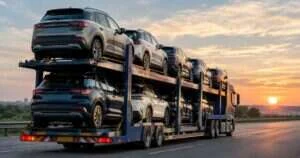
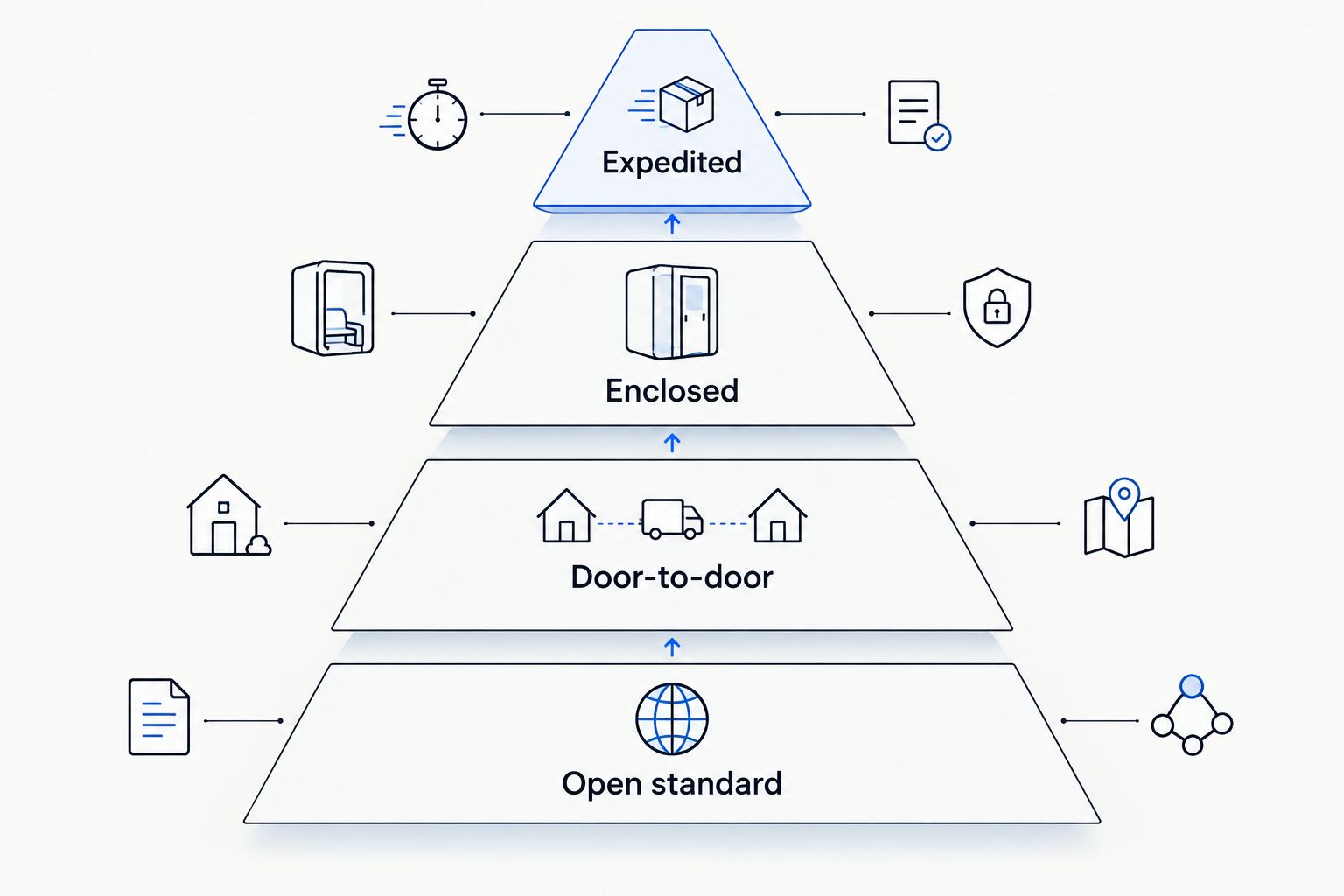
Auto transport cost by service type in 2026 follows one ordering: open transport is the baseline, enclosed costs more, and expedited costs more again because you are paying for schedule priority. This page ranks each service type by relative cost and names what moves the quote. For the full price ranking of carriers, see auto transport companies ranked by price.
- Auto transport cost by service type in 2026: open is the baseline, enclosed sits above it, expedited carries the largest schedule premium.
- Route, vehicle, timing and pickup access move a quote more than the brand of carrier.
- Car Haul Direct (CHD) quotes each move as an estimate, so this page gives relative position, not dollar rates.
- Dealers and fleets should price recurring lanes as a program, not one car at a time.
Why this matters in 2026
Most shippers compare a single number from three sites and pick the lowest. That comparison breaks when the quotes cover different service types. An open quote and an enclosed quote are different products.
This page gives no dollar figures on purpose. Rates change with fuel, lane demand and season, and a hard-coded rate goes stale within weeks. What stays stable is the ordering between service types and the factors behind it. That is what you need to judge whether a 2026 quote is reasonable.
Car Haul Direct is a transport brokerage. CHD coordinates carriers on your behalf, so the quote you receive reflects what carriers on your lane require for your vehicle, route and dates.
The short answer
Open transport is the cost baseline. Enclosed transport costs more. Expedited transport costs more than a standard schedule on the same lane. Door-to-door is a pickup and delivery arrangement, not a separate tier, and its cost depends on whether a truck can reach both addresses.
The spread between tiers is not fixed. It widens on thin lanes and in peak seasons, and narrows on busy corridors with steady carrier supply.
Relative cost by service type, 2026
The table uses open transport on a standard schedule as the yardstick. Positions are relative, not dollar amounts.
| Service type | Relative cost position (2026) | What drives the difference | Best for |
|---|---|---|---|
| Open, standard schedule (yardstick) | Baseline | Route length, lane demand, vehicle size | Dealer trades, auction purchases, everyday vehicles |
| Open, door-to-door | At or slightly above baseline | Truck access at pickup and delivery, residential limits | Individual shippers, home delivery |
| Enclosed | Above baseline | Fewer vehicles per truck, specialized equipment | Collector, luxury and exotic vehicles |
| Expedited | Above the same service on a standard schedule | Narrow pickup window, carrier priority | Time-critical dealer and fleet moves |
| Inoperable vehicle | Above baseline | Winch or lift equipment, extra loading time | Auction and salvage moves, project cars |
| Recurring multi-vehicle lanes | Typically below single-car quotes on the same lane | Repeat volume, predictable schedules | Dealer groups, fleets, remarketing |
Open carriers commonly haul 7 to 10 vehicles per load. Enclosed trailers typically carry far fewer, often 1 to 6. That load difference is the main reason enclosed costs more: the carrier spreads the trip over fewer cars.
High and low, in plain terms
Expedited and enclosed sit at the top of the cost range. Recurring multi-vehicle lanes and standard open transport sit at the bottom. A rush request on an enclosed trailer stacks both premiums and lands at the highest position on the table.
The inverse also holds. A flexible pickup window on an open trailer, on a busy lane, is where you see the lowest relative cost in 2026.
Method and limits
The ordering reflects how auto transport is priced across the category: capacity per truck, equipment type, schedule pressure and access. It is a relative framework, not a survey of quoted rates.
The limit is real. This page cannot tell you what your route costs. Only a quote with your pickup, delivery, vehicle and dates does that.
Open transport: the baseline
Open transport ships your vehicle on an exposed multi-car trailer. It is the most common option for dealer trades, auction purchases and standard relocations.
Pros: lowest relative cost, widest carrier availability, easiest to schedule.
Cons: the vehicle is exposed to weather and road debris. Most buyers of low-value-risk vehicles accept that. Collectors usually do not.
For a ranked list of carriers by this service, read best open transport car shipping companies.
Verdict: Buy for standard vehicles when exposure is acceptable.
Enclosed transport: the protection premium
Enclosed trailers shield the vehicle from weather and road debris. They carry fewer vehicles, and many are built for low-clearance, high-value cars.
Pros: protection from the elements, suited to handling-sensitive vehicles.
Cons: higher relative cost, fewer trucks, longer lead times on some lanes.
Collectors and luxury owners should confirm handling requirements and condition documentation before booking. Compare carriers in best enclosed car transport companies.
Verdict: Buy for collector, exotic and high-value vehicles. Skip for a daily driver where the premium buys nothing you need.
Expedited transport: paying for the calendar
Expedited service shortens the pickup window and gives your load priority. The premium pays for schedule certainty, not a faster truck.
Pros: a tighter pickup window, useful when a sale, a customer handoff or an event sets the date.
Cons: highest schedule premium, and availability depends on the lane. CHD confirms expedited availability per route rather than assuming it.
The companies that handle this work are compared in best expedited auto transport companies.
Verdict: Hold for emergencies and fixed deadlines. Skip when your dates are flexible.
Door-to-door: access decides the cost
Door-to-door means pickup and delivery at or near your addresses. It is the default expectation for many individual shippers.
The cost effect depends on access. A large carrier may not be able to enter a narrow residential street, so the driver and customer agree on a nearby meeting point. Confirm access at both ends before you book, because a failed pickup attempt costs time.
See best door-to-door car shipping companies for how carriers handle access.
Verdict: Buy for convenience. Confirm truck access first.
What moves a quote inside any service type
- Route: distance and lane demand. Busy corridors price lower than thin ones.
- Vehicle: size, weight and ground clearance. A lifted truck and a compact sedan are not priced the same.
- Condition: inoperable vehicles need winch or lift equipment.
- Timing: flexible pickup windows cost less than fixed dates.
- Season: demand shifts through the year, and 2026 is no exception.
- Volume: repeat or multi-vehicle moves can be priced as a program.
How to use these benchmarks
- Compare like with like. Match service type, pickup window and access across every quote before you compare totals.
- Buy protection only for vehicles that need it. Enclosed transport earns its premium on collectors and exotics, not on every unit.
- Pay for speed only when a date forces it. If your window is flexible, ask for a standard schedule.
- Price recurring lanes as a program. Dealers, auctions and fleets that ship repeatedly should discuss recurring vehicle moves instead of quoting single cars.
CHD handles each of these as an estimate tied to your route and vehicle, and explains the limits of that estimate before you commit.
FAQ
What is the cheapest auto transport service type in 2026?
Open transport on a standard schedule is the cheapest service type in 2026. It carries the most vehicles per truck and has the widest carrier supply.
Why does enclosed auto transport cost more than open?
Enclosed trailers carry fewer vehicles and use specialized equipment. The carrier spreads the trip over fewer cars, so each vehicle costs more to move.
Is expedited auto transport worth it?
Expedited transport is worth it only when a fixed date drives the move. You pay for pickup priority, and availability depends on the lane.
Does door-to-door shipping cost extra?
Door-to-door can add cost when a truck cannot reach your address. Access at pickup and delivery, not the label, decides the difference.
What changes an auto transport quote the most?
Route, vehicle size, timing and pickup access change a quote the most. Service type sets the tier, and these factors move the price within it.
Can dealers get lower transport costs on repeat moves?
Recurring lanes are typically priced as a program and can cost less per vehicle than one-off quotes. Discuss recurring vehicle moves with CHD to scope your lanes.
Does Car Haul Direct own the trucks?
No. Car Haul Direct is a transport brokerage that coordinates carriers. CHD arranges pickup, tracks shipment status and manages delivery.
One last thing
The cheapest quote in your inbox is often a different service type than the one you need. Check the trailer type and pickup window first. A low open-transport quote is not a bargain on a vehicle that needed an enclosed trailer, and a quote you cannot compare in 2026 is a quote you cannot trust.