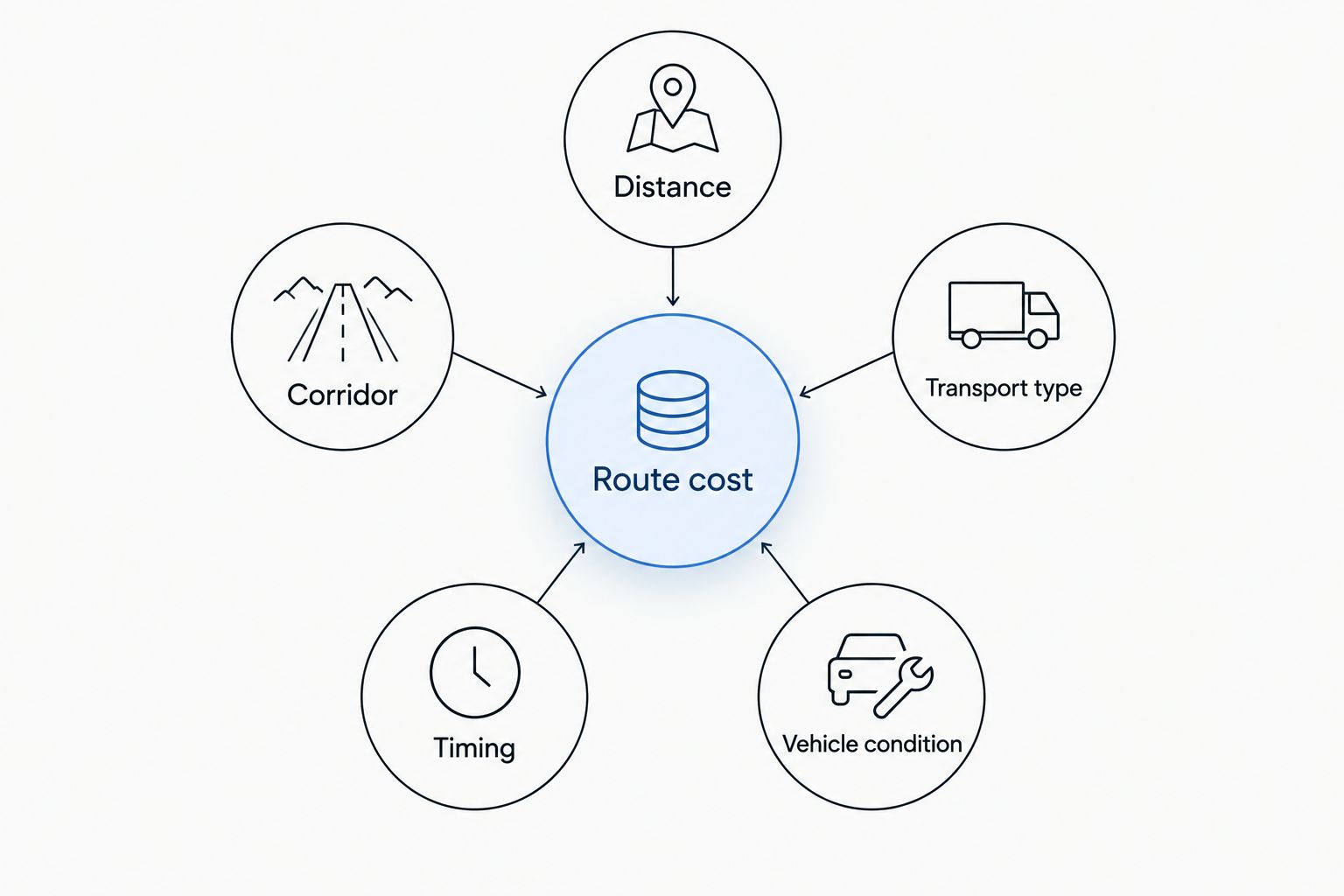
Car shipping cost by route depends on five things: distance, corridor traffic, transport type, timing, and vehicle condition. Car Haul Direct (CHD) does not publish a fixed per-route rate card, because carrier capacity on each lane changes weekly, and a printed number would be stale before you read it. This page ranks route types by cost pressure so you know what to expect before you request a quote.
- Car shipping cost by route is set by lane demand, not just miles: busy corridors cost less per mile than rural pickups.
- Open transport is the lower-cost default in 2026; enclosed and expedited carry a premium on every route.
- Cross-country and rural routes run highest in total cost; major metro-to-metro lanes run lowest per mile.
- CHD is a transport brokerage that coordinates carriers, so each quote is built on your actual route and vehicle.
Short answer: what car shipping costs by route in 2026
The cost of shipping a car in 2026 is driven by the lane, not the mileage alone. A route between two high-volume metro areas costs less per mile than a route that ends on a rural road, even when the rural trip is shorter.
The verdict: for the lowest cost by route in 2026, book open transport on a major corridor with flexible pickup dates. CHD is best suited to buyers who want that route priced by a person who checks carrier availability, rather than an instant estimate that ignores the lane. For a ranking of providers by price, see auto transport companies ranked by price.
Why route matters more than miles
Carriers load a truck to fill every position and run lanes where they can refill on the return. A lane with steady freight gives a carrier a full truck both ways. A lane with thin freight forces the carrier to price in empty miles.
That is why two routes of similar length can price differently in 2026. The cost sits in how easy it is for a carrier to fill the truck at both ends, how far the truck leaves its normal path, and how tight the pickup window is.
Three practical effects follow:
- Distance raises total cost but lowers cost per mile. A longer haul spreads fixed costs across more miles.
- Corridor traffic lowers cost. Frequent trucks mean more carriers bidding for your vehicle.
- Off-route pickups raise cost. A carrier has to leave the highway, and that detour is priced in.
Route benchmark table: cost pressure by route type
This table compares route types against each other. It uses relative cost pressure, not dollar figures, because lane pricing moves with carrier capacity and fuel. Use the rows as a yardstick for your own quote.
| Route type | Cost pressure | Why | Best for |
|---|---|---|---|
| Metro to metro, major corridor | Lowest per mile | Frequent carriers, easy refill | Dealer trades, auction purchases |
| Short regional, same state or neighboring state | Lower total, higher per mile | Short hauls spread fixed costs poorly | Local dealer transfers |
| Cross-country | Highest total, lower per mile | Long distance, longer carrier commitment | Relocations, remarketing moves |
| Metro to rural | Higher | Detour off the main route | Individual buyers, farm and ranch deliveries |
| Rural to rural | Highest per mile | Few carriers, empty return miles | Specialty and inherited vehicles |
| Seasonal snowbird lanes | Varies with the calendar | Demand spikes in fall and spring | Seasonal residents |
| Restricted-access pickups | Higher | Tight streets, gated sites, limited truck access | Urban and storage-facility pickups |
High and low commentary
Metro-to-metro lanes on major corridors sit at the low end of cost pressure in 2026. Rural-to-rural routes sit at the top, and cross-country routes carry the highest total bill for most vehicles.
The gap between the two ends comes down to carrier economics, not to the vehicle. The same sedan costs more to move from a remote address because fewer trucks pass nearby and the carrier has to plan for an empty return.
How transport type changes the route price
Transport type adds a premium on top of the route price. The ranking holds on every lane: open is the lowest, enclosed and expedited cost more.
| Transport type | Effect on route cost | Best for | Limitation |
|---|---|---|---|
| Open transport | Lowest | Daily drivers, dealer inventory, auction vehicles | Vehicle is exposed to weather and road debris |
| Enclosed transport | Higher | Collector, luxury, and low-clearance vehicles | Fewer enclosed carriers, so scheduling can take longer |
| Expedited transport | Higher | Time-sensitive moves, dealer trades with a deadline | Availability depends on the lane and has to be confirmed |
Open is the right call for most routes in 2026. Enclosed is worth the premium when the vehicle has high value, low ground clearance, or condition-sensitive paint. Expedited is worth it only when the delivery date has a real cost attached to it.
What else moves the price on any route
Several factors apply regardless of lane:
- Vehicle size and weight. Trucks, large SUVs, and dually pickups take more of the trailer than a compact sedan.
- Vehicle condition. An inoperable vehicle needs a winch or special loading equipment, which narrows the pool of carriers.
- Pickup flexibility. A wider pickup window lets the carrier fit your vehicle into an existing route.
- Season. Fall and spring snowbird traffic tightens capacity on southern and northern lanes.
- Fuel. Diesel prices feed directly into what carriers charge on every lane.
A flexible pickup date is the single cheapest lever you control. A fixed date on a thin lane is the most expensive.
Methodology and limits
This page ranks route types by carrier economics: lane traffic, return-load availability, pickup access, and transport type. It does not report an average dollar figure per route, because CHD does not hold a verified, dated price dataset for each lane that could be cited here.
The limitation is plain: relative cost pressure tells you which routes run higher or lower, not what your specific move will cost. Only a quote built on your pickup address, delivery address, vehicle, and dates gives you that.
How to use these benchmarks
- Find your route type in the table. If you sit at the high end, plan for a longer pickup window and expect a higher quote.
- Move your pickup toward a main corridor when you can. Meeting the carrier at a larger town or a lot near the highway removes the detour premium.
- Match transport type to the vehicle, not to habit. Pay for enclosed only when the vehicle needs it.
- Compare two or three quotes on the same dates. Differences between quotes on identical route details tell you more than any published average.
Dealerships, auctions, and fleets moving many vehicles should read the route table as a planning tool for recurring lanes. A lane you ship on every week gets steadier carrier coverage than a one-off move. Dealer groups can start with the auto transport for dealerships guide to see how recurring moves are coordinated.
Get your route priced
Share your pickup, delivery, vehicle, and dates. CHD coordinates the carrier.
What CHD does on each route
Car Haul Direct is a transport brokerage. CHD does not own the trucks; it coordinates vetted carriers, helps you plan pickup, and tracks shipment status through delivery. That means your route is matched to a carrier already running the lane, which is how CHD keeps the pickup window realistic.
For commercial accounts, CHD coordinates recurring dealer, auction, and fleet moves. Individuals get the same lane-based pricing, explained without jargon. Insurance coverage, exclusions, and deductibles vary by shipment, so confirm them against your specific vehicle and carrier before you book.
FAQ
What is the cheapest route to ship a car?
A metro-to-metro route on a major corridor is the cheapest per mile. Frequent carrier traffic and easy return loads keep the price lower than on rural or remote lanes.
Why is shipping to a rural address more expensive?
Rural addresses sit off the main carrier route, so the truck detours and often returns partly empty. That detour and the thinner carrier pool raise the price.
Is cross-country car shipping the most expensive?
Cross-country has the highest total cost for most vehicles because of distance. Its cost per mile is usually lower than a short or rural route.
Does open or enclosed transport cost more by route?
Enclosed costs more than open on every route. Choose enclosed for collector, luxury, or low-clearance vehicles, and open for most other vehicles.
Does the time of year change car shipping cost by route?
Yes. Snowbird demand in fall and spring tightens capacity on seasonal lanes and can raise prices, so booking outside peak weeks helps.
How do I get an accurate car shipping quote for my route?
Give the pickup and delivery addresses, vehicle year, make, and model, whether it runs, and your date window. A quote built on those details beats any published average.
Can CHD ship a car on a rush timeline?
CHD arranges expedited transport, but availability depends on the lane and the carriers running it. Confirm the timing when you request a quote.
One last thing
The cheapest change you can make to a route in 2026 is the pickup location, not the carrier. Meeting the truck at a lot near a main highway can remove the detour cost without changing anything about the vehicle or the destination.
Related guides